Editor’s Note
This article explores the innovative process of preserving flowers in precious metals, a technique that transforms fleeting natural beauty into lasting keepsakes.
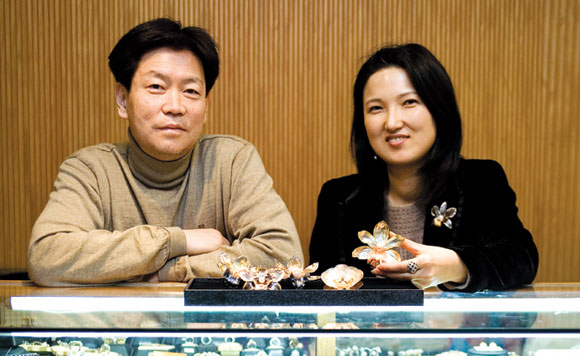
There are people who ‘resurrect’ flowers, which are beautiful when in full bloom but become shabby after wilting, into precious metals. Park Uk-seong, a director at the jewelry company ‘GINA’. Upon entering the workshop of ‘GINA’ in Sinsa-dong, Gangnam-gu, Seoul, large and small dendrobium orchids greet you. Director Park plucks a single orchid hanging from a stem and places it into a plaster investment material. The flower is buried in the plaster for about a day before entering a hot kiln. While the petals burn away completely after 4 hours in an 800°C kiln, the plaster mold captures even the finest wrinkles and fuzz. Pouring molten gold or silver into this mold and letting it harden creates jewelry that replicates the living flower. Since each piece revives a flower as it was when alive, it becomes a one-of-a-kind jewelry piece in the world.
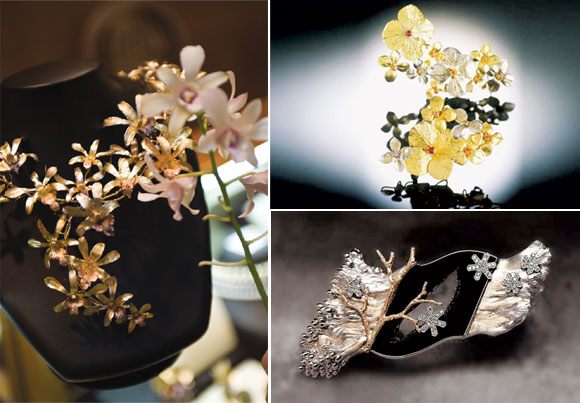
While any flower can be replicated, experiments so far have shown dendrobium orchids to be the most suitable. Based on 18K yellow gold, they are plated with pink gold, white gold, purple gold, etc., to achieve the petal colors, and pearls and other gemstones are added to create brooches, necklaces, earrings, and hair accessories. The thickness is about 0.2~0.7mm, similar to a petal. Casting this thinly while delicately expressing the slightly curled edges of the petals is a unique technology for which they have obtained a patent. When asked what the secret is, he adds a complex and professional explanation. He explains that with previous technologies, molten metal would solidify due to rapid cooling, making such thin and delicate casting impossible, but after repeated research, they acquired a world-first technology. Changing the structure of the sprue (the channel through which molten metal is poured) was the key point.
Listening to his explanation, the image of a scientist, engineer, or artisan felt stronger than that of a designer. Kim Ji-eun, the CEO of ‘GINA’ who was by his side, added,
Park Uk-seong studied crafts at Hongik University’s College of Fine Arts, and Kim Ji-eun studied crafts and precious metal design at Seoul Women’s University’s Department of Crafts and Hongik University’s Graduate School of Fine Arts, respectively. CEO Kim Ji-eun comments that Director Park challenges technologies that ordinary designers or craftsmen wouldn’t even dare attempt, calling him a
By surpassing technological limits, they can produce designs that others cannot even imitate.
The collaborative works of the two recently received permission to participate in auctions from the world’s top auction houses, Sotheby’s and Christie’s. After inquiring with both sides about “whether we could participate in gemstone auctions,” both sent an OK sign, saying, “Send the products.” This is a first for a Korean company. Having felt limitations in building their brand name due to the inability to afford enormous marketing costs, they said,
Their global strategy began in 2002. Initially, they diligently visited international exhibitions and later started presenting their works, receiving explosive responses. Many people exclaimed “gorgeous” at the fresh flower jewelry, crowding around to look. They actively participated in exhibitions in Tokyo, Hong Kong, Shanghai, Beijing, Dubai, Basel, etc., selling to global buyers, and also entered prestigious department stores like Hong Kong’s Lane Crawford and Shanghai’s Dongfang Shangsha. On the day ‘GINA’s office was visited, Park Uk-seong was busy preparing for an exhibition in Tokyo the very next day, and Kim Ji-eun for one in Hong Kong in March.
Targeting the global market means designs vary depending on the regional consumer. People in the Middle East, like Dubai, prefer large, bold designs made of gold, so fresh flower jewelry is also made with sizable blossoms. Even within Japan, there are differences: the northern region, centered on Tokyo, prefers small, delicate items, while the southern region likes flashy ones. Products sold at Shanghai’s Dongfang Shangsha are nearly twice as expensive as in Korea, yet are preferred, making them newly aware of ‘China’s economic power.’ While Director Park Uk-seong, in his 50s, is strong in designs for middle-aged and older adults, CEO Kim Ji-eun, in her 40s, is strong in trendy designs targeting younger people, creating a role division.
After graduating from Hongik University’s College of Fine Arts, Park Uk-seong, who had been involved in precious metal design and production, was a recognized artisan in the industry known for his top-tier skills. However, he had no thoughts of having his own brand and supplied products through subcontracting for design and production. He simply loved the work and saw no need to push ‘his own’ thing. He came to have the ‘GINA’ brand after starting to work with CEO Kim Ji-eun.
Park Uk-seong’s older brother, four years his senior, is Park Ho-seong, a metal craft professor at Sungshin Women’s University. Kim Ji-eun learned metal craft from Professor Park Ho-seong while attending Hongik University’s Graduate School of Fine Arts. Professor Park Ho-seong and Park Uk-seong’s workshops were in the same building, and she often received practical training from Director Park Uk-seong when Professor Park Ho-seong was frequently absent due to classes. That’s why she still calls Director Park “Master.” The two, who were working separately, joined under the name ‘GINA’ from 1997. Kim Ji-eun took on the CEO role instead of Park Uk-seong, who dislikes being in the spotlight. It was also Kim Ji-eun who persistently argued that they needed to participate in international exhibitions to make the ‘GINA’ name known and strengthen global marketing.
‘GINA’ is a company recognized for its design capabilities, having won various design competitions and been selected multiple times for the Good Design award. Yet, they express that operating a precious metal business in Korea is not easy. Consumers tend to evaluate value by weight unit without considering design, and the government treats the precious metal industry as a luxury industry, creating many obstacles even for export companies. They say social consensus is needed on how high-value-added the jewelry industry is. Seeing foreign luxury jewelry being bought at high prices without hesitation pains their hearts. Their idea is to be recognized abroad first, even if undervalued at home. Indeed, their products are more appreciated abroad.
Although they handle precious metals, much of the jewelry they create evokes ‘nature.’ There are works combining leaves and caterpillar nests collected from nature with jewelry using gold and pearls, and jewelry in the shapes of dragonflies, birds, and crabs made of platinum, opal, amber, jade, etc., so vivid they seem ready to wriggle or fly away at any moment. Ideas like brooches that are displayed as objets d’art normally and only separated for use are also ingenious. Elevating their ‘naturalist jewelry’ to the ranks of world-class luxury brands is the dream shared by these business partners, who have known each other for 20 years and worked together for 11 years.