Editor’s Note
This article highlights the expanding scope of U.S. conflict mineral regulations, which now extend to imported components. As enforcement begins, the global IT and electronics supply chain faces increased pressure to ensure responsible sourcing and traceability of key minerals.
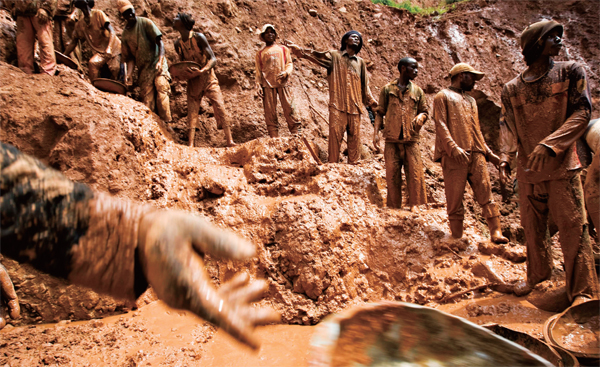
Workers line up to carry raw ore containing minerals like gold and tantalum at a mine in northeastern Congo. ⓒ REUTERS
There is a hot issue quietly brewing in the IT and electronics industry these days: conflict minerals. Starting this June, the sale of information technology (IT) devices and electronic products in the United States that use minerals mined in major conflict zones in Africa will become difficult. This is because the US passed a law last year regulating conflict minerals. Consequently, the domestic IT and electronics industry, which exports core components like semiconductors, liquid crystal displays (LCDs), and batteries to the US, is also set to be impacted and is on high alert.
Conflict minerals refer to minerals produced through abnormal methods in countries experiencing civil war or other conflicts. In such cases, the problem arises because, bypassing normal channels, rebels and others forcibly mobilize civilians or prisoners for slave labor to extract minerals, then sell them to buy weapons. Commonly referred to as ‘blood diamonds,’ African diamonds, along with tantalum (commonly known as tantalum), tungsten, manganese, and germanium, are cited as representative conflict minerals.
The US government has prohibited US companies from using components made from four minerals—tantalum, tungsten, tin, and gold—produced in nine African conflict countries: Central African Republic, Sudan, Uganda, Rwanda, Burundi, Tanzania, Zambia, Angola, and Congo. To this end, the US Congress passed Section 1502 of the Financial Regulatory Reform Act last year, and the US government plans to prepare and implement an enforcement order by the end of June. All US manufacturers listed on US stock exchanges are obligated to disclose the origin of minerals used in their components and report to the US Securities and Exchange Commission (SEC) on whether conflict zone minerals were used. While the direct target of US government regulation is US companies, in effect, foreign companies supplying components to US firms will also be subject to the rules.
Korean semiconductors, LCDs, batteries, and electronic components supplied to US electronics, automotive, aerospace, and defense industry companies must also disclose mineral origins and prove they are not from conflict zones. In this regard, 25 US companies including Apple, IBM, Dell, and HP have already requested mineral usage status from key suppliers like Samsung Electronics, SK Hynix, and LG Display early this year.
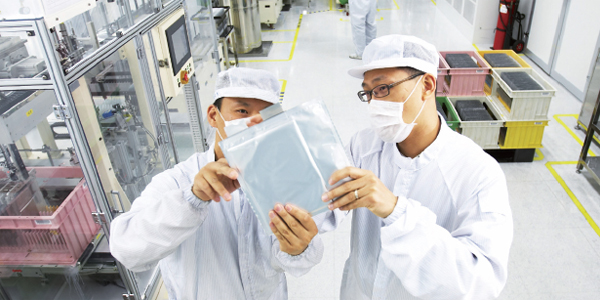
An electric vehicle battery production site. Tantalum is also a key mineral used in battery manufacturing. ⓒ LG Chem
Electronics companies say that due to rampant origin laundering by some mineral brokers, it’s difficult to verify the origin of minerals used domestically. Even if verified, there’s no way to quantify how much conflict mineral is used domestically. Large corporations dealing with numerous suppliers have an even bigger headache. They subcontract to many SMEs and receive various components from them, but have no way of knowing if these subcontractors use conflict minerals. Therefore, the common opinion in the IT and electronics industry is that verifying mineral origin is virtually impossible.
The most serious problem is tantalum. Tantalum is typically extracted from raw ore called coltan from Congo. Coltan is an ore containing columbite and tantalite, which is refined to extract tantalum. 80% of the world’s coltan supply is from Congo. However, it is known that more ore is mined by rebels like the Tutsi, who forcibly mobilize Hutu prisoners from Rwanda, than by the Congolese government. According to foreign media reports, rebels sell coltan to buy weapons, which are then given to Congolese rebel child soldiers called ‘Watoto.’ Rebels even recruit children under 10 as Watoto, drug them, and send them to war. Global human rights organizations point to tantalum from the Congo region, extracted through forced labor, as a target for regulation no less than ‘blood diamonds.’ The US government’s intent in regulating conflict minerals is to cut off rebel war funding that leads to genocide and slave labor.
Despite being extracted through such ugly processes, tantalum is an indispensable material for industry. It is used in various semiconductors, central processing units (CPUs), mobile phone antennas, nuclear reactors, microscopes, digital cameras, TVs, fighter jets, and cars. With diverse demand and limited supply, some companies are known not to hesitate to engage in illicit trade with Congolese rebels. Hence, the US government’s demand to verify the origin of minerals in products.
Tantalum is an important material used in semiconductor DRAM. ⓒ SK Hynix
Such regulatory movements on conflict minerals are emerging not only in the US but also in Europe. In Europe, human rights and civic groups have been sensitive to blood diamonds, and now, regarding conflict minerals, regulatory movements are also arising centered on private organizations. They believe that only by blocking the distribution of related products can conflict minerals be eradicated, and they are poised to publicize this within the European Union (EU), already growing into a global issue. Given this situation, companies worldwide are exploring various methods. Japanese companies like Sony and Toyota have already grasped the seriousness of the situation and are building systems with component partners to filter out conflict minerals.
Domestic large corporations, with their backs against the wall, are also finding their own countermeasures. Samsung, like other global companies, is preparing a plan to use only minerals from mines certified under the mining certification program run by the US Public-Private Alliance (PPA) and from smelters certified by the Electronic Industry Citizenship Coalition (EICC) as not using conflict minerals. There are a total of 10 EICC-certified smelters not using conflict minerals, including China’s F&X, US’s Exotech, Japan’s Mitsui, and Russia’s Solikamsk. In other words, since these smelters are certified by EICC through mineral origin tracking as not using conflict minerals, using minerals from them is not problematic. LG Electronics is also exploring joint response measures with EICC. However, many component suppliers and SMEs have yet to find a solution.
The industry observes that rising component prices will be directly transferred to product prices, inevitably leading to price increases. Another serious side effect is that mineral supply may fall short of demand. This could affect product launch timelines, causing products not to reach the market on time, which could also become a factor driving up prices. However, despite this situation, there is criticism that no government-level measures have been prepared at all. IT and electronics companies argue that individual companies have limits in coping, so the government must recognize the seriousness of the situation and prepare countermeasures.
Choi Yeon-jin│Hankook Ilbo