Editor’s Note
The fantastical world of “Oz” is brought to life not just by its characters, but by the nearly 2,000 meticulously crafted costumes designed by Gary Jones and Michael Kutsche. This piece explores how they created a unique visual identity for every inhabitant of this magical land.
Costume designers Gary Jones and Michael Kutsche are responsible for the fascinating wardrobe of “Oz, a World of Fantasy.” They have designed, created, and tailored nearly 2,000 costumes for the film. Working with all kinds of characters, both costume designers conceived a special look for each of the fascinating and unique inhabitants of the Land of Oz.
Designer Michael Kutsche is a German artist who works in both traditional and digital media. Kutsche’s original approach to his imaginative character creation led him to serve as a character designer on Tim Burton’s film “Alice in Wonderland,” which marked his first film experience.
For the experienced Gary Jones, the costume demands of major films are nothing new. Jones reunited with director Sam Raimi on this film, having previously designed the costumes for Raimi’s “Spider-Man 2.” Since then, Kutsche has designed characters for numerous Disney films: “John Carter: Between Two Worlds” and “Thor.”
Kutsche reflects the characters’ environment in the costumes, inspired by the sets created by production designer Robert Stromberg.

Kutsche began his process by drawing “several sheets of small pencil sketches,” reflecting how he perceived the look of each character according to their environment, personality, and social status.
Once the form and design were defined, Kutsche created an inked version of the sketch, which he then scanned into his computer. Once on his computer, it allowed Kutsche to color the sketch and add the most minute and intricate details of the wardrobe.
Jones and Kutsche debated the costume sketches and the fabrics with which the garments could ultimately be made. Kutsche had very clear ideas about how he wanted to portray the characters and what specific characteristics their different costumes should present. It was up to Jones to give body to these ideas, both literally and figuratively.
To create the look of Oscar Diggs, Gary worked in collaboration with director Sam Raimi and actor James Franco.
The research conducted for the creation of Franco’s costumes took Jones on a journey that held nostalgic significance for the veteran designer, who has a history with Ringling Bros.

With his inspiration and some vintage photographs in hand, Jones met with actor James Franco in a Soho café in New York, where he showed him the turn-of-the-century photographs they had collected. Some were of Alexander Graham Bell, others of the Wright brothers: all personalities that L. Frank Baum admired. And from those elements, they arrived at the final costume design for Oz: a black tuxedo from the turn of the century. Throughout the film, Franco wears the same three-piece suit that Oz wore in Kansas.
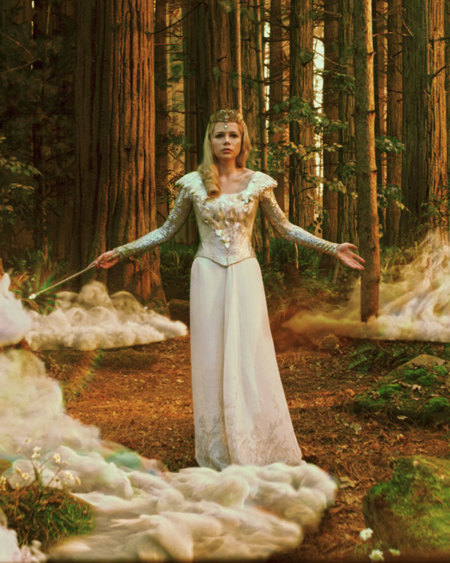
Alongside Oz, the film stars three very different witches: Evanora (Rachel Weisz), Theodora (Mila Kunis), and Glinda (Michelle Williams), whose garments reflect their personalities and their environment.
Evanora is the sovereign of the Emerald City, so her dress is inspired by the architecture of that city, both in design and color, inspired by Art Deco. A green dress with a slightly military cut.
Glinda is the most demure, wearing very delicate fabrics. Then, as the battle begins to unfold, her wardrobe undergoes a new change and becomes rougher, as if it were the armor of a fairy princess. For her, three different white robe-dresses were created.