Editor’s Note
This article examines the complex link between minerals sourced from conflict zones like the Democratic Republic of the Congo and the global electronics supply chain. While reporting on recent military developments, it highlights a persistent and sobering reality: the minerals essential to our everyday devices can fuel violence and exploitation, underscoring the urgent need for greater transparency and ethical sourcing in the tech industry.

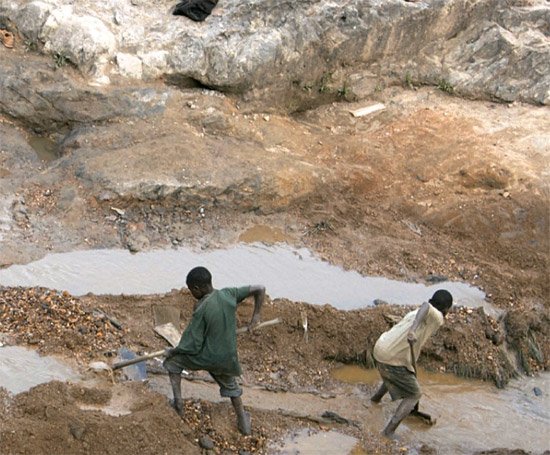
Boys holding shovels working in a mine in eastern DR Congo. DR Congo is a treasure trove of mineral resources for high-tech industries. The profits from here are used to purchase weapons for conflict and hardly reach the local residents. [Photo: The Enough Project]
On the 30th of last month (local time), the British BBC reported that the government forces of the Democratic Republic of the Congo (DR Congo) had cleared the M23 rebel group from their stronghold in the east. This comes a year and a half after armed groups staged a rebellion centered around Bunagana in April last year, creating over 800,000 refugees. Looking further back, the ethnic conflict that erupted in neighboring Rwanda in 1994 turned DR Congo and the wider Central African region into a wasteland. Most Koreans are indifferent to such news, viewing it as common ethnic conflict or military rebellion in sub-Saharan Africa. However, the tragedy of DR Congo casts a shadow surprisingly close to us. This is because the main production area for tantalum, an essential material for the mobile phones used daily by modern people, is the DR Congo region.
Tin, Tantalum, Tungsten, Gold. Taking the first letters of their English names, these are known as 3TG, representative ‘conflict minerals’. This means these mineral resources cause conflicts between ethnic groups and nations.
African resources have long been a source of conflict. The ‘blood diamonds’ that stained West Africa, including Sierra Leone and Liberia, are a prime example. Civil wars broke out to secure diamonds, and hundreds of thousands were sacrificed in bloody struggles to sell diamonds to fund these military expenses.
3TG has emerged as conflict minerals in the modern era. Tin is widely used in the electronics and automotive industries for pipes, circuit soldering, and alloys. Tantalum is indispensable in various semiconductors, central processing units (CPUs), mobile phone antennas, nuclear power generators, microscopes, digital cameras, TVs, fighter jets, and automobiles. Tungsten is mainly used for metal wires and electrical contacts. Gold is also a jewel but is a material widely used in the electronics and aerospace industries.
Among these, tantalum poses the most serious problem. Tantalum is usually extracted from an ore called coltan. Over 90% of the world’s coltan reserves are distributed in the DR Congo region. The provinces of North Kivu and South Kivu boast overwhelming reserves even within that. Congo’s production accounts for 20-50% of the world’s total.
Given this, coltan mines have been a major source of funding in the DR Congo conflict. The amount of coltan mined and sold by Tutsi rebel groups is even greater than that mined by the Congolese government. They forcibly mobilize Hutu prisoners and others to mine coltan. Children are also driven into mines carrying shovels taller than themselves. The money earned from mining is again used for military expansion.
International human rights organizations have long strongly raised issues about this. They have demanded that governments step in to regulate to break the vicious cycle of conflict minerals. There are arguments that something like the ‘Kimberley Process’, which restricted the global market circulation of ‘blood diamonds’, should be applied to 3TG as well. Accordingly, in 2010, the US Congress included a conflict minerals provision in the Dodd-Frank Wall Street Reform and Consumer Protection Act. Section 1502 of the Act can be summarized as a measure to prevent armed rebel groups in Central Africa, centered on DR Congo, from financing themselves through conflict minerals.
According to this measure, companies must henceforth undergo strict verification procedures when using 3TG produced from 10 conflict countries including DR Congo, Central African Republic, South Sudan, Uganda, Rwanda, Burundi, Tanzania, Zambia, Angola, and Congo. They must disclose the origin of minerals used in components and report to the US Securities and Exchange Commission (SEC) on the use of minerals from conflict zones. All manufacturers listed on the US stock market are targeted, estimated to be around 6,000 companies. Eight Korean companies, including LG Display and POSCO, are also directly subject to regulation. Domestic partner companies trading with US firms must also report on their use of conflict minerals by May 2014.
Accordingly, major electronics and electrical manufacturers such as Apple, Philips, Hewlett-Packard, and Motorola have begun tracking the 3TG supply chain. A new scene has emerged in DR Congo mines. When miners bring out ore in sacks, supervisors attach white plastic tags. This certifies it as ‘conflict-free’ mineral.
However, there are voices concerned about its effectiveness. Some illegally trade the tags. It’s common for monitoring teams, colluding with rebels, to pretend to supervise only during the day and then divert minerals at night. Although aimed at suppressing conflict, there is a possibility that rebels who lose their funding source may turn to other resources. A Financial Times investigation in the UK last May confirmed a trend of armed groups shifting their income sources to timber, coal, cannabis, ivory, and even human trafficking.
Moreover, there is a counterargument that such measures could further impoverish the lives of DR Congo residents. A side effect is that companies, considering the costs of origin due diligence, may prefer resources ‘not from Congo’ rather than ‘conflict-free’ resources. In fact, mineral production in North Kivu province in 2011 fell to 80% of the 2008 level. With Chinese traders becoming the only export channel, price gouging also occurs.
The New York Times (NYT), while reporting the news of the M23 rebel defeat, stated,
Other armed groups replacing M23 will infiltrate the vacuum where government forces cannot reach. In reality, whether controlled by the government or rebels, the enormous profits from the rich mines are not contributing to improving the lives of local residents, including miners.
The path to ending DR Congo’s tragedy is very long and still requires the world’s attention.
Reporter Kang Hye-ran