Editor’s Note
This article explores the geological rarity of emeralds, explaining how the unique convergence of chromium and vanadium—elements typically found in separate parts of Earth’s crust—creates this prized green gemstone.
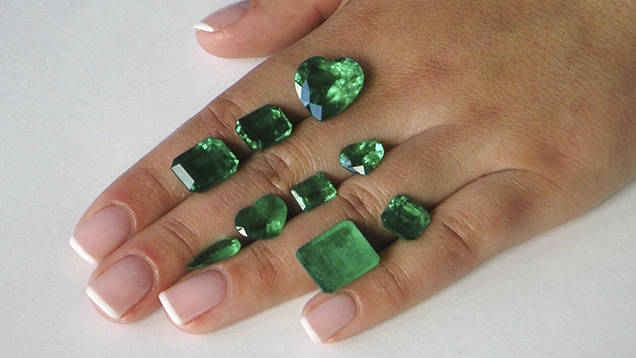
Emerald is the green variety of the mineral beryl, colored by chromium and vanadium. These trace elements are normally concentrated in quite different parts of the Earth’s crust, and only complicated geological processes enabled these contrasting elements to find each other and to crystallize into one of the most beautiful gemstones.
Colombian emeralds are mined from two belts within a mountain range known as the Eastern Cordillera. The western zone hosts, from north to south, the Peñas Blancas, Cosquez, La Pita, Muzo, and Yacopi mining regions; the eastern zone hosts the Chivor (Somondoco) and Gachala mines. These mines are located in the state of Boyacá, and access is difficult.
Colombian emeralds formed through a hydrothermal-sedimentary process. The geochemical processes for both the western and eastern zones are basically the same. The emeralds occur in organic rich shales and limestones. The fractures in the shales allowed hydrothermal fluids to infiltrate and deposit emerald and other accompanying minerals. This deposition occurred in several episodes involving heat and sometimes violent pulses of pressure. Fluid inclusions of the solutions from which the emeralds were formed became trapped during the crystallization process. These fluid inclusions represent a geological “fingerprint.”
Peñas Blancas emeralds are slightly bluish green, with little color zoning and a velvety appearance. One unique characteristic of the rough material is called “cascocho,” which refers to the crystals’ tendency to have pits and cavities due to secondary chemical etching. The abundance of quartz as a vein mineral differentiates Peñas Blancas from other emerald mines in the area.
Trapiche emeralds are perhaps the rarest and most memorable of “pattern” gems.
Two distinct growth regimes are responsible for the formation. First, the central tapered core grows under hydrothermal conditions. Then, growth conditions change and both emerald and albite are formed. The hexagonal prism faces of the core maintain their uniform growth, producing pure emerald, while areas growing from the edges between prism faces do not and are filled with albite. This results in six sectors of clear emerald, and six of predominantly albite and minor emerald. Trapiche emeralds are cut into cabochons to display the beautiful spoke-like star. In the 1960s and 1970s, many large trapiches from Peñas Blancas found their way into collections all over the world.
Colombian emeralds are among the world’s finest in terms of quality. The Andean nation is still one of the main emerald producing countries, alongside Brazil and Zambia. A lack of investment and mechanization at aging mines led to a decline after easily accessible gems became scarce. Heavy overgrowth has inhibited geologic exploration, and prospecting has been hindered by remoteness, steep topography, and a difficult social climate. A sound government policy along with investment and thorough prospecting could tap the full potential of the Colombian emerald deposits.