Editor’s Note
This article explores the seismic shift in the global diamond trade, tracing how the cutting and polishing center of gravity has moved from the historic hub of Antwerp to the Indian city of Surat.
Antwerp is considered the mecca of the global diamond trade. However, over the past three decades, there has been a remarkable shift in this business. It is no longer the strictly orthodox Jewish craftsmen and merchants who dominate this very special market. Instead, today about 90% of all rough diamonds go to Surat in the Indian state of Gujarat. There, the gemstones are cut and then exported worldwide via Mumbai airport, located about 240 kilometers away. More than 500,000 of Surat’s 5 million inhabitants are said to live from the diamond business alone. According to the local chamber of commerce, diamonds worth the equivalent of 210 million euros were traded daily in Surat in 2015. The city’s success has two reasons: firstly, the wage level for cutters is much lower than in Europe. Secondly, it is the Jains, whose diligent craftsmen made this success possible in the first place. By the way, the best-known follower of this religious group in Germany is Anshu Jain, the former CEO of Deutsche Bank. Jain businessmen are now also said to control more than 50% of the trade in Antwerp.
Even though the oldest documented diamond finds by humans were probably in India 6,000 years ago, the subcontinent is not a giant in the production of the gemstones. Most stones that come onto the world market today originate from Russia and southern Africa. Accordingly, the business is dominated by the Russian Alrosa and the De Beers Group, which belongs to Anglo American.
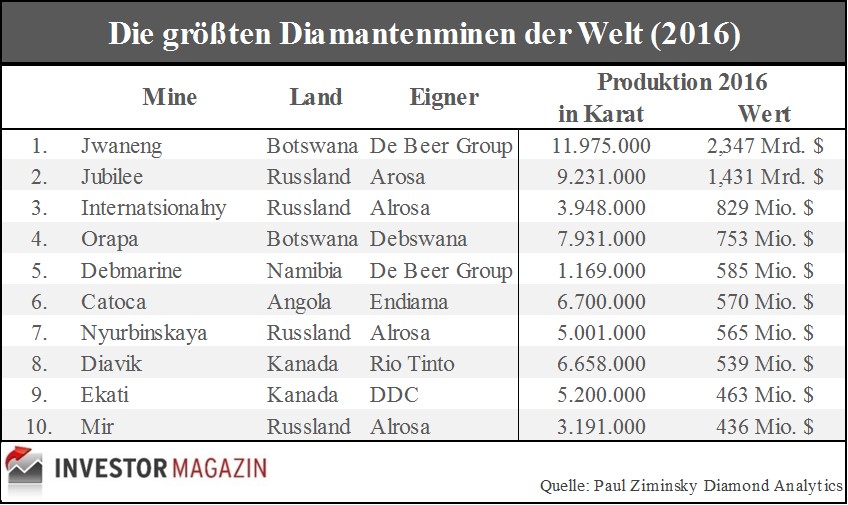
In 2016, the Jwaneng mine in southern Botswana filled the coffers of its owner De Beers. Stones with a total of 11.975 million carats and a value of 2.347 billion US dollars were mined there. No other mine in the world can match that. The “Prince of Mines” was opened as early as 1982 and is considered the catalyst that turned poor Botswana into one of the richest countries on the continent. The Orapa mine, ranked fourth, also contributed to this. It belongs to a joint venture between De Beers and the state. Slightly smaller yields than in Jwaneng are produced in the Jubilee and Internatsionalny mines in Russia. Nevertheless, they brought operator Alrosa a combined revenue of around 2.25 billion euros in 2016 alone. However, Internatsionalny is likely to gradually lose its position. Alrosa expects that no more diamonds will be found there from around 2022 onwards.
A special case is De Beers’ Debmarine “mine”. Because it is not located on land, but at sea. With five special ships, material is mined from the seabed there and then transported to land by helicopter. In 2016, they accounted for about 70% of Namibia’s production.
With the financial crisis of 2007/08, diamonds reached a significantly higher price level. However, for years now, prices have only moved sideways. Market observers believe this could change soon. Because while demand is growing slightly but steadily, production is on shaky ground. It is expected to decline significantly from around 2019!