Editor’s Note
This article highlights a notable deceleration in growth rates across key luxury sectors, with all divisions reporting single-digit increases—a significant shift from the 16% group-wide expansion seen in 2015. The data underscores evolving consumer trends and a potential market recalibration in the luxury industry.
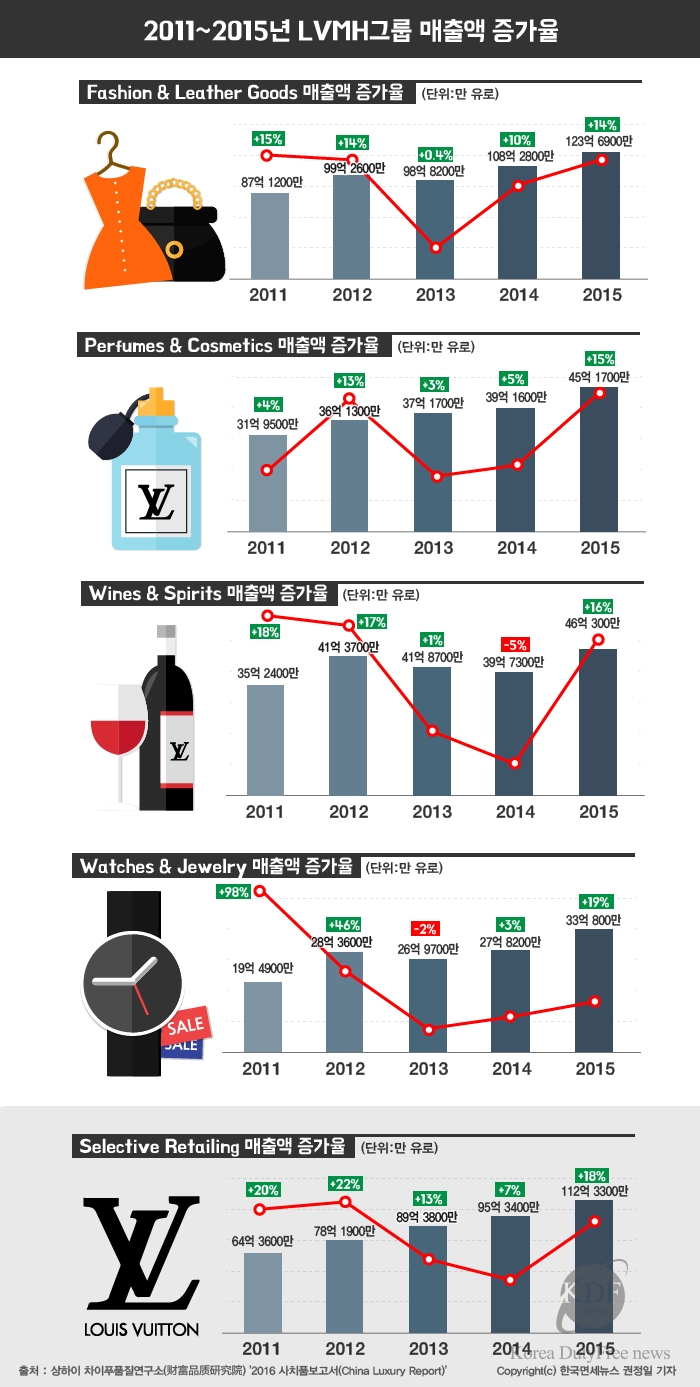
Sales increased by 14% in ‘Fashion & Leather’, 15% in ‘Perfumes & Cosmetics’, 16% in ‘Wines & Spirits’, and 19% in ‘Watches & Jewelry’.
Researcher Li Luran noted a trend where Chinese consumers are focusing more on ‘individuality’ rather than ‘brand’ and ‘trend’.
The ‘2016 China Luxury Report’ by the Shanghai Fortune Character Institute pointed out that the growth momentum of the global luxury industry has generally weakened. The report evaluated that while ‘change’ and ‘innovation’ were key issues for 2016 for leading companies like LVMH, Richemont Group, Kering Group (represented by Gucci), Hermès Group, and Swatch Group, they could not prevent a decline in sales.
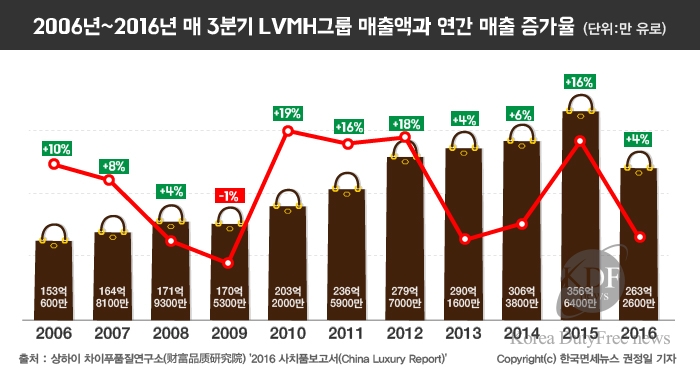
LVMH Group’s status as a leading global luxury company was reaffirmed. Its sales revenue reached 35.664 billion euros in 2015, an increase of about 16% compared to 2014, and group profits also rose slightly compared to recent years. However, a 36% increase in ‘marketing advertising costs’ in the ‘Perfumes’ and ‘Leather Goods’ sectors led to an increase in the cost of sales. The group’s total sales revenue up to Q3 2016 is estimated at 26.3 billion euros, a 4% growth compared to sales up to Q3 2015. Regional sales in 2016 showed overall growth in Asia (excluding Japan), stability in North America, and a decline in Europe due to a decrease in tourists.
After a 1% negative growth in 2009, LVMH achieved continuous growth of 19%-18% from 2010 to 2012. Although it grew by 16% in 2015, the growth momentum has weakened in 2016. While LVMH leads the global luxury industry with a diverse portfolio of brands, the most representative is the ‘Louis Vuitton’ brand. The performance of sub-brands supporting Louis Vuitton appears to be key to maintaining the group’s overall growth momentum.
LVMH Group divides its operations into five business segments: ‘Fashion & Leather Goods’ (including Louis Vuitton), ‘Perfumes & Cosmetics’, ‘Wines & Spirits’, ‘Watches & Jewelry’, and ‘Selective Retailing’ (large-scale wholesale sales).
– Fashion & Leather Goods: Dominates with sales of 12.369 billion euros in 2015, a 14% increase from 2014. Growth is attributed to brands like Louis Vuitton, Fendi, Céline, Givenchy, and Kenzo, with Louis Vuitton being the core driver.
– Perfumes & Cosmetics: Achieved total sales of 4.517 billion euros in 2015, a 15% growth from 2014. The main reason is Christian Dior’s increased global market share, along with the rise of Guerlain, Kenzo, and Givenchy fragrance brands.
– Wines & Spirits: Showed a dramatic rebound, growing 16% in 2015 after a 5% decline in 2014, largely due to expansion into emerging markets like the Philippines and Indonesia. It showed an additional 7% growth up to Q3 2016.
– Watches & Jewelry: A relatively weaker segment for LVMH, yet it achieved the highest growth rate among the five segments in 2015 at 19%, driven by the rapid growth of BULGARI and CHAUMET.
– Selective Retailing: This separate business unit, including DFS, Sephora, and Bluebell Group, grew 18% in 2015, mainly due to increased sales from Chinese tourists in Asian duty-free shops. However, growth slowed to around 6% by Q3 2016, analyzed to be due to changes in the shopping environment in Hong Kong and Macau.
As a comprehensive luxury company, LVMH implements a brand diversification policy across fashion, leather goods, perfumes, cosmetics, watches, and jewelry. A key task is transforming fashion brands into service brands through business diversification. Efforts include entering the hotel industry, high-end restaurants, and media.
– Hotels: Cheval Blanc hotel in France (2006), with two additional hotels in the Maldives and the Caribbean.
– Restaurants: In 2014, invested $100 million via subsidiary LCapital Asia to acquire a 90% stake in Singapore’s Chinese cuisine franchise group Crystal Jade.
– Media: Acquired the French economic newspaper Les Echos and its magazines for 240 million francs in 2007.
The ‘2016 Luxury Report’ diagnoses these attempts as LVMH’s vision to leap from a diversified product seller to a comprehensive cultural product group embedded in daily life and culture.
Louis Vuitton remains LVMH’s core brand, generating about half of total sales. Therefore, Louis Vuitton’s focus is inevitably on China, a major hub for global luxury shopping. However, as Chinese consumer perspectives change, LVMH’s strategy for increasing sales in China is being adjusted.
The core strategy is “diversifying the Louis Vuitton brand image, striving for new product development, while reducing brand exposure. Additionally, the advancement of subsidiaries like Fendi and Céline is necessary.” The number of Louis Vuitton stores in China decreased from 66 in 2014 to 41 as of January 2017.
Researcher Lin Na from the Shanghai Fortune Character Institute explained the strategic shift.
