Editor’s Note
This excerpt from a travel narrative captures the sensory immediacy of Jaipur’s famed Johari Bazaar, where the promise of hidden gems is as vivid as the city’s signature hues.

“Sir, need gems?” a man whispered to me. I was on Johari Bazaar, one of Jaipur’s most famous streets, a straight colonnade lined with shopfronts. All walls were painted in shades of saffron, terracotta, and burnt pink. The man, dressed in a white kurta-pajama with an air of indifference, unfolded a white paper to reveal colored stones. “Emeralds, sapphires, rubies…” he said. He was part of a cluster of local dealers haggling over prices. The avenue, literally meaning ‘street of jewelers,’ is flanked by dozens of shops displaying ornate necklaces, bracelets, and rings.
According to UNESCO, Johari Bazaar was “designed as a commercial capital,” a key reason UNESCO listed it as a World Heritage site.
My experience illustrates why this northern Indian “Pink City” was recently designated a UNESCO World Heritage site. Jaipur’s listing is partly based on its urban planning, featuring colonnaded streets and public squares called chaupars. The city also boasts architectural wonders: the City Palace, Amber Fort, and Jal Mahal (Water Palace). Walking through the pink sandstone Hawa Mahal (Palace of Winds) is a breathtaking experience, with its five-story, honeycombed facade featuring over 50 latticed windows, mini-domes, and painted decorations inside.
Jaipur and its ceremonial court architecture were built for commerce. As UNESCO states, the city was “designed as a commercial capital.” Today, dealers and vendors animate the streets. In back alleys and upper-floor workshops, curious visitors find artisans crafting decorative arts. UNESCO notes Jaipur “continues to maintain local commercial, artisanal and cooperative traditions.”
Jaipur is known for block printing, tailoring, carpets, and wood and metalwork. There are modern boutiques like Teatro Dhora selling elegant clothing and accessories. But historically, the city’s jewelry industry has been exceptional.
After founding Jaipur in 1727, Maharaja Sawai Jai Singh II is said to have organized a procession where locals threw gems at him and his entourage. He was obsessed with jewelry. Under his patronage, Jaipur began evolving into a jewelry hub, attracting artisans and traders from afar. Today, the city is home to thousands of jewelers and dealers.
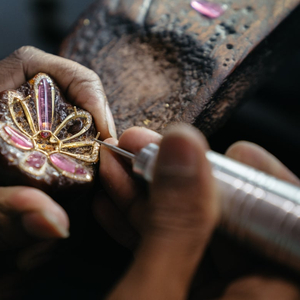
By chatting with dealers, visitors can meet jewelers like Narenda. I spoke with him in his first-floor workshop outside Chandpol Bazaar. Sitting cross-legged on the floor, he examined a gemstone on his worktable.

Framed paintings of three Hindu gods hung on the wall, adorned with orange marigold garlands. Downstairs, the street buzzed with motorcycles and rickshaws. Through the window, the Nahargarh Fort was visible on the hills outside the city.
Narenda works in the traditional Kundan Meena style. Kundan jewelry is distinctive, using wax in gold or silver settings, incorporating glass and paintings with white, green, red, or blue floral patterns. The result has an ethnic feel, yet a full set of necklace, headpiece, earrings, and rings looks dazzling. This explains its popularity among wealthy brides in Mumbai and Delhi.
It’s not just wealthy Indians who come to Jaipur for gems; the city welcomes customers from anywhere. Backpackers and tourists can find affordable, quality goods in dozens of shops across the city, requiring patience and a keen eye.
Visitors can also deepen their knowledge of Indian jewelry at the Amrapali Museum on Ashok Marg. This two-story building houses an extraordinary jewelry collection. A captivating one-foot-long gold waistband from 19th-century Tamil Nadu, carved with Hindu deities, is just one of hundreds of spectacular pieces.
Amrapali also produces jewelry on a large scale. Its “workshop” employs 1,500 artisans crafting goods mostly sold to other companies at a set minimum price. Goldsmiths often come from Bengal, stone-cutters historically from the local Muslim community, and gem dealers are Marwaris, a caste from Rajasthan. Most jewelers in Jaipur are men, though efforts are being made to hire more women. Tarang Arora, son of an Amrapali founder, emphasizes the company’s commitment to employee welfare.
To some extent, the Amrapali workshop and other Jaipur companies are trying to compete with Chinese firms. However, in terms of mass economics, Jaipur might lose out. It seems more meaningful for the city’s jewelry producers to integrate into Jaipur’s “brand” as a handicraft hub.
This is where Akshat Ghiya’s workshop-cum-jewelry store, Tarini, finds its best footing. The company employs about 20 artisans who work in an upstairs space along Johari Bazaar. Tarini produces traditional Rajasthani and Art Deco-style pieces. Anyone can observe the artisans at work and admire the sparkling goods in Akshat’s office-cum-showroom.
Such an intimate environment must be conducive to good craftsmanship. Srikanth, a Tarini artisan, spoke of how the business connects him with his talent, even his gift. He added that for him and his fellow Bengalis, making jewelry brings something else:
Undoubtedly, this is what UNESCO hopes to continue preserving.