Editor’s Note
This article explores the unique status of diamonds, from their elemental properties to their dominant role in the gem market and their separate classification in gemology.
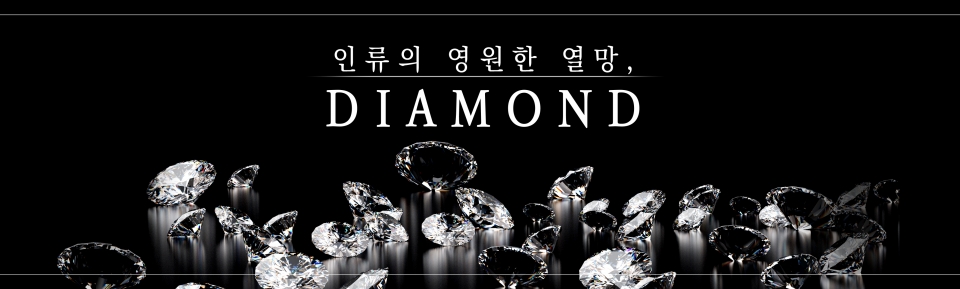
Diamond is an elemental mineral composed solely of carbon, possessing excellent properties such as high hardness and thermal conductivity, making it important in various fields. This is also true in gemology, the study of gems and their processing and appraisal. Diamond’s unique properties have earned it special recognition as a gemstone and it is handled on an overwhelming scale in the gem market. Therefore, in gemology, colored gemstones and diamonds are classified and treated as separate categories with significant weight.
Diamond first appeared in human history around the 4th century BC in India. Diamonds were consumed by India’s wealthy class and later spread worldwide through trade. The fact that diamonds came to account for the majority of global gem market transactions owes much to the British mining company De Beers, founded in 1859. As De Beers monopolized diamond production and sales for over a century, diamonds rose to the status of the ultimate gemstone. The advertising slogan ‘A diamond is forever’ used at that time is still quoted in many places today.
The properties of diamond can be largely divided into physical properties and optical properties related to light. The physical properties of diamond are related to its crystal structure. Crystal structure refers to the regular arrangement of atoms forming a mineral, creating a defined structure. Crystal structure forms when molecules arrange in an orderly fashion as a substance cools after its creation. Even if composed of the same element, different crystal structures result in completely different materials. Diamond and graphite are examples of this. Crystal structures are classified by the angles and lengths of their crystallographic axes. Diamond belongs to the cubic system, where three axes of equal length meet at right angles. In contrast, graphite, though also composed of carbon, belongs to the hexagonal system.
The property that most contributes to diamond’s symbolism of eternity is its hardness. Hardness indicates a mineral’s resistance to scratching. This depends on the density of the crystal structure arrangement. Diamond occupies the highest hardness level of 10 on the well-known Mohs scale of mineral hardness. However, this does not mean diamond is completely unbreakable. A mineral’s resistance to breaking is called toughness. Even a hard mineral that doesn’t scratch easily has directions within its crystal structure where the arrangement is relatively loose. Minerals tend to cleave along these directions, which determines their toughness. Diamond’s toughness is relatively weak compared to its own hardness but is excellent compared to other minerals. The characteristic of being neither easily scratched nor cleaved led people to believe that diamond remains unchanged forever.
The optical properties of gems include luster, transparency and color, and brilliance. Among these, the notable property related to diamond is brilliance. Brilliance refers to the amount of white light visible to our eyes. Higher brilliance makes it appear more sparkling to our eyes. The most important factor determining brilliance is the refractive index. This is because a higher refractive index allows more of the received light to be reflected. Diamond has the highest refractive index of 2.42 among naturally transparent gemstones.
Diamond rough is polished by professional polishers. Diamond polishing aims to maintain or enhance the beauty of the rough while removing as little material as possible. Accordingly, the first step is to directly mark the location on the rough with oil-based ink to decide which part to cut. When dividing the rough, a rotating saw coated with diamond powder or a laser beam is used to cleave the diamond along the direction where the molecular arrangement is loose. Then, the cut diamonds are rubbed against each other to create the overall shape, and finally, the specific shape is completed by adjusting angles on a polishing wheel. The value of a diamond varies greatly depending on the shape created in this final stage. Modern diamonds are primarily made into the brilliant cut, consisting of 58 facets. The brilliant cut was designed in 1919 by mathematician Marcel Tolkowsky.
The value assessment of diamonds is based on the 4Cs: Carat weight, Clarity, Color, and Cut. Generally, the heavier the carat weight and the clearer the clarity, the more valuable the diamond. Clarity is determined by the presence of internal and external flaws. External flaws can be easily removed by re-polishing the diamond, so internal flaws have a greater impact on a diamond’s value than external ones. The more transparent the color of a diamond, the higher its value. When a diamond is formed, if impurities enter the crystal structure or defects occur, other colors mix into the diamond. The most common is yellow. However, colored diamonds recognized for their attractive hues are called fancy diamonds and possess much higher value than ordinary colorless diamonds. In fact, in 2015, a 12.8-carat blue diamond was sold at a Sotheby’s auction for a record price of approximately 56 billion won per carat.