Editor’s Note
This article examines how pandemic-driven supply chain disruptions are exposing vulnerabilities in our globalized economic model, particularly in critical sectors like pharmaceuticals and technology.
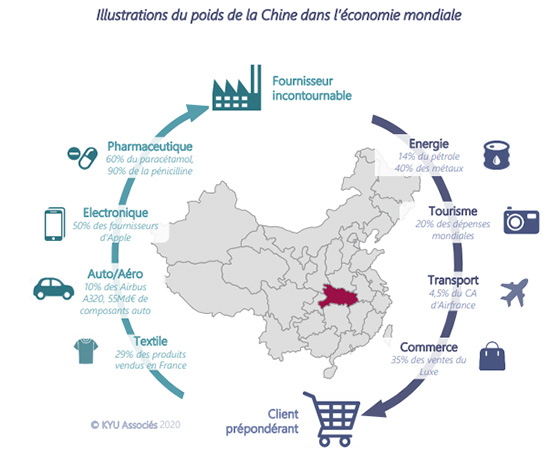
The coronavirus is calling this economic model into question. Due to disruptions in the production chain, we are already seeing, for example, the risks associated with the supply of medicines, the active ingredients of which are manufactured in Asia in 80% of cases. Like them, the lithium essential for mobile phones and computer batteries, the rare earth minerals that are an integral part of solar panels and wind turbines, as well as semiconductors are predominantly manufactured in China.
It is now a viral risk in the epidemiological sense of the term that forces us to rethink our supply chain and the quality of our supplies, as much as their quantity, probably turning or re-turning the spotlight on European SMEs. Let us wish them now to have the capacity to redefine, in the post-crisis period, the new map of the production/consumption pair for our continent.

In ancient history and up to the Middle Ages, Christian Europe, for theological-cultural reasons, became attached to gold, while the secular world moved closer to silver. Ghana’s gold was exchanged for salt and slaves in Mali and used to pay the Roman legions. The Greeks exploited the silver mines of Laurion to finance their cultural influence, and the diamonds of Golconda and precious stones fueled global conquests for fifteen centuries, before the discovery of South African mines at the end of the 19th century. In the Middle Ages, Latin American mines supplied Europe, and the silver mines of Iwami Ginzan, the Japanese shogunate, as well as gold deposits in Siberia and Iraqi grain, financed Nicholas I until the Crimean War.
Thus, for centuries, military personnel, explorers, and merchants were in a permanent search for precious metals and raw materials more generally, to finance armies, make voyages profitable and continue them, develop trade, and secure their public/private supplies for the purpose of territorial expansion or, quite simply, the development of national economies. But this economic windfall was accompanied by a procession of barbarism and inequalities, served by a slavery in which the poor were considered only as an adjustment variable. Such was the curse of raw materials. “Auri sacra fames!” or the hunger for gold. In the 1960s, Fernand Braudel defined the concept of a world-economy as a piece of the planet that is economically autonomous, which, according to him, would be largely self-sufficient and to which its internal connections and exchanges would confer a certain organic unity. In the late 1970s, against the backdrop of oil crises (1973-79) that would herald the end of the “Trente Glorieuses” for the Western world, the international economy sought a second wind to perpetuate this Braudelian economic autonomy.

The division of production into several distinct stages was made possible by technological advances in transport and communication and, above all, by the opening of world markets. In the 1980s, the rule of the three “Ds” of the French economist Henri Bourguinat applied: Financial Deregulation, Global Decompartmentalization of companies, Dismantling of the State. As part of the implementation of an economic liberalization policy, financial deregulation will allow the market economy to produce more money to finance the appetites of administrations and companies from the financial platforms that are the Stock Exchanges. The global decompartmentalization of firms will encourage foreign direct investment, allowing financial transactions between parent companies and subsidiaries. The gradual dismantling of the State will further promote the market and its invisible hand by lightening it from the weight of institutional and regulatory constraints.
One of the collateral effects of this sudden organized deregulation will be the creation of financial mass and the decoupling between its paper volume and the physical. Paper, meaning an increase in paper transactions on raw materials; and physical, through commercial and tangible counterparts constrained by the reality of resource availability permitted by the planet. This decoupling will have the effect of driving up commodity prices and pushing for the extraction of raw materials all over the world in an attempt to restore balance. It is the reign of liberal economists (Friedman, Hayek), from the Chicago School, an American sociological school of thought that emerged in the early 20th century. The 1990s and 2000s saw the beginning of the reign of GAFAM (Google and its search engine, Amazon and its online shopping center, Facebook and its global address book, Apple and its iPhone, Microsoft and its office environment) and their insatiable appetite for rare earths. The 2010s will see the birth in addition of NATU (Netflix, AirBnB, Tesla, Uber).
