Editor’s Note
As Arabella Roden explores, the integration of CAD/CAM technology has fundamentally reshaped the jewellery industry, moving from a novel innovation to an essential tool for customisation and efficiency. This article examines its lasting impact and widespread adoption.
Computer-aided design and manufacturing have become an almost intrinsic part of the jewellery industry – especially given the demand for custom makes and personalisation, writes ARABELLA RODEN.
Perhaps the most significant change in the jewellery industry in recent decades has been the adoption of CAD/CAM – computer-aided design and computer-aided manufacturing.
Today, nearly a decade after Jeweller first questioned its permanence, the answer is assuredly yes. The financial limitations that once confined CAD/CAM to larger companies rapidly fell away as technology evolved, leading jewellers of all stripes to embrace the benefits.
Chris Botha, operations manager at Palloys, reflects on the technology’s evolution. He notes a substantial increase in jewellers using CAD/CAM since 2018, with CAD’s share in their casting cycle rising from approximately 30% to nearly 45%.
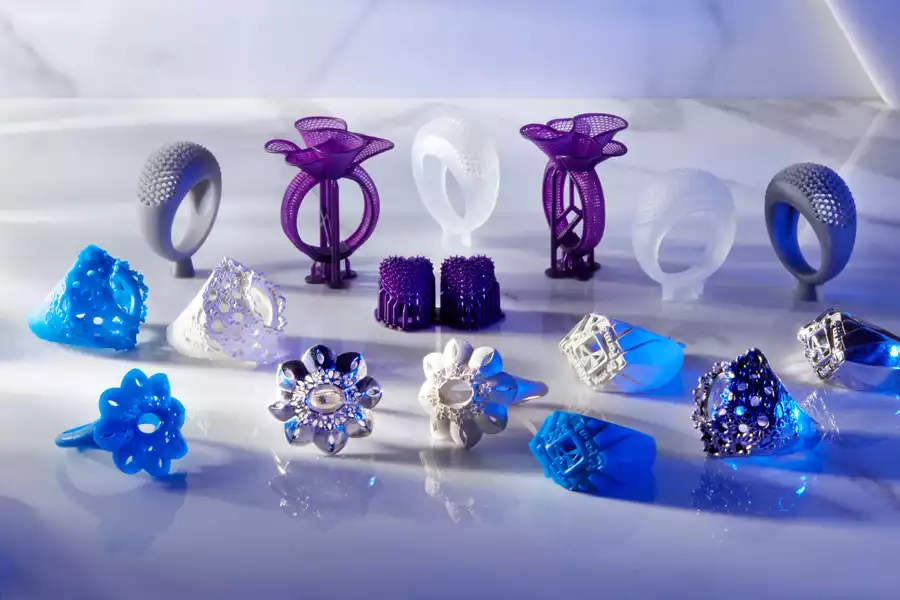
Darren Sher explains the trend, highlighting jewellers’ growing awareness of the quality achievable from CAD. He attributes this to leading technology resin and wax printers that ensure the best surface finish and high-quality castings from CAD files.
Tok from Tok Bros notes that since 2018, they have updated their fleet of 3D printers and fine-tuned their resins to achieve a smoother print and cast surface finish.
Gabriel has observed a “proliferation of much smaller – and therefore more affordable – resin printing machines” enabling jewellers to produce their own high-quality prints, a feat previously requiring hugely expensive machines.
Improvements in resins have also become a sector focus. In January 2021, US-based Formlabs introduced Castable Wax 40 Resin, developed with the Gemological Institute of America (GIA) and supplier Rio Grande.
Formlabs stated that this 40 per cent wax-filled material is designed to produce results similar to traditional blue carving wax used in lost wax casting.
Gabriel notes an “explosion in availability” of different resins, with most suppliers searching for the ‘Holy Grail’ material that behaves like a resin when printing and like a wax when casting.
In addition to resin and wax printers, companies like Lenrose make “extensive use of 3D scanning to further enhance the quality of CAD designs”. Best-known for film/TV motion-capture and medical prosthetics, 3D scanning is increasingly applied to jewellery to generate digital models of real-world pieces.