Editor’s Note
This article explores the key trends reshaping the global diamond industry in 2021, highlighting the growing influence of digital transactions, the rise of synthetic diamonds, and an increasing focus on sustainability.
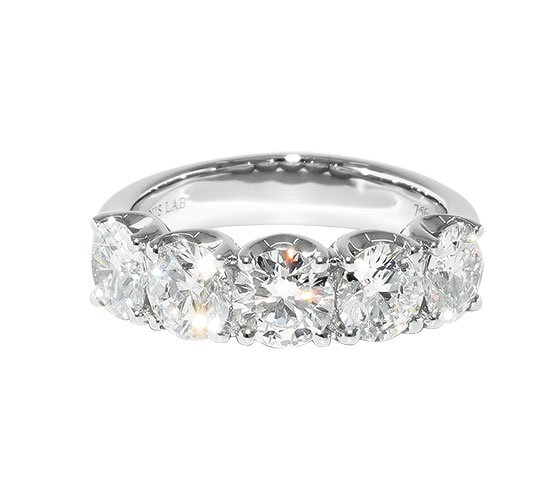
In July of this year, a super-expensive diamond auctioned at Sotheby’s for $12.3 million was paid for with cryptocurrency. In October, a Harry Winston diamond necklace can also be auctioned for cryptocurrency. The diamond industry’s swift moves to secure new customers have recently shifted to a focus on synthetic diamonds (lab diamonds, lab-grown diamonds). The movement of the global diamond industry, which just a few years ago vehemently opposed the spread of artificial, non-natural diamonds, is already a world apart. Of course, the popularity of natural diamonds, welcomed by the super-rich, remains strong. Amid this extreme polarization of high popularity, companies that dominate the diamond market, such as De Beers and Pandora, are also stepping up their pace. So, from an investment perspective, how should we view this interest? We examine the keywords that have led the global diamond market last year and this year. We introduce the market movements targeting the MZ generation during the pandemic and the super-rich’s methods of investing in jewelry.
This is no exception for the diamond market, where unusual movements are being detected at both the very top and bottom ends of the pyramid.
On July 9th, a super-expensive diamond auctioned in Hong Kong at Sotheby’s caused quite a stir in the industry by being settled with cryptocurrency. The star of the show was the 101.38-carat, D-color, flawless diamond ‘The Key 10138’. This diamond fetched a hammer price of $12.3 million, claiming the title of the first and most expensive gemstone ever paid for with cryptocurrency in auction history (for a gemstone auction). Three months later, Sotheby’s also supported cryptocurrency transactions for a Harry Winston necklace set with a total of 177.51 carats of diamonds, accelerating its efforts to attract new customer segments. Thus, Sotheby’s, having successfully drawn the ‘Digital-Savvy’ crowd into the conservative gemstone auction market, has ushered in an era where virtual assets contribute to traditional luxury sales.
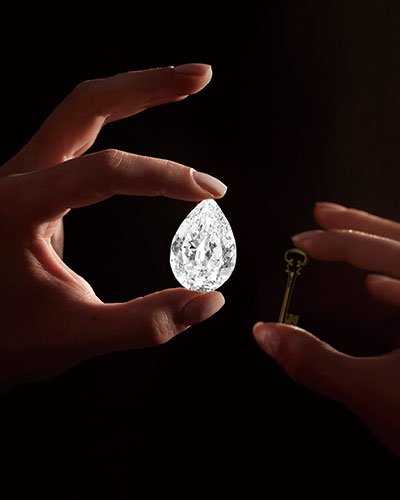
In 2021, the level of capital pouring into the synthetic diamond (Lab-grown Diamond) market is also beyond imagination. It is now the third year since De Beers launched ‘Lightbox’ and threw its hat into the ring of the gem-quality synthetic diamond market. De Beers, which once monopolized the world diamond market, still mines one-fifth of the world’s diamonds. It is indeed an ironic situation that the traditional powerhouse of the diamond industry, which until a few years ago was focusing all its efforts to prevent the spread of artificial diamonds, is now exerting influence as a major price setter and supplier of synthetic diamonds.
Jewelry companies with high global market share and Silicon Valley startups armed with innovative technology are also growing at a furious pace in the synthetic diamond market. Pandora announced its ‘Pandora Brilliance’ collection set with synthetic diamonds in May, declaring that it would switch all its products to synthetic diamonds starting in 2022. ‘Diamond Foundry’, the largest synthetic diamond producer in the US, recently secured an additional $200 million in investment to increase its production to the level of ‘natural stone mining’. This raised the company’s valuation to $1.8 billion. Thus, in just a year and a half, the high-quality natural diamond market has led to an expansion of payment methods targeting the digital generation craving ‘scarcity value’, while the synthetic diamond market is expanding its breadth with major players equipped with massive capital and strong marketing power under the banner of ‘democratization of diamonds’. Both markets are focusing all their efforts on targeting young consumers.
As the king of gemstones, diamond is a mineral with the most special creation story in nature. Formed billions of years ago under extreme pressure 150-200 km below the Earth’s surface in the mantle, diamonds are a product of chance and miracle that rose to the surface with volcanic eruptions. Even the youngest diamond finished forming before the extinction of the dinosaurs. If natural diamond is like a glacier made from primordial water that existed before humanity, then synthetic diamond produced in a factory in two weeks is like ice from a freezer? Of course, the chemical composition, crystal structure, optical and physical properties of synthetic diamonds are identical to those of natural diamonds. This is why synthetic diamond producers scattered around the world prefer the concept of ‘genuine product born of science’ over ‘synthetic’. They argue that it is the same material both gemologically and aesthetically, distinguishable only by the precise inspection equipment of gemological institutes, expressing frustration with the public’s misunderstanding and speculation about its ‘dubious pedigree’.
The official honor of being the world’s first developer of artificial diamonds belongs to America’s General Electric (GE). In 1954, GE succeeded in synthesizing graphite into diamond using the High-Pressure High-Temperature (HPHT) method, similar to the environment where natural diamonds form. Of course, they were extremely small and far from transparent, but they were perfect for industrial abrasives. As synthesis technology advanced, humanity succeeded in developing ‘gem-quality’ diamonds, and with the advent of Chemical Vapor Deposition (CVD), which is simpler and does not require high pressure like HPHT, a great achievement was made in significantly reducing cost and time. Quality also improved dramatically to the point where it is difficult to distinguish from natural with the naked eye. Lightbox, Pandora Brilliance, and Diamond Foundry diamonds are also produced using CVD technology.
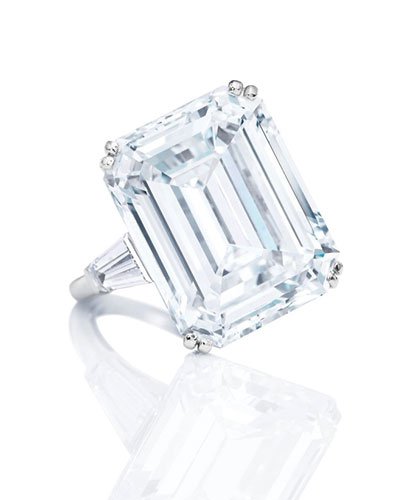
Ultimately, the killer feature that allows synthetic diamonds to excel in the tug-of-war with consumers is price. Depending on the stone or brand, white diamonds are on average 30-40% cheaper at retail prices as of 2021. So, what about their investment value? Looking back at history, the answer is closer to ‘no’. Wasn’t cubic zirconia, the epitome of imitation diamonds, once sold for $800 per carat? The synthetic diamond industry is a manufacturing industry. Moreover, it is an item with a much higher dependence on technology than natural diamond mining. As technology advances, production will continue to increase, and as supply increases, price decline is a natural consequence.
Looking at the price trend of synthetic diamonds over the past three years, the wholesale price of synthetic diamonds, which had maintained a somewhat high level, began to decline after May 2018. That was precisely when De Beers announced Lightbox’s groundbreaking price structure of $800 per carat. According to Ethan Golan Diamond Research & Data, the wholesale price of synthetic diamonds fell 26% in Q1-Q3 2018, and this trend continued until Q3 2019. Then, from Q4 2019, prices began to recover. Despite many producers entering the market and increasing supply, they benefited greatly from strong consumer demand. In fact, the market share of synthetic diamonds rose from 2.1% to 3.4% in Q4 2019. While the numbers may seem modest, it was a surprising result of a 62% increase in market share in one year.
Thus, the price of synthetic diamonds, which showed strength even amid oversupply, began to decline again in March 2020 as consumers closed their wallets due to COVID-19 lockdowns and isolation measures. Although retail stores began reopening from late summer and the jewelry market slowly revived, while the wholesale price of natural diamonds rose, synthetic diamonds could not escape a downward trend. Accumulated oversupply and fierce competition were the main causes. Although the rate of decline has slowed this year, due to intensified competition and various efforts to make up for losses from the first year of the pandemic, synthetic diamond prices are expected to maintain a slight downward trend for the time being.
Ultimately, the diamond jewelry market is bound to be stratified into multiple levels. Led by fancy color diamonds, the highest-grade natural diamonds will occupy the top of the pyramid, while at the bottom will be synthetic diamonds (which are also divided into quality comparable to natural and low quality) and low-priced natural diamonds competing with them. Even in the world of the super-rich, there is a trend of demand for Type IIa diamonds, which contain no nitrogen, even among top-grade white diamonds. Most diamonds, about 98%, contain trace amounts of nitrogen, which is the main culprit for creating a yellowish tint. However, super-rich who have sought differentiation with colorless D-color diamonds are now craving Type IIa diamonds (1-2%) made of pure carbon without even trace amounts of nitrogen, even among D-color diamonds. Luxury brands like Cartier, Tiffany, Chaumet, Louis Vuitton, and Chanel are also vying to secure perfect Type IIa diamonds. Sotheby’s ‘The Key 10138’ and Harry Winston’s necklace are also Type IIa diamonds. This reminds us that the super-rich’s jewelry investment strictly follows a ‘scarcity value worldview’.
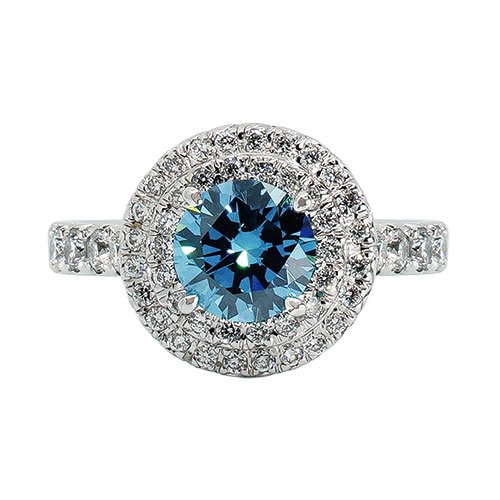
When De Beers launched Lightbox in September 2018, both the natural and synthetic diamond industries were shocked. However, De Beers seemed to have already prepared an escape route to avoid shooting itself in the foot by eroding the bridal market. Its policies were: the industry’s lowest price, not selling loose stones separately, not grading them, and selling only online. It also did not go all-in on philanthropic storytelling emphasizing ethics and eco-friendliness like other companies. Ultimately, the underlying intention was to differentiate it from its own natural diamonds. Views were divided, with some seeing it as “an effort not to fall behind the times” and others ridiculing it as “a swift move to devalue synthetic diamonds”. So far, as per their plan, they are targeting the MZ generation in their 20s and 30s, who have emerged as the core purchasing group, by targeting the mid-to-low-priced fashion-oriented demi-fine jewelry market and the gift market. For reference, Lightbox’s sales in 2020 increased by 50% compared to the previous year, and this year it also expects a threefold increase in sales compared to the previous year. Initially distributed only in the US, it is now sold in 75 countries, with overseas market sales accounting for 20% of total e-commerce sales.
When synthetic diamonds were first developed by GE in 1954, many thought the end had come for natural diamonds. However, over the past 70 years, natural and synthetic diamonds have ‘peacefully’ coexisted. However, as technology has advanced, enabling the large-scale production of larger and better quality stones, the atmosphere is more about forming a new jewelry category rather than completely replacing natural stones. For example, choosing synthetic stones for jewelry to be worn lightly, and natural stones for once-in-a-lifetime commemorative occasions like weddings. In particular, they are expanding the market by demonstrating the power to stimulate the purchasing desire of consumers who never even considered diamond jewelry before.