Editor’s Note
This article explores Antwerp’s pivotal role in the global diamond trade, detailing how the city handles a dominant share of both rough and polished stones. It also delves into the secretive, high-value nature of this niche market.
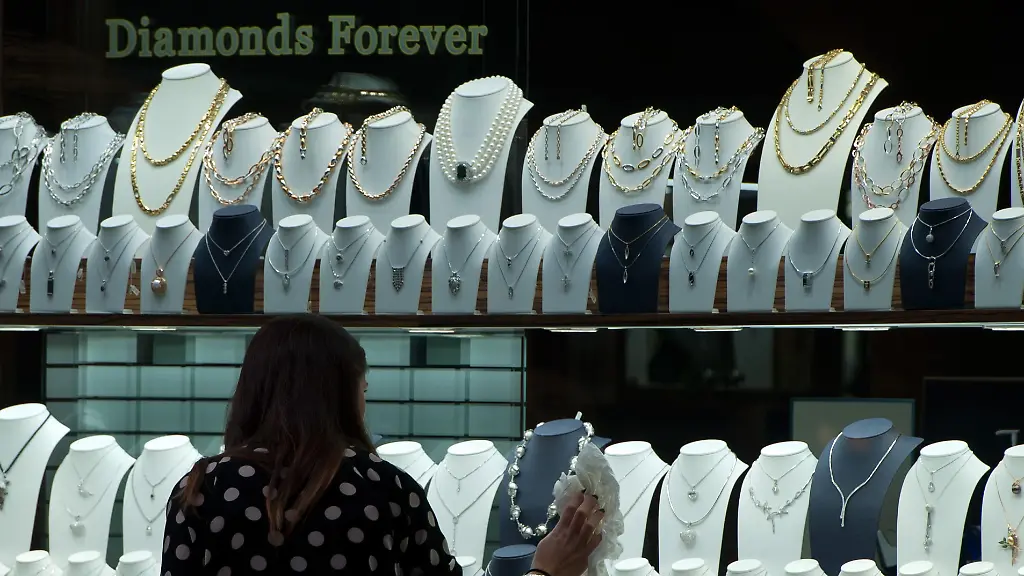
Antwerp is a diamond trading center. Here, 84 percent of the world’s rough diamonds and 50 percent of the world’s polished diamonds are traded.
The diamond business is a niche market with billions in turnover, about which traders, however, prefer to remain silent. One in four stones comes from Russia. Although the sale of luxury goods to Russia is sanctioned, the import of Russian gemstones remains permitted. The reasons for this are debated.
With gloves, jewels are draped on velvet in the window of a shop in the diamond district in Antwerp. The Belgian port city has been one of the hubs for the gemstone business since the 15th century. According to the Antwerp World Diamond Centre, 37 billion euros are turned over here discreetly and confidentially each year. When asked where the diamonds come from, a jeweler answers with a laugh:
His reticence is not entirely unfounded.
The rough diamonds come from Angola, Congo, Sierra Leone, South Africa, and also from Russia, as Sigal Vantzovski, owner of Binson Diamonds in Antwerp, explains. They are brought to Belgium to be polished in manufacturing workshops. The diamonds are then further processed into pieces of jewelry and sold, among other places, in her store.
It is a noble niche market with billions in turnover, from which Russia—despite the war in Ukraine—continues to benefit. Since the start of Russia’s war of aggression in Ukraine, the European Union has imposed many sanctions against Moscow. For instance, the import of certain goods such as gold, vodka, and caviar was stopped—Russian diamonds were spared, and for a specific reason.
According to figures from the Russian Finance Ministry, Russia exported over 48.6 million carats of rough diamonds abroad in 2021—the highest volume since the start of the observation period in 2007. The monetary turnover was not quantified. The main export destinations: the United Arab Emirates and Belgium.
Belgium—the country where the EU has its headquarters—thus plays a key role in the diamond industry and advocated in sanction negotiations for Russian stones to remain excluded from the measures.
From an economic perspective, Europe would harm itself with sanctions, says Koen Vandenbempt, Dean of the Faculty of Economics at the University of Antwerp. A halt to the import of Russian rough diamonds would cause an industry to be lost and relocate to Dubai or Mumbai—places where far less emphasis would be placed on transparency or sustainability than in Antwerp, says Vandenbempt.
Since many countries such as India, Israel, or the United Arab Emirates have not joined a boycott, the Russian stones would ultimately find their way into the world market through them, explains Joachim Dünkelmann from the German Federal Association of Jewelers, Jewelry and Watch Retailers (BJV).
The Kremlin, however, most likely benefits from the diamond frenzy. One of the largest producers is the Russian diamond giant Alrosa, which, according to its own statements, is “partially” state-owned. Experts estimate the state’s share at about 33 percent.
Alrosa accounts for 95 percent of Russian diamond production—globally about 27 percent. This means that at least one in four stones on world markets comes from Russia. The giant operates several mines in the Sakha region in northeastern Russia as well as in Arkhangelsk in the northwest and is also involved in mines abroad—for example, in Angola.
In contrast to Vandenbempt, raw materials expert Larisa Stanciu emphasizes that a ban on the import of Russian rough diamonds would mean less money flowing into the state treasury via Alrosa.
Alrosa CEO Sergey Ivanov is also no stranger. He was among the first oligarchs from Putin’s circle to be sanctioned by the United States. While the European Union hesitates, the US government imposed sanctions against Alrosa shortly after the outbreak of the war and subsequently tightened them.
says Vandenbempt, critically noting that Europeans are naive to think Americans would do something that harms their own economy. According to him, jewelry sales in the US account for 50 percent of the world market. Thus, there is also a loophole in the US sanctions regulation thanks to a not entirely crystal-clear formulation. It states: If a diamond has been significantly altered in another country, it may claim that region as its origin.