Editor’s Note
This article marks a decade since Jeweller began covering the digital revolution in jewellery making. Samuel Ord revisits early predictions and assesses how CAD/CAM technology has truly transformed the Australian industry.
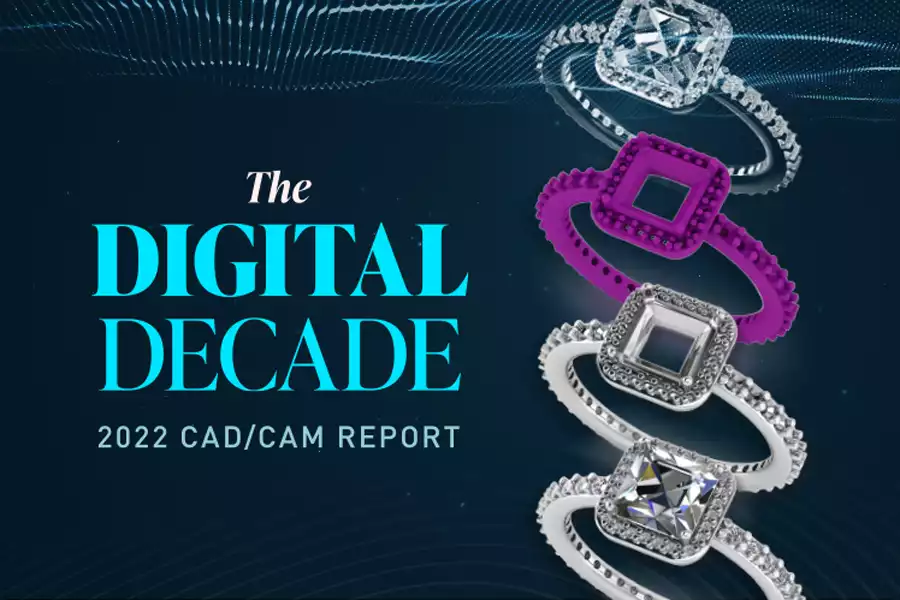
It has been 10 years since Jeweller first began exploring the world of CAD/CAM technology and its impact on the Australian jewellery industry. SAMUEL ORD winds back the clock to examine some early expectations before surveying the state of play today.
The past 10 years have brought about remarkable advances in science and technology. Advances in science and technology have also reshaped a number of retail industries. It has been a significant period of advancement for the use of technology within the jewellery industry, particularly when it comes to Computer-Aided Design and Computer-Aided Manufacturing (CAD/CAM).
Jeweller published its first report in June 2012 on the state of CAD/CAM within the Australian jewellery industry.
At the time, the question on the minds of retailers was whether or not CAD/CAM would become a significant ‘force’ in the jewellery industry. Would it make a lasting impact on the trade, or come and go like so many other ideas once entertained as revolutionary?
It didn’t take long for that question to be answered. With manufacturing costs shrinking with each passing year, the industry has increasingly embraced technology which has showcased increasingly user-friendly functionality and cost-effectiveness.
Since the 1950s, Palloys – one of six entities which forms the Pallion Group – has taken pride in the expansion of jewellery casting, custom jewellery production and CAD/CAM services on offer. Palloys was an early adopter of CAD/CAM and in 2012, was one of the first companies to share insight with Jeweller on the rise of the technology in the jewellery industry.
Ten years ago, head of operations, Manuel Kalergis, had this to say about the future of the trade.
One decade later, Palloys operations manager Chris Botha says those predictions were close to the mark but not quite in line with what was to come, showcasing that advances in technology aren’t always linear.

Palloys is currently investigating an investment in DMSL technology.
CAD/CAM has been lauded as a way of bringing ‘in-house’ manufacturing back for jewellers. Botha says that remains one of the most promising aspects of the trade.
Best-known for its use in motion-capture for films and TV, as well as medical prosthetics manufacturing and robotics, 3D scanning is increasingly being applied to jewellery in order to generate digital models of real-world pieces.
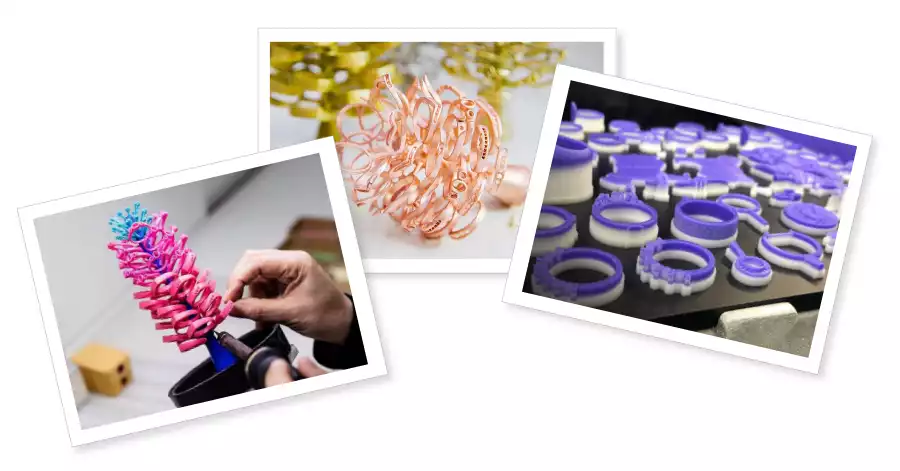
Riacetech introduced lean production systems with the aim of eliminating waste; Wax moulds created by Riacetech.