Editor’s Note
This article highlights a significant rebound in Japan’s domestic jewelry retail market in 2021, showing a strong recovery from the pandemic’s impact. The data suggests a shift in consumer behavior, with pent-up demand driving growth.
Market Overview and Future Outlook
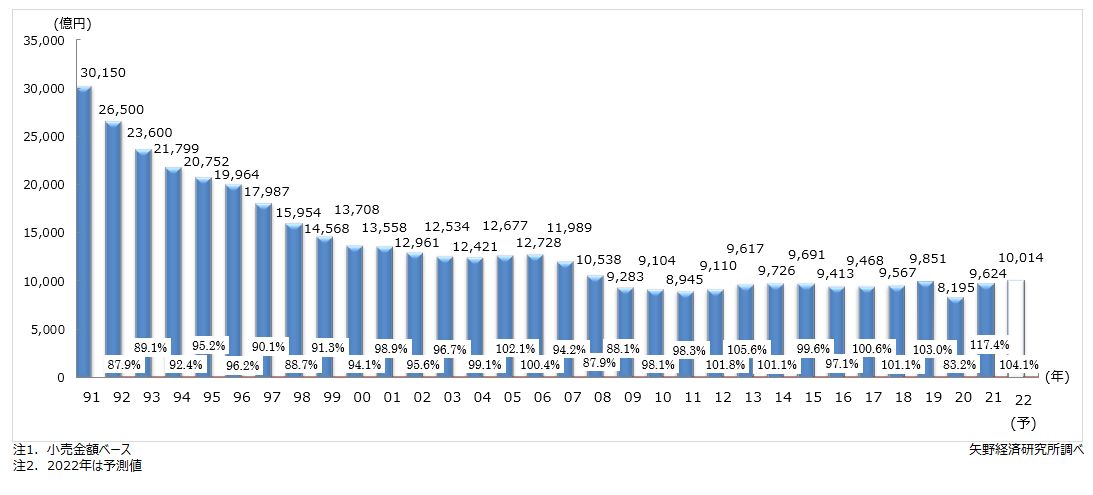
The domestic jewelry retail market size in 2021 was 962.4 billion yen, a 117.4% increase compared to the previous year. While it did not reach the market size of 2019 before the COVID-19 pandemic, it expanded significantly, marking a clear recovery.
There is an aspect of rebound from the nearly 20% decline in the previous year, 2020. This can be attributed to consumers’ fatigue from self-restraint and the redirection of spending, which in normal years would have gone towards travel, events, and dining out, towards jewelry as “revenge consumption.” Furthermore, in 2021, even during the pandemic, there were hardly any closures of commercial facilities throughout the year, and many event venues, which are important sales channels for jewelry, operated as scheduled. Additionally, purchases of high-value items by affluent consumers have been active, with continued popularity for large, high-quality diamonds, rare colored gemstones, and bullion jewelry such as Kippei chains. The prices of these materials have been rising, and they are also being purchased for investment purposes.
Revenge consumption and other trends similar to 2021 are expected to continue in 2022. The domestic jewelry retail market size for 2022 is forecasted to be 1.0014 trillion yen, a 104.1% increase compared to the previous year.
Against the backdrop of the COVID-19 pandemic, the wave of DX (Digital Transformation) is reaching the jewelry industry. Among recent trends, sales using live video are expanding.
This live video commerce is primarily thriving in China, having started with a wide range of products including cosmetics and food, not limited to jewelry. In the jewelry sector, it has gained attention as a method for foreigners residing in Japan to act as shopping proxies and ship items to their home countries, as foreign tourists, particularly from China, have been unable to visit Japan due to the pandemic.
Specifically, foreigners residing in Japan sell products by introducing them via social media to friends in their home countries or overseas, or to their own followers. Due to its cost efficiency, this method is actively used not so much by retailers but rather by manufacturers and wholesalers without physical stores. The influence of foreign influencers residing in Japan with large followings is immense, with a single person sometimes selling several million yen worth of goods in a day, making it a noteworthy new sales method. Furthermore, sales targeting domestic Japanese consumers have also begun, utilizing live broadcasts on platforms like TikTok and Instagram for promotion and sales.
※ Survey Outline
1. Survey Period: January to December 2021
2. Survey Subjects: Jewelry specialty store chains, department stores, watch & jewelry stores, companies from other industries entering the jewelry market (e.g., kimono fabric retailers), imported jewelry brand companies, etc.
3. Survey Method: Interviews via telephone and direct meetings by our specialist researchers, combined with mailed questionnaires.
In this survey, “jewelry” primarily refers to ornaments made from materials such as gold or platinum, using diamonds, precious stones, pearls, etc. It includes jewelry watches, as well as some items made from silver materials or semi-precious stones.