Editor’s Note
This article highlights the strong export performance of South Korean jewelry manufacturers, with notable growth and order backlogs indicating a robust recovery in the global market.
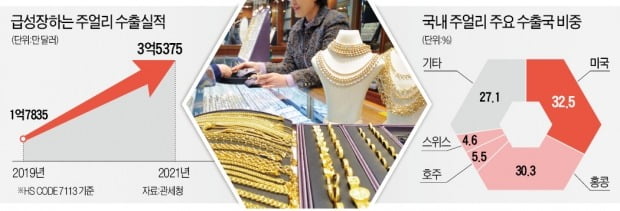
Last year’s export value reached $353.75 million, a 73% increase compared to the previous year, showing strong performance. J.ESTINA is expected to turn a profit for the first time in five years, while Coa Jewelry has a backlog of orders equivalent to three months.
Seoul-based jewelry manufacturer Coa Jewelry saw its sales more than double last year. This is due to increased export performance as the global market, suppressed by the COVID-19 pandemic, recovered rapidly. Even now, with a backlog of three months’ worth of orders, about 20 employees are sweating to meet deadlines, focusing intently on crafting work. The jewelry market, encompassing precious metals and fashion accessories, is gaining vitality thanks to the export recovery trend. The main factor is analyzed to be increased demand from ‘revenge consumption’ in the United States, which had been suppressed during the COVID-19 crisis.

According to the Korea Customs Service on the 26th, last year’s jewelry export value totaled $353.75 million (approximately 423.5 billion won). This represents a sharp increase of 73.5% compared to 2020 ($203.88 million). Jewelry exports had decreased from $242.19 million in 2017 to $168.62 million the following year but have been increasing for the past three years. Last year, as the U.S. jewelry market, a major export destination, entered a recovery phase post-pandemic, it led to record-high export performance. Last year’s jewelry exports to the U.S. amounted to $111.50 million, accounting for 32.5% of total exports. This is an increase of about 110% ($60.22 million) compared to the previous year.
The jewelry manufacturing industry is classified as a labor-intensive SME-type industry where mass production is difficult due to the nature of handling precious metals. Most are small and medium-sized enterprises with 10-20 workers possessing crafting skills. The number of domestic jewelry manufacturers is estimated at about 1,600, of which around 40 companies, including Coa Jewelry, are leading jewelry exports. They mainly export semi-finished products like rings without diamonds to the United States, Hong Kong, Australia, and Switzerland. An industry official explained, “Chinese jewelry products, which lost price competitiveness due to tariffs imposed amid the U.S.-China trade dispute, have been struggling to regain momentum since the pandemic, and domestic products are filling that gap.”
Domestic jewelry exports began in earnest after the 1997 foreign exchange crisis. They enjoyed a heyday in 2001 when exports reached $390 million. However, growth stagnated from 2007 due to labor shortages and rising labor costs. This was because global market share was gradually taken by China and India, which led with price competitiveness. However, as global supply chains were reorganized after the COVID-19 pandemic, domestic jewelry products with unparalleled crafting technology in Asia are attracting attention again.
The domestic jewelry market is also performing well. Securities firms expect J.ESTINA, a domestic jewelry company listed on the KOSDAQ market, to turn a profit last year, ending five consecutive years of operating losses. The company’s cumulative sales through the third quarter of last year were 48.3 billion won, an increase of about 9% compared to the same period in 2020. During the same period, operating profit improved from a loss of 9.4 billion won to a profit of 300 million won.
However, there are concerns that domestic companies may lose their footing as foreign luxury brands rise. Last year’s jewelry import value reached a record high of $942.83 million, approaching 1.1 trillion won. This is a 62% increase compared to the previous year. Products from Italy and France, which hold many luxury brands, accounted for half of all jewelry imports.
