Editor’s Note
This article highlights how sanctions on a major diamond miner are creating supply shortages, driving up prices for certain rough diamonds. Unlike past crunches, industry giant De Beers is unable to fill the gap this time.

Bloomberg — Prices are rising in some corners of the rough diamond market as sanctions against one of the world’s two largest miners ripple through the supply chain.
In the past, the industry could turn to the giant De Beers to produce additional gems when supply was tight, but not this time.
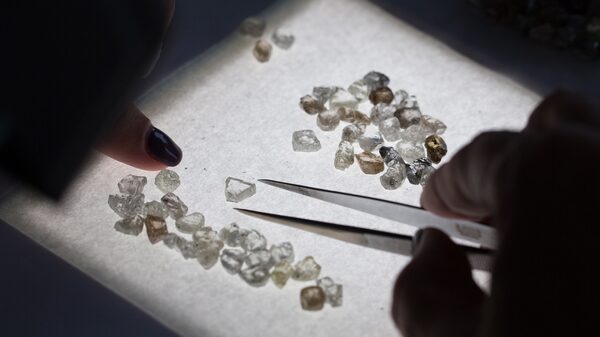
The price of a small rough diamond, the type that would end up clustered around the solitaire stone in a ring, has risen by 20% since early March, according to people familiar with the matter. The reason: diamond cutters, polishers, and traders are struggling to obtain stones after the United States imposed sanctions on De Beers’ Russian rival, Alrosa PJSC (ALRS), which accounts for about one-third of global production.
For most of the modern history of diamonds, this is the type of situation where De Beers could have leveraged its vast reserves or simply activated latent mining capacity. Just over 20 years ago, its vaults in London held diamond stocks worth perhaps up to $5 billion.
Those days are now gone.
The company only has working inventory stocks and its mines are operating at full capacity. There is little chance of material increases in supply before 2024, when an expansion at its flagship South African mine will be completed.
De Beers also produces relatively few of the type of diamonds in which Alrosa specializes: the small, cheap gems that surround a larger center stone or are used in low-end jewelry sold at places like Walmart (WMT) or Costco (COST).
For many in the sector, that means a growing shortage unless Alrosa and its commercial buyers can find a solution.
Alrosa canceled its last sale in April and is unlikely to sell large volumes again this month, the people said. It is unclear when the company will be able to sell normally again, they said, even as the company, banks, and buyers seek solutions.
A U.S. Treasury license that allowed the settlement of transactions with the company expired on May 7.
The consequences of Russia’s invasion of Ukraine have divided global trade. As Western governments impose sanctions on Russia and companies withdraw from the country, many in India’s diamond industry still want to continue buying, according to people familiar with the matter. And while prominent U.S. jewelers Tiffany & Co. and Signet Jewelers Ltd. (SIG) have said they will stop buying newly mined Russian diamonds, retailers in places like China, India, and the Middle East have not done the same.
This dynamic raises concerns that Russian diamonds could be passed off as originating from elsewhere.
Very few diamonds remain in the custody of one party throughout the entire supply chain. Most are cut, polished, manufactured, and then set into jewelry by different companies and are often traded between each step. Diamonds are routinely mixed into parcels of similar sizes and qualities throughout this process, making origin tracking nearly impossible in many cases.
De Beers, which sells to about 60 carefully selected clients, is already looking to improve its standards. It is considering increasing the physical and paper audits it already conducts on its clients to ensure the supply remains segregated.