Editor’s Note
This article explores the latest investment trend among younger generations, who are now turning to raw and colored gemstones as alternative assets. From tanzanite to opal, discover what’s driving this shift and how it reflects broader changes in investment behavior.
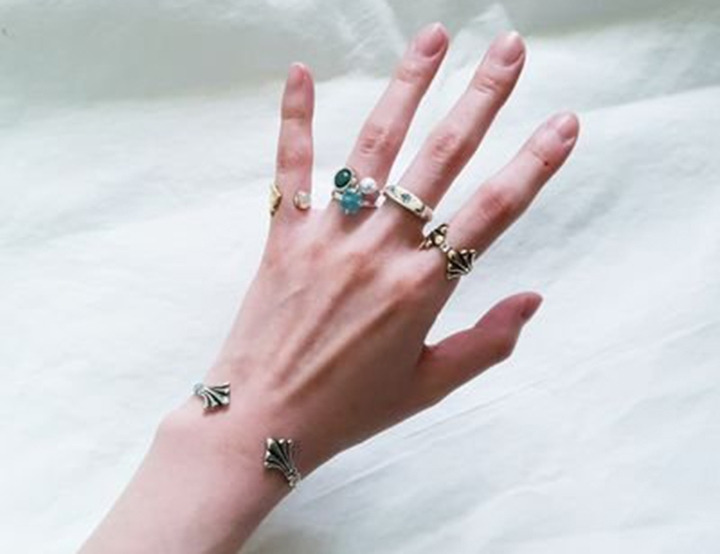
The MZ generation is turning everything into an investment asset.
From sneakers and artworks to liquor bottles, they collect items that seem ‘hip’ and resell them at high prices. Now, their focus has shifted to ‘raw gemstones’. What exactly is this investment trend about?
Recently, the MZ generation has been busy collecting ‘raw gemstones’. They are gathering mid-to-low-priced gemstones like tanzanite, ruby, sapphire, and opal. While the colored gemstone market in South Korea wasn’t particularly large before, it has recently gained vitality based on the purchasing power of the MZ generation.
According to export-import trade statistics from the Korea Customs Service, the import volume of precious and semi-precious stones, which fall under colored gemstones, reached 252.1 tons last year, a 216.3% increase compared to 2020. Last year’s import value was $4.002 million (approximately 5.6 billion KRW), a significant rise from the previous year ($3.577 million).
Their reasons for getting into raw gemstones vary.
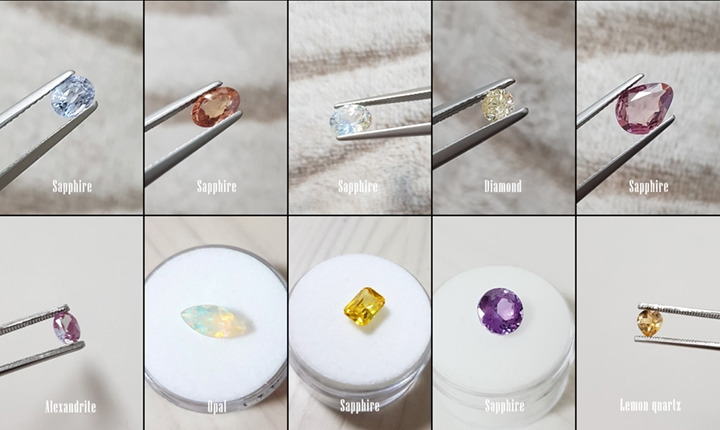
Each person has their own interesting story.
Gemstone prices vary depending on size and trends. Typically, stones smaller than 5mm in length and width trade for around 50,000 KRW. They can be easily bought and sold through online markets. While some are for collection, others are transformed into necklaces or bracelets tailored to one’s personality.
Consequently, the consumption index has also increased. According to the ‘General Jewelry Consumer Sentiment Index’ conducted by Gallup Korea, the purchase volume change index for those in their 20s compared to the previous year was 110%, ranking first among all age groups. The raw gemstone craze among the MZ generation has ultimately led to consumption where diamonds can be purchased at low prices. Recently, someone appeared who bought three diamond rings for 1.3 million KRW.
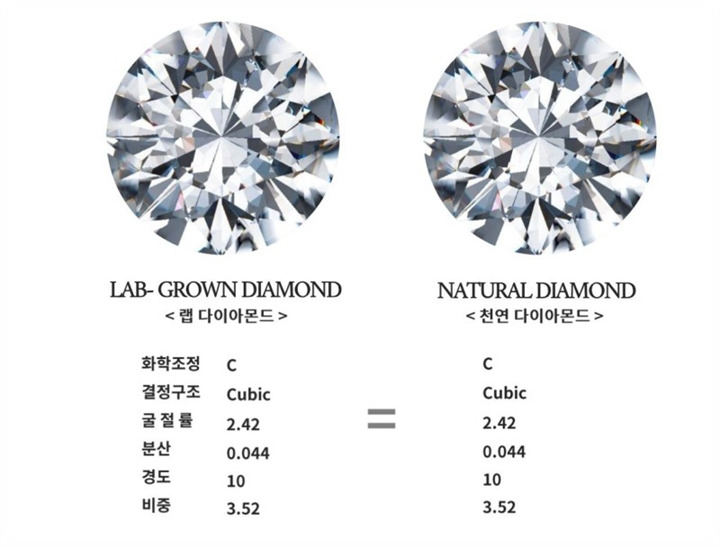
These days, ‘lab-grown’ diamonds, which have the same composition as natural diamonds but are more affordable, are gaining popularity among the MZ generation. They refer to artificial diamonds made in laboratories, not mined from nature. These diamonds can receive grading reports from global gemological institutes like GIA using the same grading standards as natural diamonds.
However, their price is about a quarter of the cost. A 3-carat lab-grown diamond costs 980,000 KRW, while a natural one costs 1.48 million KRW. Furthermore, a 1-carat lab-grown diamond is 3.5 million KRW, compared to 11.7 million KRW for a natural one—a price difference of over 8 million KRW.
Compared to natural diamonds, they are produced in an environmentally friendly manner, reportedly receiving a warmer welcome from the environmentally conscious MZ generation. Mining 1 carat of natural diamond requires an average of 500L of water and excavating 6.5 tons of earth, whereas producing 1 carat of lab-grown diamond uses an average of 18.5L of water with almost no soil pollution or carbon emissions.
Netizens who heard this news left various reactions: