Editor’s Note
This article explores how the rise of lab-grown diamonds is reshaping careers and the global industry, moving from a story of individual adaptation to a broader technological transformation.
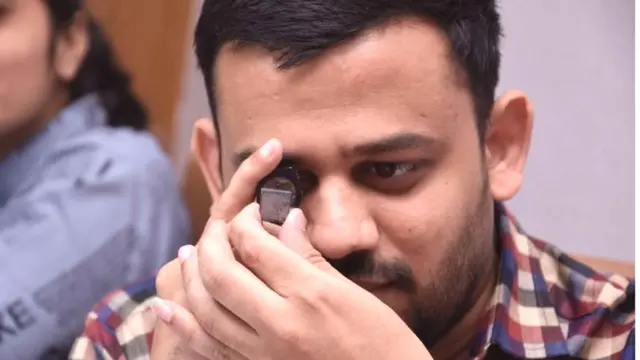
Chintan Suhagiya, at just 26 years old, already has seven years of experience in India’s diamond industry. He started by transporting diamonds for a company in Surat, western India, the global hub for diamond polishing. Over the years, he learned diamond inspection techniques and now grades quality using specialized equipment.
A seismic shift in the diamond industry has altered Suhagiya’s career. Until two years ago, every diamond he inspected was a natural, mined diamond. Now, he works with lab-grown diamonds (LGDs), cultivated in special machines within laboratories. A field that was almost non-existent a decade ago, it has exploded in growth thanks to technological advancements.
Natural diamonds are formed deep underground under immense heat and pressure. Since the 1950s, scientists have worked to replicate this process on the surface, resulting in two main technologies.
The High-Pressure High-Temperature (HPHT) method involves placing pure graphite (a form of carbon) around a diamond seed crystal in a chamber, subjecting it to temperatures around 1,500°C and pressures of about 1.5 million lb/in².
The other method is Chemical Vapor Deposition (CVD), which involves placing a carbon-rich gas and a seed crystal in a sealed chamber and heating it to around 800°C. The gas adheres to the seed, growing diamond atoms.
While these technologies emerged in the late 20th century, it was only about a decade ago that production costs and quality improved enough for the process to be suitable for jewelry making.

Linde states that the production cost of lab-grown diamonds has halved every four years since the early 2000s. Recently, the cost of producing a 1-carat diamond (a popular size for engagement rings) in a lab is about 20% cheaper than its natural counterpart.
As costs fell, businesses took notice. Snehal Dungarni founded Bandari Lab Diamonds in 2013, which produces diamonds using the CVD method.
India has long played a crucial role in the diamond industry, with an estimated 9 out of 10 diamonds worldwide polished in Surat. Now, the Indian government wants India to be at the center of the lab-grown diamond business.
According to India’s Ministry of Commerce, India already produces about 3 million lab-grown diamonds annually, accounting for 15% of global production. China is also a major producer with a similar market share.
In January, the Indian government announced the removal of a 5% tax on imported diamond seeds and pledged funding to produce diamond seeds domestically, aiming to further grow the industry.
Hari Krishna Exports, with 30 years in the traditional diamond industry, is one of India’s top diamond cutting and polishing producers. Its director, Ghanshyambhai Dholakia, launched a lab-grown diamond business this year.

Will this new business erode the market share of the traditional diamond trade?
However, it may take time for the Indian middle-class market to become prominent. Most LGDs made in India are exported to the US.
Shah, who is also chairman of the diamond trading firm Nine Diam founded by his great-grandfather, believes synthetic diamonds will occupy a very different position from the mined diamond market.
Even if this is true, lab-grown diamonds offer greater freedom to jewelry designers.
The world’s largest jewelry company, Denmark’s Pandora, is also turning its attention to lab-grown diamonds. In 2021, its CEO stated the move would expand the diamond market and enhance the business’s sustainability profile.
Back in Surat, Chintan Suhagiya is satisfied with his career shift into the LGD industry and believes the number of people working in this field will increase.