Editor’s Note
This article details Botswana’s landmark renegotiation of its diamond revenue agreement with De Beers, a significant shift in the long-standing partnership that grants the nation greater financial benefit from its natural resources.
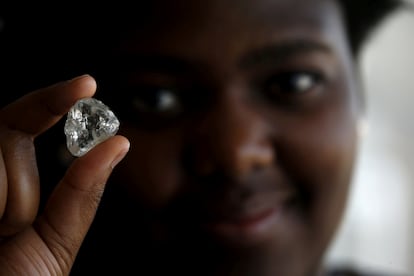
After years of negotiations, the government of Botswana has reached a new agreement with the gemstone giant De Beers, granting the African country a larger share of the revenue from its diamond trade. A visitor holds a diamond during a tour of the De Beers gem company headquarters in Gaborone, Botswana.
Siphiwe Sibeko (Reuters)
Joost Bastmeijer
Dakar (Senegal)
The government of Botswana’s push to secure a larger share of the revenue from diamonds mined in its land and marketed by the giant De Beers has borne fruit. After years of negotiations, the African country signed a renewed mining agreement with the South African company, one of the world’s largest diamond firms, this summer, which will allow it to export a larger proportion of these precious stones. According to official data, the business provided Botswana with revenues of $2.8 billion (€2.625 billion) last year alone, a figure expected to increase with the new commercial pact. However, this lucrative business, which has enabled the country to move away from being one of the poorest in the world, has not resolved the severe inequality problem that continues to affect this southern African state.
Negotiations over diamond trade and extraction have been tense, as there was much at stake for both parties. Since the discovery of diamonds in Botswana’s mines in the 1960s, shortly after independence from the United Kingdom (1966), this African country has worked closely with De Beers to extract rough gems through the joint venture Debswana, a collaboration that has proven highly beneficial for both sides. On one hand, the South African mining giant depends on its neighbor’s rough diamonds for 70% of its trade. On the other, Botswana’s economy thrives on the sale of these precious stones: diamonds account for 90% of its exports, according to International Monetary Fund data.
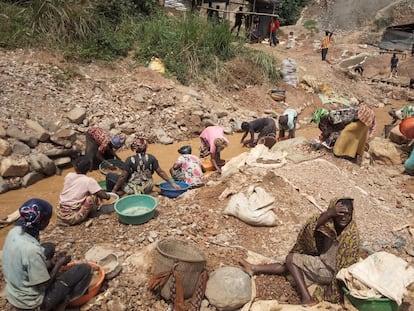
Under the previous contract, the government of Botswana could only sell a small portion of the extracted stones for years; the rest was managed by De Beers. That percentage was still 10% in 2010, but according to the new agreement, it will progressively increase to 50% over the next decade. The mining company will also invest $75 million (about €70 million) in diversifying Botswana’s economy to make it less dependent on diamond sales. This last point was essential for Masisi’s government, as Botswana, the world’s top diamond producer by value, generates 70% of its revenue from gems, meaning the country’s economy is highly exposed to fluctuations in the global price of this precious stone.
Beyond the firm stance of Masisi’s government, experts argue that the terms of the pact are also a result of the ripple effect of the war in Ukraine. As a consequence of sanctions against Russia, Western buyers are avoiding diamonds from this country, which is the world’s largest exporter of natural diamonds. That is, the ban that previously affected so-called “blood diamonds” from conflict zones now also affects Russian diamonds, notes Benno Leeser, a diamond trader at the Dutch company Gassan, which has forced a search for other suppliers.
This Western boycott of Russian gems has made Botswana “the most important source of diamonds in the world,” says precious stone expert Paul Zimnisky.
Increased demand for non-Russian diamonds, combined with high gem prices, has benefited both De Beers and the government of Botswana. In 2022, the joint venture Debswana’s revenue was €4.2 billion, compared to €3.2 billion the previous year. Thanks to these revenues, Botswana recorded a budget surplus of 0.6%, the first since 2016.
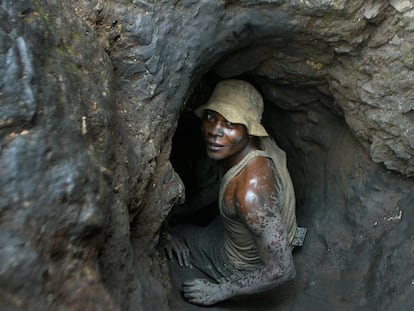
However, although the diamond business has allowed Botswana, according to the World Bank, to become an upper-middle-income country—in the 1960s, after independence, it had almost no paved roads and only three secondary schools—the wealth has not reached the entire population. The same institution ranks it among the most unequal countries on the planet—only eight other countries are more unequal. A 2021 report by the United Nations Development Programme (UNDP) notes that the difference between various living standards is “very pronounced,” and that “urban areas consume 76% more than rural areas.” In other words, people living in the capital, Gaborone, and its surroundings have much more money to spend.