Editor’s Note
The Korea Testing Certification Institute (KTC) has expanded its global footprint with a new branch in Dubai. This strategic move, coupled with key local partnerships, is designed to bolster support for South Korean exporters entering the Middle Eastern market.
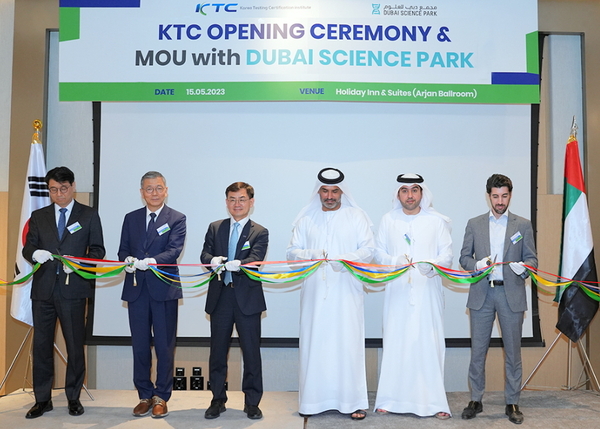
The Korea Testing Certification Institute (KTC) announced the establishment of a branch in Dubai, UAE, and the signing of business agreements with local certification bodies to expand support for domestic companies exporting to the Middle East.
The opening ceremony, held on the 15th (local time) in the Dubai Science Park free zone, was attended by key stakeholders from both countries, including Marwan, Director of UAE Dubai Science Park, Hamad, Executive Director, Ryu Je-seung, Ambassador to the UAE, Moon Byung-joon, Consul General in Dubai, and KTC President Ahn Seong-il. At the ceremony, KTC also signed a business agreement with the ‘DSP Free Zone’ to support corporate exports, marking the first such agreement by a domestic certification body.
Unlike free zones like Jebel Ali for logistics and trade or DMCC for trading commodities like gold and diamonds, the DSP Free Zone is an economic zone focused on the UAE’s own industrial diversification and the development of the technology industry.
Furthermore, on the 16th, KTC signed additional business agreements with two major local certification bodies, ‘RACS’ and ‘GulfTIC’, to strengthen export support for domestic companies. These two bodies are the most influential certification agencies, handling most certifications within the UAE, such as ‘ECAS’ and ‘EQM’.
* RACS: Regulatory Authority for Communications and Service
* GulfTIC: Gulf Technical Inspection and Certification
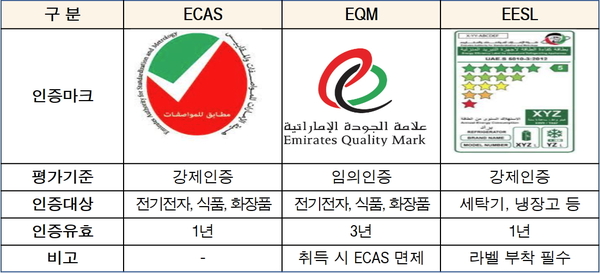
* ECAS (Emirates Conformity Assessment Scheme): Mandatory certification system for cosmetics, electrical/electronics, food, etc.
* EQM (Emirates Quality Mark): Voluntary certification system for food, cosmetics, electrical/electronics; obtaining it can exempt products from ECAS.
KTC, designated as Korea’s first GCC (Gulf Cooperation Council) integrated certification body in 2016, is already a leading Middle East certification agency well-known to domestic exporters. Through these new agreements, KTC can now provide domestic companies with various certification services within the UAE, not only for electrical products but also for machinery, construction, cosmetics, and halal.
* GCC Certification: Mandatory certification required for exports to the seven GSO countries (Saudi Arabia, UAE, Bahrain, Kuwait, Qatar, Oman, Yemen).
In addition to the existing GCC integrated certification and Saudi SASO certification, KTC can now also handle ECAS and EQM certifications, enabling it to provide a one-stop ‘Middle East Integrated Certification Solution’ to domestic companies through a single application.
As of 2022, South Korea’s exports to the Middle East (GCC) reached $10.26 billion, an 18.7% increase compared to 2021. South Korea’s exports to the UAE in 2021 amounted to $3.97 billion, showing an 8.7% growth rate compared to the same period the previous year.
Following the Middle East construction boom of the 1970s, recent industrial diversification efforts by Middle Eastern countries are underway. Notably, the UAE has announced a vision to move away from oil and gas-centric industries, establishing a 10-year industrial development strategy called ‘Operation 300bn’.
Within this strategy, plans have been announced to introduce and expand the adoption of solar energy and electric vehicle chargers for energy transition, indicating that the market for domestic companies is expected to continue growing.
The major difficulties cited by domestic companies exporting to the Middle East have been: ▲ Lack of information on technical regulations and certification ▲ Time required to obtain certification ▲ Resolving issues arising locally after certification.
Recently, as GCC countries rapidly announce new technical regulations, coupled with regional industrial diversification policies and domestic industry protection, they are acting as trade barriers for South Korean exporters. Even in the UAE alone, the introduction of mandatory regulations like ECAS and EQM since 2018 has increased difficulties for companies.
KTC plans to utilize its Dubai branch as a base to support all issues arising in GCC countries to expand exports for domestic companies. By taking charge of the most challenging aspect in the Middle East—local communication—KTC aims to reduce companies’ costs and time by more than 30% compared to before.