Editor’s Note
This article offers a glimpse into the global diamond trade, centered in Antwerp, where a glittering retail front conceals a high-security industry handling the majority of the world’s rough gems.
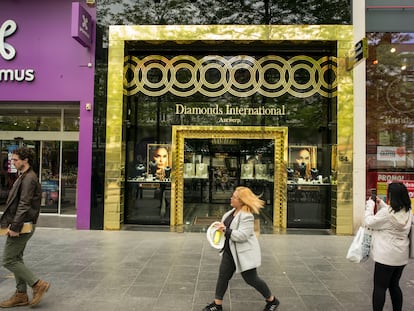
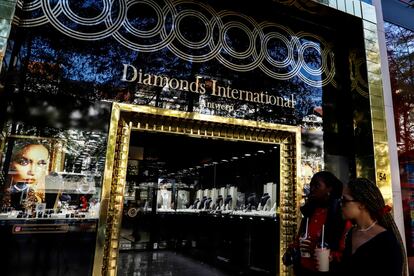
Anyone who has walked through the diamond district in Antwerp, Belgium, has witnessed a sequence of jewelry stores where gems rotate, some on steel stands like candies in a pastry shop, alongside a group of anodized glass and concrete buildings. While the stores multiply the brilliance of purchases, the bunker-like offices hide the fact that the city trades 86% of the world’s rough diamonds. The flow has been constant, from the frozen tundras of Siberia, Russia, to the African heat of Angola. These gems emit the golden iridescence of $40 billion (€37 billion). That is—according to Antwerp’s own traders—the global turnover of the industry. Since the 15th century, they have been selling and acquiring diamonds.
An activity that occupies about 1,700 companies and 4,500 traders in the city district, according to data from the trade association Antwerp World Diamond Centre (AWDC).
However, for the first time in five centuries, that brilliance may fade due to war. In 2021, Russia exported $4.7 billion in diamonds (following data from the Observatory of Economic Complexity, OEC). It ranks eighth in the world. “80% comes from 24 mines in Siberia,” details Mira Milosevich, Senior Researcher for Russia at the Elcano Royal Institute. The country’s major diamond company, Alrosa, is controlled by the state and the Siberian republic of Yakutia. Together they own 66% of the company. In 2021, it generated $3.004 billion in revenue, according to estimates from the specialized platform Idex Online. Its CEO, Sergei Sergeevich Ivanov, was sanctioned by the United States on the first day of the invasion of Ukraine. Unabashedly, the firm has paid for the B-871 combat submarine, named Alrosa, and armed with Kalibr cruise missiles.
If the G-7 imposes a ban on exporting cut, rough, or polished diamonds, the consequences could be enormous or minimal. They are not only used in jewelry but also in drilling, computers, and dentistry. Opinions vary because geopolitics, the uncertain behavior of customers, and luxury firms come into play. The diamond lobby is known to be tough.
Last year, the European Union imported—according to Eurostat—€1.4 billion in Russian diamonds, a drop from €1.8 billion in 2021.
Far away in Tel Aviv, Israel, one of the most reputable analysts in this opaque world, Edahn Golan, echoes part of this narrative. “Sanctions, especially if focused on rough diamonds, will only affect Belgium. The impact on the market will be minimal. One fact: the United States accounts for more than half of the consumption of polished diamonds from Russian rough gems.”
Due to its geopolitical importance, 90% of the world’s diamonds are cut and polished in India, in cities like Surat. Siberian stones, which are usually small, below one carat, and require low-wage workers to be profitable, arrive there. India—which has remained on the sidelines regarding the Ukraine war—is the ideal territory. The sector turns the Belgian arguments around. The country employs one million workers.
It doesn’t matter. “With its meeting in Hiroshima, Japan [held in mid-May], the G-7 sent a message to the world’s main producer. These diamonds are not accepted,” highlights Mira Milosevich.
The strategy is to safeguard its own interests and find new routes. “Because most major luxury brands [the watchmaker Breitling will use synthetic diamonds in 2024] avoid these new blood diamonds, Russia has created trade routes that bypass Antwerp,” reveals Hans Merket, a Belgian researcher at the International Peace Information Service. He adds: “The main goal is to ensure that a ban is designed that prevents competitors, think of Bombay or Dubai, from taking advantage of the situation at the city’s expense.” Although it only affects one EU country, Belgium seeks its exception. The Czech Republic, Slovakia, and Hungary are excluded from the oil embargo and Italy from steel.
There has never been a war à la carte, but there have been its sanctions. And “tricks.” Mixing small Russian diamonds with those carrying a Kimberley Process certificate (which prevents stones that fund armed conflicts from reaching the market), strongly promoted by Russia in 2002. In slang, they are called ‘mixed’. Russia did not export any to Belgium between April and September 2022. However, in January 2023, the Financial Times estimates…