Editor’s Note
This article highlights the extraordinary luxury items on display at South Korea’s premier jewelry event, showcasing the intersection of high-value craftsmanship and artistic innovation.
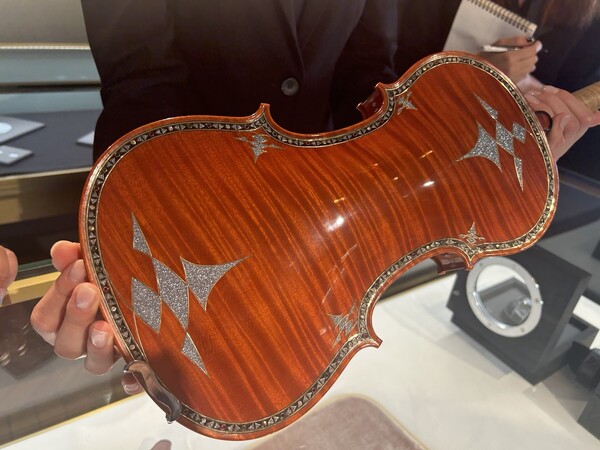
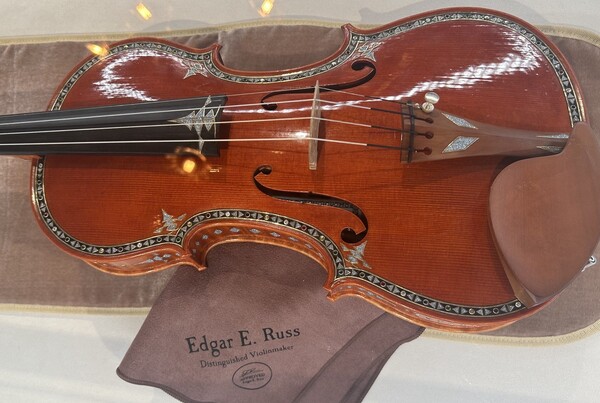
A watch worth 4 billion won and a violin valued at 6 billion won, crafted by an instrument artisan, appeared at the exhibition hall of the ‘2023 Seoul International Jewelry & Accessory Show’. ‘THE MOST Valuables 2023’ is South Korea’s only large-scale jewelry event. Held for the second time this year following last year, it took place from October 5th to 7th at COEX in Samseong-dong, Seoul. This year, a total of about 120 domestic and international jewelry companies participated.
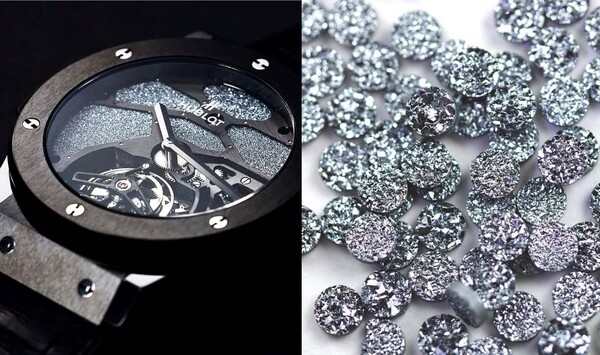
The appearance of ultra-luxury watches and a violin at a jewelry show was somewhat unexpected. The watch is a product from the Swiss high-end watchmaker Hublot. This limited-edition Hublot watch, of which only a few pieces were made, was equipped with a dial plate that sparkled brilliantly under the light. It is common for luxury watches to be decorated with diamonds or colored gemstones. Therefore, one might think the sparkling dial plate of the Hublot watch on display was densely inlaid with diamonds.
However, upon closer inspection, the dial plate had no gemstones embedded piece by piece, nor any metal framework supporting gemstones. The dial plate itself shone. It was not a gemstone but osmium. What is osmium, known as the rarest precious metal in the world, with a sun-like, radiant, and unfamiliar appearance?
Osmium (Os) is the 76th element on the periodic table, belonging to the platinum group along with platinum (Pt), palladium (Pd), rhodium (Rh), ruthenium (Ru), and iridium (Ir). Like other precious metals, it does not tarnish or rust. Osmium is particularly distinguished from other precious metals chemically and visually, possessing a unique bluish-silver luster. It has the highest density among elements known to humanity. With superior wear resistance compared to any other element, it is one of the most stable natural elements on Earth.
Osmium is primarily extracted as a byproduct of metal production processes like platinum. However, the quantity is extremely small. It is said that only 30g of pure osmium can be extracted from 10,000 tons of platinum ore. Osmium separated from platinum resembles a light gray powder. This unprocessed ‘raw material’ is called osmium sponge and is known to be a highly toxic substance. This is because, upon contact with air, it combines with oxygen to form the volatile compound osmium tetroxide.
However, osmium that has undergone a crystallization process becomes non-reactive and achieves a much nobler state than other rare elements. This process is similar to carbon turning into diamond. Crystallized osmium is chemically stable and non-toxic. It has been proven safe for prolonged direct contact with the skin.
Osmium was discovered around 1804 by British chemist William Tennant and listed as the 76th element on the periodic table. In 1906, the German company Osram began using osmium industrially for manufacturing light bulb filaments. The company name Osram is derived from combining ‘Os’ from Osmium and ‘Ram’ from Wolfram (the German word for tungsten). Both elements, osmium and tungsten, were used in the filaments of lighting fixtures at the time of Osram’s founding.
However, due to its scarcity and extraction costs, osmium was not widely used. After prolonged research, crystallized osmium is now primarily utilized as a tangible investment asset or in producing high-end luxury goods.
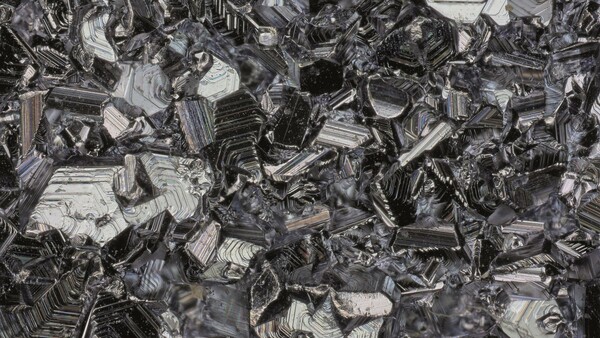
When osmium undergoes a physical-chemical process of rearranging its atomic structure, it forms a hard, sparkling osmium crystal structure with a purity of 99.999% to 99.999995%. This is called Crystalline Osmium. The appearance of Crystalline Osmium is very unique because it is the only precious metal with a bluish-silver hue.
A major characteristic of osmium after going through the crystal crystallization stage is that it displays a dazzling sparkle, as if millions of tiny mirrors are reflecting light. Crystalline Osmium shines brighter than diamond under direct sunlight like the sun. In fact, when osmium was illuminated under sunlight, it was so blindingly bright that one instinctively averted their gaze.
In 2013, with the successful development of a crystallization process by a Swiss institute enabling consistent high-purity quality levels, famous luxury brands like Hublot and Ulysse Nardin launched high-end watches using osmium. Beyond watches and jewelry, its use has expanded to items like violins.
On average, 160 steps are required for osmium in its raw form to become its final crystallized form. A single osmium atom must pass through these steps over 100 times to finally become a product suitable for certification. Currently, the Osmium Institute, headquartered in Bavaria, Germany, is the sole producer of Crystalline Osmium with such high purity and consistent form.
The Osmium Institute established its first Asian branch, Osmium Institute Korea, in South Korea last July and is introducing osmium as a material for jewelry and watches to domestic companies and consumers. The ‘2023 Seoul International Jewelry & Accessory Show’ was the first occasion to unveil osmium to the general public.
Based on its scarcity and impossibility of counterfeiting, osmium is gaining attention in the latest tangible asset investment markets in Europe, including Germany. Unlike the highly volatile stock market over the past five years, osmium has shown independent, steady price growth. Its current price in 2023 has more than doubled compared to 2017. This is a significantly higher figure than gold’s price growth rate.
Osmium is mainly distributed in flat, round disc forms. There are sparkle levels from 1 to 5; the higher the number, the larger the crystal size.
In particular, osmium’s high value density is an attractive factor for investors. It is very easy to transport and store. An osmium piece the size of a 500-won coin (diameter: 26.50mm, thickness: 2mm) can have a net asset value of up to 24,000 euros (approximately 34.32 million KRW).
Scarlet Klaus, Executive Vice President of the Osmium Institute, whom we met at the jewelry show exhibition hall, said the above.
As his confident words suggest, osmium’s superior brilliance was a beauty never seen before. Another fascination has penetrated the domestic jewelry market.