Editor’s Note
This article highlights the remarkable resilience of Ehwa Diamond, a Korean technology leader that has not only weathered major global economic crises but achieved record growth during them. Its story offers a compelling case study in corporate endurance and strategic foresight.
True champions shine even brighter in times of crisis. Ehwa Diamond, Korea’s leading diamond tool company, which weathered the IMF foreign exchange crisis and the Lehman Brothers collapse with ease, is showing extraordinary momentum. Equipped with DNA resilient to crises, the company has achieved sustained growth even as the global economy staggers. We met with CEO Kim Jae-hee, who has led the company to record its best performance for two consecutive years since its founding in 1975.
The past few years, with the COVID-19 pandemic, the Russia-Ukraine war, and economic crises piling up one after another, have been a time of hardship for businesspeople. Perhaps that’s why the message of ‘turning adversity into advantage’ was particularly prominent in New Year’s addresses this year. Leaders including SK Group Chairman Chey Tae-won, Hyundai Motor Group Chairman Chung Eui-sun, and Lotte Group Chairman Shin Dong-bin urged their members to ‘not fear the crisis but turn it into an opportunity to enhance corporate value.’
Can companies truly solve these complex, intertwined problems? Furthermore, what opportunities must they create? If they fail to create opportunities, will they perish? Even in crises where fear and uncertainty coexist, someone always finds an answer. Ehwa Diamond, a specialized diamond tool company that has dug deep into the single well of diamond tools for decades since its founding in 1975, is that protagonist.
Ehwa Diamond marks its 48th anniversary this year. Throughout its long history, it has steadfastly endured numerous domestic and international economic crises. There were difficulties, but it did not collapse. Instead, it surprised the world by growing with even greater strides with each crisis, embodying the principle of ‘turning adversity into advantage.’
Here are a few examples demonstrating Ehwa Diamond’s crisis response capabilities. First, let’s go back to 1998 when the IMF foreign exchange crisis shook the entire nation. As funding dried up, most industries contracted, and the demand for diamond tools plummeted as a result. The domestic market shrank by over 50%, and export prices fell by more than 20%. Despite this, Ehwa Diamond grew compared to 1997, achieving sales of 94 billion won. During the 2008 Lehman Brothers crisis, Ehwa Diamond remained unfazed. Although company sales dipped temporarily, they recovered the following year without significant damage like restructuring.
Ehwa Diamond’s ability to overcome various adverse conditions was the result of the foresight and bold decisions of its founder, Chairman Kim Soo-kwang. When signs of company difficulties appeared around the time of the IMF crisis, he actively encouraged employees to start their own businesses. He helped them become independent by providing various benefits, such as leasing equipment and designating them as cooperative partners. He also increased the proportion of exports to prepare for risks associated with the domestic market downturn. This reduced labor cost burdens and allowed the company to navigate the foreign exchange storm caused by the sharp depreciation of the Korean won. The experience of overcoming this crisis also became a great strength during the Lehman Brothers crisis.
Ehwa Diamond’s crisis response capabilities shone again during the COVID-19 pandemic, which intensified from 2020. While formidable global competitors sighed due to ‘shutdowns,’ Ehwa achieved record-high sales for two consecutive years. In 2021, it recorded sales of 336 billion won and operating profit of 26.7 billion won, marking its best performance since founding. The following year, 2022, it immediately broke that record with sales of 348.6 billion won. This achievement is particularly meaningful as it came from a traditional manufacturing sector, not from so-called ‘COVID-beneficiary’ industries like platforms or services.
CEO Kim Jae-hee, who succeeded his father, founder Chairman Kim Soo-kwang, in 2010, explained this. CEO Kim emphasized, “Ehwa Diamond has dug deep into the single well of diamond tools, but it is a comprehensive tool maker reaching out to numerous industrial fields.” Ehwa Diamond is building a diverse portfolio worthy of the name ‘comprehensive tool maker,’ focusing on three sectors: electronics, precision machining, and construction stone. This contrasts with most diamond tool companies that concentrate on products for specific fields. Regarding this, CEO Kim explained, “Our business diversification strategy plays a central role in dispersing and managing risks for our company in the medium to long term. If performance in a specific industry is poor, other industries fill the gap.” Thanks to this, Ehwa Diamond has maintained a stable performance, largely unaffected by economic trends, continuing its profitable march for 48 years.
Of course, portfolio diversification does not only have advantages. Given the nature of tools, most are produced custom-made to meet customer requirements. Adding diverse industrial fields to this inevitably leads to the problem of ‘multi-variety, small-quantity production,’ which reduces production efficiency. In fact, it is said that less than 60% of Ehwa Diamond’s 30,000 product lineups are produced exactly the same the following year. The rest are reproduced after undergoing various changes, big and small. CEO Kim explained, “To increase production process efficiency, we are gradually computerizing and automating processes that are still semi-automated or manual, step by step.”
Chairman Kim Soo-kwang’s obsession with technological prowess was remarkable. He early on demonstrated in action the phrase he emphasized like a mantra: ‘The foundation of manufacturing is technology.’ In 1988, he established an in-house research institute, a first in the industry and rare for an SME at the time. He invested over 3% of annual sales (approximately 9 billion won) in R&D without stinting on support. About 30 researchers lived up to Chairman Kim’s expectations, gaining recognition for their technological prowess by winning awards like the Jang Young-sil Award in the diamond wire saw sector and gold and excellence awards at precision technology competitions. Thanks to them, Ehwa Diamond was able to solidify its foundation.
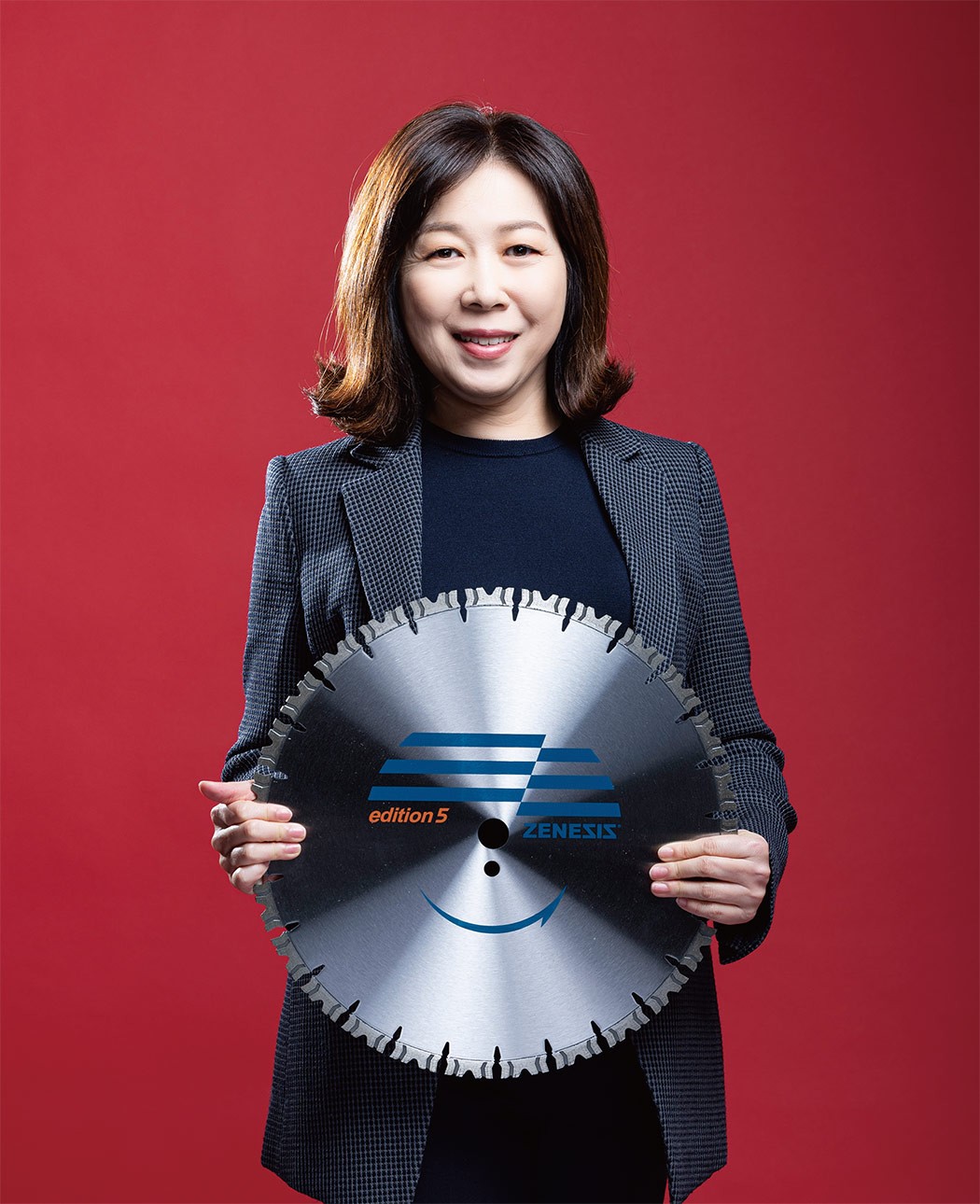
Given the substantial investment in technology development, the results are also significant. To date, the company holds 130 domestic patents and 145 international patents. CEO Kim introduced a few representative patented technologies. First is the technology for uniformly arranging diamond powder. The blade part of a diamond tool contains a mixture of diamond powder and metal powder, with the diamond powder responsible for cutting or grinding the metal. Therefore, performance improves when diamond powder is arranged at regular intervals on the blade’s edge. Until now, powder was mixed by shaking it in a container, resulting in uneven arrangement. However, Ehwa Diamond developed a technology to uniformly arrange diamond powder in patterns. Based on this technology, they created a product called ‘ZENESIS,’ which improved both the performance and lifespan of existing diamond tools, causing a sensation in the market. It is now applied in stone cutting, concrete column removal, etc., establishing itself as a representative item in the construction field.
Recently, Ehwa Diamond’s technology also created an innovative item in the semiconductor field. In the semiconductor back-end process, the technology for stacking multiple layers of chips on a wafer is important. To create such chips, the wafer must be ground as thin as possible. The thinner the wafer, the thinner and lighter the finished products like mobile phones become. This is called ‘back-grinding,’ and Ehwa Diamond successfully developed the equipment used for this, the ‘back-grinding wheel.’
The process of researching and developing technology also serves as a stepping stone connecting existing business with new business. CEO Kim explained, “For example, glass processing technology can be applied to various industries like construction glass, automotive glass, and display glass. Technology or processes developed in one field are sometimes applied and developed in other fields, or the same technology is slightly modified to create new product groups.”