Editor’s Note
This article provides a concise overview of the diamond coating market, defining the technology and outlining the key segmentation—by technology, substrate, and region—used in industry analysis. It highlights the material’s exceptional properties and its growing industrial applications.
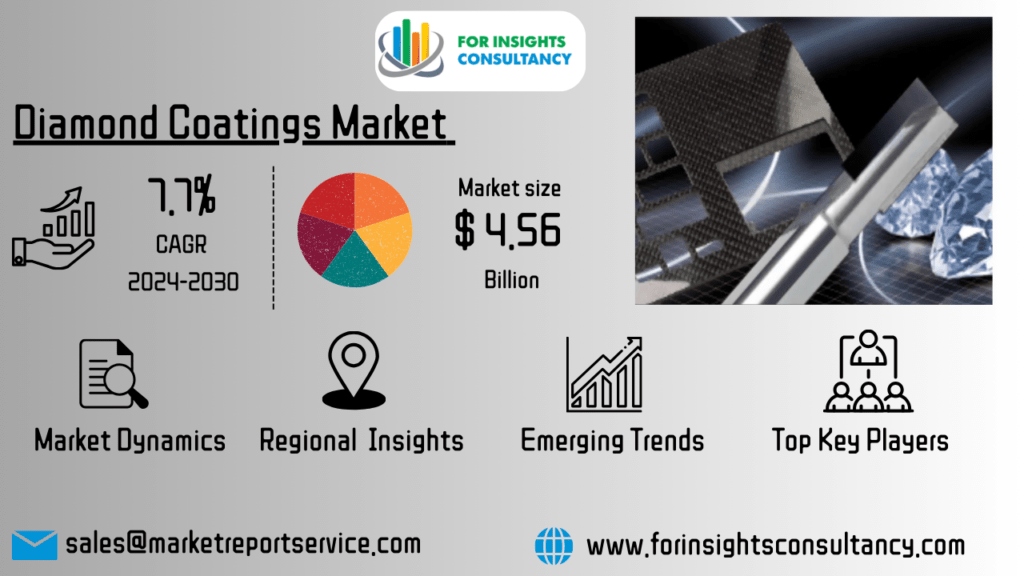
Market research report data is segmented by technology (CVD, PVD), substrate (metal, ceramic, composite), and region, with global trends and forecasts from 2024 to 2030.
In short, diamond coating refers to the application of diamond as an extremely thin film onto different materials to enhance their properties. Characteristics such as hardness, wear resistance, and thermal conductivity make these coatings highly attractive for numerous applications, including industries like automotive, electronics, and aerospace. The demand for such products is driving the growth of the diamond coating market.
Following the major trends mentioned above, the diamond coating market is on the brink of another transformation as demand from the electronics industry undergoes dramatic changes. The industry is gaining a competitive edge by manufacturing smaller, more powerful products, necessitating the use of materials that can withstand harsh operating conditions. Consequently, diamond coatings, with their wear and corrosion resistance, have become the material of choice for protecting electronic components.
Similarly, the demand for environmentally friendly materials has introduced a new growth trend for the diamond coating market. Governments and consumers are jointly pushing for sustainability, driving demand for eco-friendly coatings to unprecedented levels. Diamond coatings, with their excellent durability and non-toxicity to living organisms, align well with this trend.
Influenced by factors such as increased R&D activities, technological innovation, and the expanding application areas for diamond coatings, the market is expected to maintain robust growth in the coming years. Therefore, as the application scope of diamond coatings expands from traditional industries to healthcare and renewable energy, their impact will be transformative.
The global diamond coating market is segmented by technology into two major segments: Chemical Vapor Deposition (CVD) and Physical Vapor Deposition (PVD). CVD diamond coating is the largest market segment because it deposits diamond from a carbon vapor phase, suitable for large-area and curved-surface coatings. This process can produce free-standing components that can be cut and finished to the desired size and shape. It typically requires maintaining a plasma containing atomic hydrogen on the growth surface and involves methane (CH4). CVD technology can address challenges related to high-pressure operations.
The diamond coating market is segmented by substrate into three major categories: metal, ceramic, and composite, where the chemical properties of composites significantly influence the process. Diamond nucleation and growth can be inhibited by interactions involving amino groups, molecular hydrogen, and carbon species, especially on ceramic substrates. This has led to a surge in the market for ceramic and metal substrates, with demand growth in developing countries like Southeast Asia, China, and India being a primary driver.
The Asia-Pacific diamond coating market is expanding rapidly due to low labor costs and reasonable raw material prices, attracting substantial international investment and driving market expansion.
Due to rising income levels, expanding end-use applications, and growing domestic demand, the Asian diamond coating market is expanding swiftly. Foreign investment and low labor costs are key factors propelling market growth. However, North America and Europe remain ideal markets for high-quality, well-known brand products. The Asia-Pacific market faces intense price competition, while local Asian manufacturers are producing diamond coating oils and equipment at lower costs.
The North American diamond coating market is experiencing significant growth. The primary reason is the increasing demand for diamond coatings across various end-user industries. Specifically, the automotive, electronics, and aerospace sectors are the main drivers of this trend. The growth in demand for diamond coatings is primarily due to their excellent hardness, wear resistance, and thermal conductivity.
China: With its strong production capacity and numerous industry giants, China is the largest contributor to the Asia-Pacific diamond coating market. The electronics and automotive industries are the largest consumers of diamond coatings and the primary drivers of market growth in the region.
Japan: Japan is another major diamond coating market in the Asia-Pacific region, renowned for its technological innovation and high-quality products. Furthermore, Japan’s thriving aerospace and medical industries have been major drivers of diamond coating demand, offering significant growth opportunities for the market.
India: India is becoming an attractive market for diamond coatings, primarily due to its rapid industrialization and the coating industry’s increasing focus on advanced technologies. The rapid development of India’s automotive and healthcare sectors is a key driver for the demand for high-performance coatings, thus showing immense growth potential.
South Korea: With its substantial investments in innovation and technological breakthroughs, South Korea is a significant contributor to the Asia-Pacific diamond coating market. South Korea’s thriving electronics and semiconductor industry is the primary consumer market for diamond coatings, leading market growth trends.
Australia: In recent years, Australia’s diamond coating industry has shown positive development, largely due to growth in the country’s mining and resources sector. As sustainability and eco-friendly coatings gain popularity in Australia, diamond coatings are likely to see broader application across various fields.
Growth Drivers: The service life of cutting tools and equipment has been significantly extended. Diamond is known for its high strength, hardness, low friction coefficient, and good chemical stability. Its application in cutting tools is increasing due to the emergence of advanced surface engineering technologies like Chemical Vapor Deposition (CVD) and Physical Vapor Deposition (PVD). Diamond coatings offer potential for various machining types, especially for tools with complex geometries like drill bits. They also extend the service life of tools and equipment, making them more popular for manufacturing high-strength, lightweight components, thereby attracting attention from end consumers.
Constraints: The diamond coating process requires substantial capital investment due to the high cost of manufacturing equipment and the dominance of large multinational corporations. End-user industries also face high tool and equipment costs, primarily because diamond coating equipment itself is expensive. Different applications require different coating processes, and coating thickness determines the substance being coated. The high cost of diamond coating equipment makes it difficult for end-users to retrofit their own machines to enable coating tools with diamond powder.
Key players include Blue Wave Semiconductors, De Beers Corp, Endura Coatings, Neocoat SA, OC Oerlikon Corp. AG, Robb-Jack Corp., Sandvik AB, Smiths Group PLC, and SP3 Inc.
Surface Technology Inc. (STI): The creator of Composite Diamond Coating® (CDC), STI has emphasized the environmental benefits of its technology in 2024 and 2025. The company’s CDC process is chromium-free and requires less nickel, making it a more sustainable alternative to traditional chrome plating.
In summary, the diamond coating market is rapidly restructuring and expanding due to technological breakthroughs and shifting consumer trends. The growing demand across industries for high-performance materials capable of meeting the most demanding conditions in today’s applications is being met by diamond coatings as a versatile material, redefining standards for durability and efficiency. The future heralds a new era for advanced materials, with more exciting developments expected for the diamond coating market!
The global diamond coating market is projected to grow from 2024 to 2030 at a compound annual growth rate (CAGR) of 7.7%, reaching a size of over USD 456 million by 2030.