Editor’s Note
This article examines the recent downturn in diamond prices, which have fallen significantly from their 2022 peaks. It explores the factors behind this decline and why the traditional perception of diamonds as a stable investment is currently being challenged.
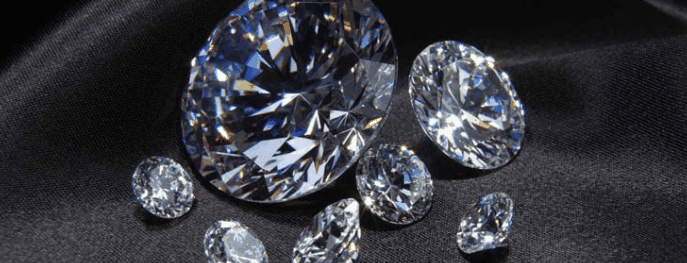
“Diamonds are a girl’s best friend,” as the old song goes. But currently, they are not favorites among investors, as the precious gems have lost significant value in recent months.
Diamond prices have fallen 18% from their all-time highs in February 2022 and are 6.5% lower year-to-date, according to a global rough diamond price index. And their value is poised to plunge even further, market watchers predict.
Diamonds, along with other jewelry, recorded high prices during the Covid-19 pandemic, culminating in a peak early last year.
When people couldn’t travel or eat out, all that excess money went towards luxury items and jewelry, said Ankur Daga, CEO of Angara Jewelry.
And when the economy began to reopen, diamond prices began to moderate and slid into a “deep slump,” he added.
Ongoing competition from lab-grown diamonds, a slower-than-expected Chinese economic recovery, and an uncertain macroeconomic backdrop are also drivers of a mediocre market, according to industry experts.
An increasing number of consumers are turning to lab-grown diamonds, said Edahn.
Lab-grown diamonds are manufactured in a controlled environment using extreme pressure and heat that recreates how natural diamonds are forged hundreds of kilometers deep in the Earth’s mantle.
They are chemically, physically, and optically identical to natural diamonds and are considered a “perfect substitute,” said Daga. But most importantly for most: they are much cheaper.
He added that his fiancée had specified a smaller diamond and did not want him to spend an exorbitant amount on the ring.
Lab-grown diamond prices have been “plummeting,” said Edahn Golan, CEO of Edahn Golan Diamond Research & Data, with prices sinking 59% over the past three years.
The energy-intensive lab-grown diamond industry has also seen energy costs soar from their peak.
In a bearish scenario, he expects natural diamond prices to register a drop of between 20% and 25% from current prices over the next 12 months, which would mark a 40% decline from the February peak. And Daga is not alone.
However, even so, the decline could eventually hit a “natural floor” due to labor costs.
The mid-market stage of diamond production involves cutting and polishing the diamond before turning it into jewelry, which is the “most complex” and extensive part of the value chain, according to Bain & Company.
Furthermore, diamond market watchers do not expect sanctions imposed on the world’s top producer, Russia, to cause a sharp price increase.
In early May, G7 economies convened a discussion on imposing sanctions on Russian diamonds, with the UK leading the charge in sanctioning Russian state-owned company Alrosa.