Editor’s Note
This article highlights a creative approach to tackling the mounting global e-waste crisis. By reclaiming precious metals from discarded electronics for use in jewelry, these initiatives offer a compelling model for sustainable design and circular economies.
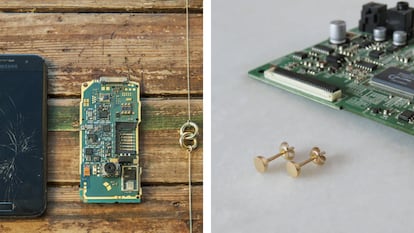
Some brands are utilizing the gold and silver hidden in electronic devices to create bracelets, necklaces, and earrings.
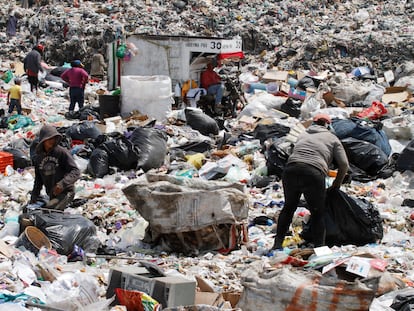
Each year, about 50 million tons of electronic waste are discarded, a weight greater than “enough Eiffel Towers to occupy the entire island of Manhattan,” according to the United Nations. Mobile phones, computers, or game consoles hide precious metals inside, which can be recycled to create jewelry. And some brands take advantage of the gold and silver from these devices to create bracelets, necklaces, and earrings.
Only 17.4% of electronic waste worldwide is recycled, according to data from the 2020 report. The rest ends up in landfills where it degrades and releases toxins into the air, soil, and groundwater. A problem that could worsen considering that the amount of electronic waste is expected to increase at an alarming rate in the coming years. If in 2019 more than 53 million tons of this waste were generated, by 2030 the figure will rise to 74 million, predicts the aforementioned report.
These devices are often rich in precious metals and minerals that are good conductors of electricity, such as gold, silver, platinum, and copper.
It is precisely there that some jewelry companies like Lylie, Nowa, and AuTerra have seen an opportunity, creating jewelry from the gold or silver in electronic waste.
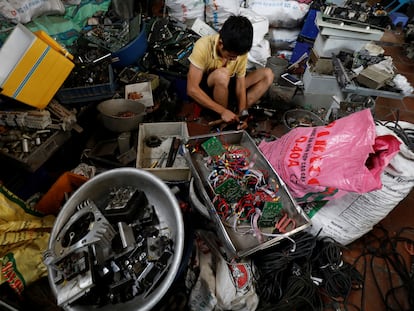
In the case of AuTerra, the refining process begins with the manual dismantling of these devices and the separation of their components.
This mass is a combination of copper, gold, silver, and other metals, which finally go through a recycling process and are melted “to ensure a pure and high-quality material.”
Recycling these devices could also help reduce mining, an activity with a significant impact on the environment. In addition to causing direct destruction of habitats, it leads to wildlife displacement, loss of vegetation, deforestation, erosion, and alteration of soil profiles, according to a report on the social and environmental impacts of mining activities in the European Union.
Extracting just ten grams of gold displaces almost five tons of earth, according to AuTerra, which portrays gold mining as “a destructive industry that results in ruined landscapes, displaced communities, and the release of multiple toxic compounds into the air and groundwater.” An environmental impact that in theory could be reduced if gold were extracted directly from electronic waste, according to sources from Lylie, a jewelry brand that works with a refinery in the UK to extract precious metals from these devices:
From an ecological point of view, “recycled gold is the best option, as two-thirds of the planet’s gold has already been extracted.” Furthermore, Lylie highlights that by extracting one ton of minerals from the earth, a yield of 30 grams of gold is obtained. In contrast, with one ton of electronic waste, “about 300 grams of this metal are obtained.”
Even so, transforming electronic waste into gold still entails some challenges. In addition to some technologies being particularly costly and inefficient, it is important that the process is carried out properly:
Despite these limitations, more and more jewelry companies are showing interest in recycled metals. In 2020, the Danish brand Pandora, one of the largest manufacturers in the world, announced that by 2025 all its jewelry would be made from recycled gold and silver.
For now, this and other companies have already laid the foundations to achieve an ambitious goal: building a more circular industry.