Editor’s Note
This article provides a clear introduction to the core principles and applications of resin 3D printing, a technology prized for its high precision and detail. It serves as a useful primer for anyone looking to understand this popular additive manufacturing process.
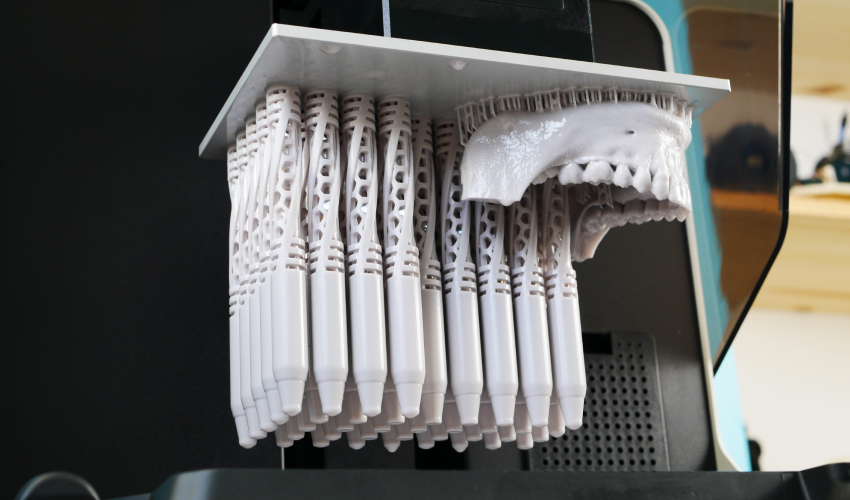
Resin 3D printing, also known as vat photopolymerization, is one of the most popular families of 3D printing technologies. It delivers precise, detailed, and high-quality results, making it a popular choice in many industrial sectors such as jewelry, dentistry, and rapid prototyping. In this article, we will explore in detail how resin 3D printing works and its applications.
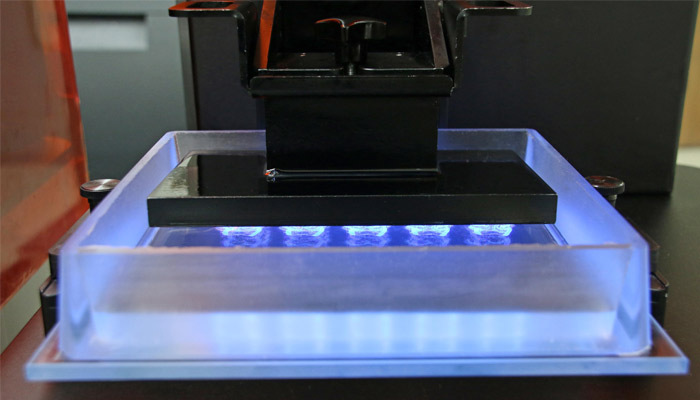
Resin 3D printing uses a type of liquid called photosensitive resin, which solidifies when exposed to UV radiation. This technology is divided into three main categories: SLA, DLP, and MSLA, which are distinguished by the light source used and the method of shaping this light.
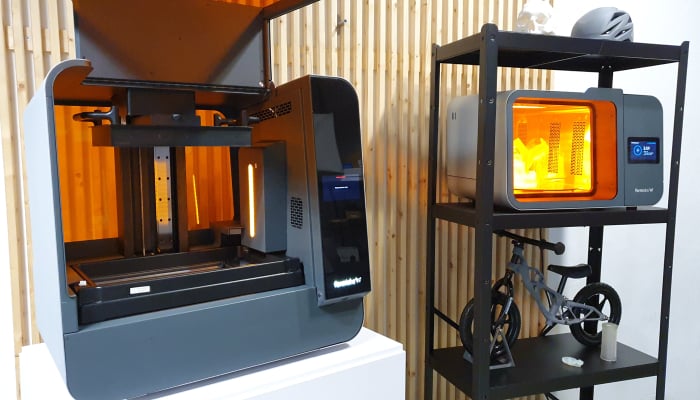
The three methods share a similar architecture consisting of:
– A resin vat;
– A build plate movable along the Z-axis.
While the three main resin technologies are SLA, DLP, and MSLA, some manufacturers seek to improve these technologies to achieve optimal performance. For example, Formlabs has developed a type of SLA called LFS (Low Force Stereolithography), which aims to improve printing accuracy. Carbon has developed DLS (Digital Light Synthesis), an evolution of DLP designed to offer faster printing speeds.
BCN3D has patented VLM (Viscous Lithography Manufacturing) technology, which uses MSLA as a base, offering advanced features such as multi-material printing.
After resin 3D printing, all resin technologies require similar post-processing steps. The printed part must be cleaned to remove excess uncured resin. Then, it must be post-cured, as the curing during printing is only partial. Specific post-processing machines are available to facilitate the washing and curing of resin prints.
With the various resin technologies available, the resin 3D printing market is vast and diverse. There are machines suited to different needs, ranging from affordable small desktop machines to large industrial SLA printers. Resin 3D printers offer fine applications thanks to their precision and high detail reproduction. They are used in many sectors, such as jewelry, dentistry, the medical industry, aerospace, and automotive.
Resin 3D printing is a technology that enables the additive manufacturing of precise and detailed parts. Thanks to its different technological variations (SLA, DLP, and MSLA) and the advancements made by manufacturers, this technology offers endless possibilities in many fields. Whether for prototyping, production of functional parts, or artistic creation, resin 3D printing has become an essential tool for many professionals seeking a precise tool capable of producing high-quality parts.