Editor’s Note
Swarovski has partnered with additive manufacturing firm Xolo to explore volumetric 3D printing for creating highly detailed, customizable crystal jewelry. This collaboration aims to merge traditional craftsmanship with cutting-edge technology, offering new possibilities for personalized design.
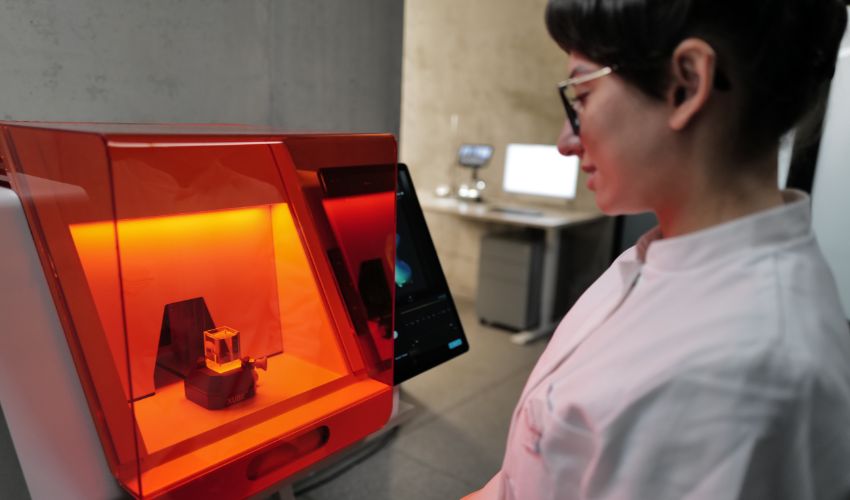
Swarovski, the renowned jewelry manufacturer famous for its work with various crystals, has recently signed a collaboration with an additive manufacturing player, xolo. This manufacturer has developed a volumetric 3D printing technology that enables high resolutions and extremely precise details. The goal of this partnership is to directly print crystal pieces, in order to offer unique, customized, and detailed jewelry. It is also a way for Swarovski to highlight its commitment to innovation and use new technologies to stay at the forefront of its industry.
Crystal is a type of glass distinguished by its lead content, whereas conventional glass is composed more of silica. Specifically, it offers sharper characteristics in terms of brilliance, transparency, and clarity. The Austrian company Swarovski has been working with this material for years, primarily to design jewelry, accessories, and watches. One of its goals is to combine tradition and cutting-edge technology, and that is precisely what it intends to do with xolo.
The startup xolo has developed a special photopolymerization process based on xolography. It uses different initiators and two types of wavelengths to polymerize the resin. Some advantages of this method are its speed, the surface finish obtained, and its compatibility with a wide range of materials. Thus, Xolo will work with crystal to design sharp and detailed pieces. Dirik Radzinski, CEO of xolo, stated:
The long-term goal of this collaboration is to establish new industrial standards for glass manufacturing. The official press release states that the vision is to offer
Although little information has been published to date, this collaboration could shake up the jewelry sector and, of course, the production process of a material valued by many industries.