Editor’s Note
Colombia has initiated a deep-water expedition to the San José, a Spanish galleon that sank in 1708. Believed to hold one of history’s greatest maritime treasures, the wreck is also at the center of an international legal dispute over its rightful ownership.
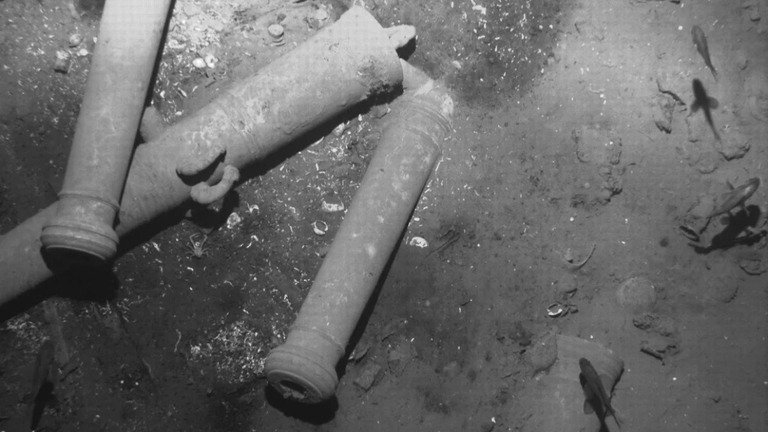
Colombia has recently launched an underwater investigation of a warship that sank in the Caribbean Sea more than 300 years ago. The ship is believed to be carrying a vast treasure, and disputes over its rights are intensifying.
The treasure ship is named the “San José.” It was discovered by the Colombian government off the coast of the port city of Cartagena in 2015 and is often referred to as the “holy grail of shipwrecks.”
Armed with 62 cannons and three masts, the ship was the flagship and largest galleon of the Spanish fleet, believed to have been carrying valuables such as gold, silver, and emeralds mined from the Potosí mine in Peru.
It is said to have sunk on June 8, 1708, while en route from Panama to Colombia, during a battle with British ships in the War of the Spanish Succession, with 600 people on board.
According to Colombia’s Institute of Anthropology and History (ICANH), the first phase of the investigation will focus on imaging the ship using “non-invasive” remote sensors. Based on the results of the initial survey, additional investigations may be conducted, which could include the recovery of archaeological materials from the wreck.
ICANH also designated the discovery site as an “Archaeological Protected Area” to “preserve the scientific and archaeological value of the ship.”
The discovery of the San José is significant for Colombia due to the cultural and historical artifacts on board. It may also provide clues about the economic, social, and political conditions in Europe in the early 18th century.
However, the ship’s discovery has also sparked legal battles.
The Colombian side claims that it was the first to discover the San José in 2015 with the help of an international research team.