Editor’s Note
This article spotlights the women breaking barriers in Colombia’s historically male-dominated emerald mining industry. Driven by economic necessity and the dream of discovery, they are carving out a new and challenging path for themselves.
Deep inside mountain tunnels where the heat is so intense it causes headaches, women with power tools are chipping away at boulders in search of gems. They have opened a difficult path for themselves in Colombia’s emerald industry, a sector long dominated by men.
The lack of job opportunities, combined with the hope of a find that will make them rich, has pushed the women into mining. Colombian emeralds are known around the world for their quality and the best can be sold for thousands of dollars, though most people in the industry aren’t wealthy.
She lives in a precarious hillside house where the walls are unpainted and the floor is made of cement.
Some of the biggest emeralds in the world have been mined in Colombia, including one weighing 3 pounds (1.36 kilograms) that broke the world record in 1995. In Coscuez, rumors circulate that one miner recently found an emerald that sold for $177,000, and left the ramshackle town forever.
In 2022, Colombian emerald exports were worth $122 million, according to the national federation of emerald companies. The gems are one of the nation’s most iconic products, and are sold in jewelry shops in cities like Cartagena and Bogotá.
But most emerald profits go to merchants and large companies that have invested millions of dollars in technologies that help them find the most valuable stones.
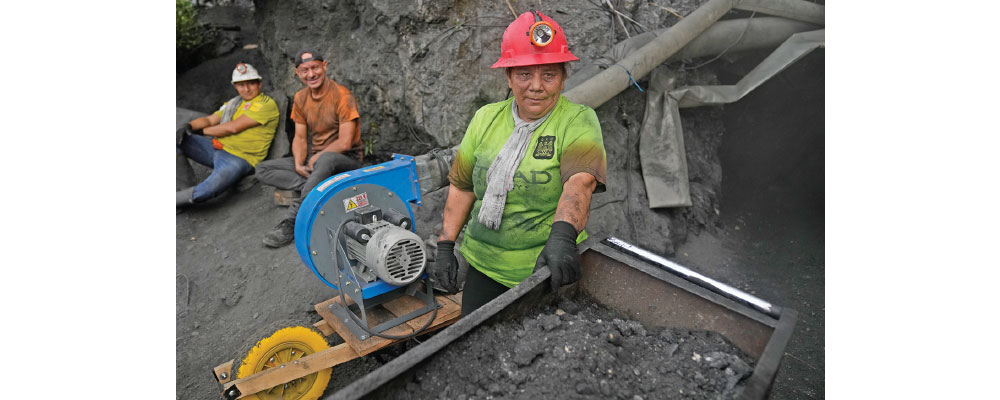
Workers at small, unregulated mines like Forero, who still use dynamite sticks to open tunnels, have a slim chance of finding the emeralds that can change someone’s destiny.
In her home outside Coscuez, Forero keeps some small, opaque emeralds that she has gathered over the past three months. She reckons that they are not worth more than $76 in all.
Her earnings are not enough to maintain her four children or help her father, who has developed a respiratory illness after working in emerald mines for decades and needs an oxygen tank to breathe.
So she also works random jobs to make ends meet like washing uniforms, ironing clothes and cleaning homes.
The 52-year-old said she has struggled to leave this way of life because the economy in Coscuez revolves around mining, and there are few other opportunities.
Working in the mines is tougher for women. Once they are done drilling in deep tunnels and sifting through rocks, they must care for their children and do domestic tasks that men are often reluctant to do.
Flor Marina Morales said she started to work in the mines around Coscuez because she needed to provide for her kids.
Morales’ children are now in university studying psychology and law.
After they enter in a single file, they branch off in different directions and head into tunnels where each person has a designated area to drill. The rocks that break off the walls are carried outside in carts, washed and sifted through.
This kind of involvement by women was unthinkable a few decades ago in Colombia. Older villagers said that men previously barred women from approaching the mines because they believed that if women were around, the emeralds would hide.
She said that between the 1960s and 1990s, when miners attacked each other for control of the area in a period known as the “green wars,” women who attempted to work in mines were threatened, and some were raped.
Ávila said she started to work at the mines when she was 19, but she was not allowed to enter the shafts. Instead, she sifted through rocks picked by the men.
The area has become less violent after a series of peace deals brokered by the Catholic church. Many miners who were behind the violence have died. Some sold off their properties to international companies as finding valuable emeralds became tougher and required more money.
Currently there are 200 women working in the mines around Coscuez, according to the local association of female miners. Some work alongside men, while others work in five small mines owned by women, where only female miners are allowed.

Because the tunnels are so small, the women take turns working inside them.