Editor’s Note
As COVID-19 cases rise with the new KP.3 variant, health authorities note a recurring summer pattern. While severity remains low, this report underscores the importance of sustained personal hygiene even as the pandemic evolves.

(Seoul=News1) Reporter Cheon Seon-hyu — “Sigh… I got it again. It’s already the third time. What else could it be? COVID-19.”
The number of COVID-19 patients, which seemed to have disappeared since last winter, is rapidly increasing. Not only are people who have tested positive for COVID-19 easily found around, but also more people are taking out masks they had put away in drawers and wearing them again due to the rapid spread.
Doctors also said they are feeling the increasing number of COVID-19 patients.
An internal medicine specialist operating a clinic in Seoul said,
A private practitioner in Suwon, Gyeonggi Province also said,
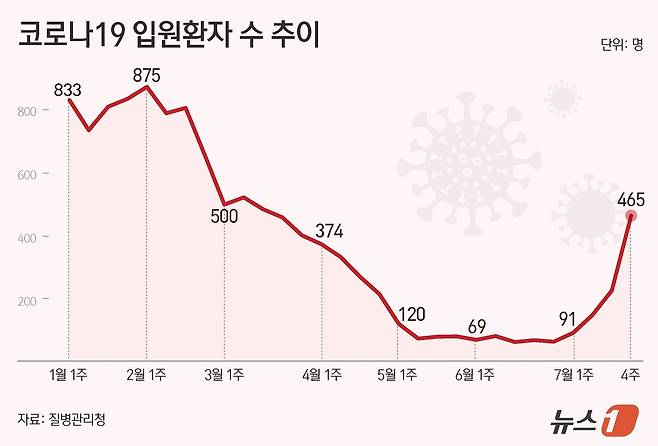
According to the Korea Disease Control and Prevention Agency (KDCA) on the 7th, the number of patients hospitalized for COVID-19 from June 21 to 27 (week 30) was 465, a twofold increase compared to the previous week (226).
Looking at the epidemic trend, after peaking in the first week of February, it continued to decline until the fourth week of June (week 26) with 63 cases, then reversed to 91 cases in early July (week 27), and increased to 148 cases in week 28 → 226 cases in week 29 → 465 cases in week 30. It surged about 5.1 times in four weeks.
According to the KDCA, the virus currently in circulation is the new variant KP.3. The detection rate of JN.1, which had been dominant since January, decreased by about 40 percentage points from 59.3% in June to 19.5% last month, while the proportion of the new variant KP.3 increased by 27.78 percentage points to 39.8% compared to June (12.1%).
A KDCA official explained,
Immune evasion refers to the virus evading the human body’s immune response system.
This means that even people who have been previously infected with COVID-19 or have antibodies from vaccination can be reinfected with COVID-19 if a virus with immune evasion ability invades the body. In other words, it means transmission power has strengthened.
Accordingly, the KDCA formed a Respiratory Infectious Disease Response TF on June 22 to monitor the spread of COVID-19, whooping cough, mycoplasma pneumonia, etc.
However, health authorities say that based on overseas cases like the U.S. and Japan, which have already experienced the KP.3 epidemic since last year, and Korea’s COVID-19 epidemic pattern, there is no need for excessive fear regarding this spread.
Kim Dong-geun, head of the KDCA’s Respiratory Infectious Disease Response TF, said,
He added,
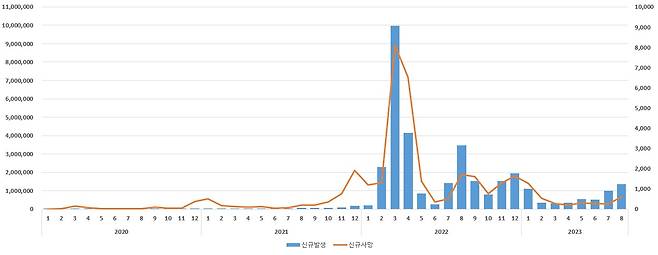
Indeed, Korea has shown a pattern of increasing COVID-19 patient numbers in summer and winter.
On top of this, the emergence of KP.3 with good immune evasion ability, and factors like not yet receiving vaccines effective against KP.3, are overlapping, leading to the rapid spread of patients.
Yang Jin-seon, head of the KDCA’s Infectious Disease Management Division, said,
However, he urged efforts to prevent spread by complying with personal hygiene rules and paying attention to indoor ventilation.
Director Yang urged,
Additionally, the KDCA is planning vaccination against the JN.1 virus, the ancestor of the KP.3 variant, in October.
The vaccine administered in the first half of this year was effective against XBB.1.5, which was prevalent last winter and fall, but the preventive vaccine for JN.1 is known to be effective even against the currently circulating KP.3 or KP.2.