Editor’s Note
This article explores the innovative application of 3D printing technology in the performing arts, highlighting its growing role in theater and stage production. As additive manufacturing expands beyond industrial uses, it offers new creative possibilities for set design, props, and costumes, demonstrating how technology is reshaping artistic expression.
3D printing has already established itself in various fields. For years, it has been increasingly used in the automotive, aerospace, and medical industries, and the technology continues to be driven forward by new advances. However, additive manufacturing is also gaining ground in other areas and is being introduced into less industrialized domains, such as art. Museums use 3D printing in various ways, and we are seeing more and more examples of its use in music. The theater industry is also benefiting from the use of 3D technologies and is exploring the possibilities of 3D modeling, 3D scanning, and 3D printing. But how and why do opera and theater use 3D printing? We try to get to the bottom of this question using examples and expert opinions.
In general, it can be said that the arts and culture are very open to new approaches and therefore more willing to experiment than other sectors. Particularly during the Covid pandemic, many cultural institutions took the time to explore 3D printing, on-site production, and environmentally friendly materials. The spirit of research does not stop at the big stages. Meanwhile, 3D printing and the entire range of 3D technologies are not only being implemented in small, innovative institutes but have even reached Broadway!
The fact that 3D printing is occupying an increasingly important place in the theater industry is not only due to the openness of the world’s major theaters to innovation. Although those in charge usually have the final say on projects and the budget allocated to them, the foundations for innovation are already laid in the training of those involved. For example, 3D printing is already part of stage design training. More and more costume designers are turning to 3D technologies to realize their creations. Due to the demand for artistic creations from the printer, some service providers have also specialized in 3D printing for theater and stage.
The applications of 3D printing in theater range from large, visible backdrops to the smallest details. 3D printing allows for large-format printing, making it possible to put creative experiments into practice and design a wide variety of shapes. It is also possible to achieve lightweight construction, which facilitates the transport and placement of elements for sets and scenery. On one hand, additive manufacturing is used to create theater models and construction plans, and on the other hand, for the scenery itself. We are also seeing more and more applications of 3D printing for luminaires and furniture pieces, where various materials and decorative elements are combined. Due to design flexibility, 3D printing is also increasingly used for the production of all kinds of props. Not only are prototypes created, but also full-scale final objects. 3D printing is not limited to scenery. Helmets, masks, jewelry, and various decorative elements and accessories are already being manufactured with 3D technologies along with costumes. Now, let’s take a closer look at some specific examples where sets, props, and costumes have been 3D printed.
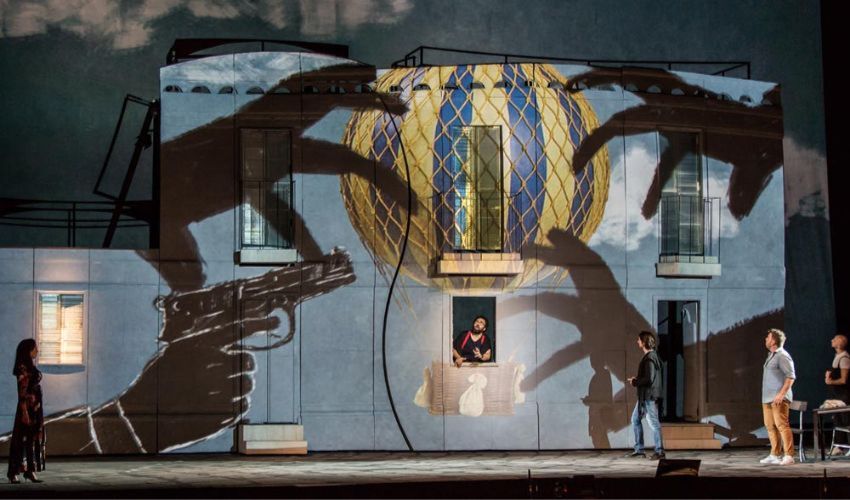
The first completely 3D printed set was created in 2017 in Rome, at the Teatro dell’Opera, for the production of “Fra Diavolo.” The set mimics an old apartment block divided into two sections with windows and balconies. A total of 223 large-format pieces had to be printed and assembled to produce the surreal house in the appropriate size. WASP produced them with five Delta WASP 3MT printers and needed only three months to 3D print the complete set.
Another impressive example of 3D printed scenery was launched by ETH Zurich. Using a robot-assisted 3D printing process, nine “dancing” concrete columns were manufactured that adorned the backdrop of the Riom musical theater for the 2019 Origen Summer Festival. The printing process was exceptionally fast, so that the nine columns for the stage installation “Concrete Choreography” could be printed in 2.5 hours.
A detailed 18 x 10 meter map of London was reproduced. Thanks to its infinite versatility, additive manufacturing has been part of McCann’s production repertoire for several years and also allowed for a striking production for this project.
It is also used for the great masterpieces of opera. In 2022, the simul+Reallabor SAMSax 3D printed the scenery for the performance of “Aida” in Chemnitz. After initial prototypes, the 3D printed capitals ended up adorning the scenery. 3D printing and milling also enabled a particularly elaborate and robust scenery for the performance of “Carmen” in the St. Margarethen quarry in 2023. The manufacturing was handled by Winter Artservice.