Editor’s Note
As the Russia-Ukraine conflict continues, Western sanctions are evolving to target key Russian economic sectors. This article examines the latest measures, including the EU’s new restrictions on Russian diamonds, and their potential impact.
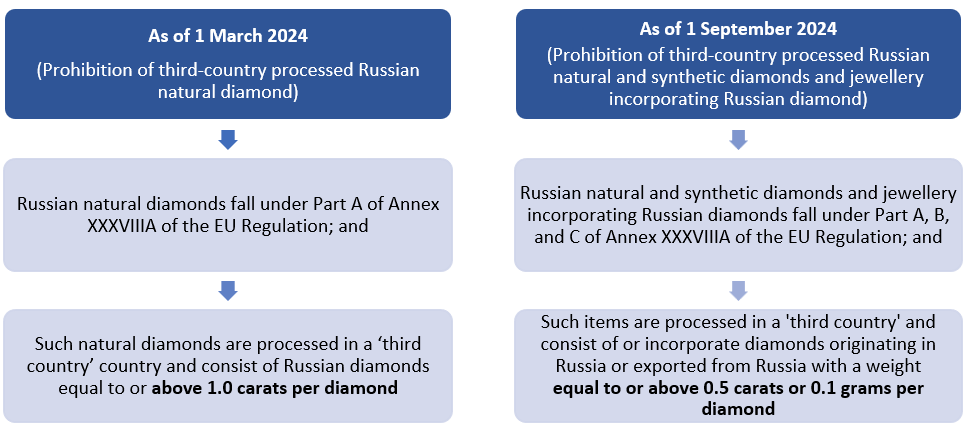
Amidst the ongoing Russia-Ukraine conflict, the evolution of sanction measures continues. Several critical sectors of economic importance to Russia have been targeted by G7 countries, a prominent recent example being the EU’s restrictions on the import of Russian natural diamonds (rough and polished) and jewellery processed in third countries.
The EU’s restrictions on imports of Russian natural diamonds (rough and polished) and jewellery processed in third countries are set out in EU Regulation (EU) 833/2014 (EU Regulation), and apply in different stages.
The EU has imposed a positive requirement for importers to provide evidence of the country of origin of (i) diamonds or (ii) products incorporating diamonds, that are in turn used as input to process a product in a third country. For example, if a third country processed product containing diamonds falling under Part A of Annex XXXVIIIA is imported after 1 March 2024 and contains a diamond equal to or above 1.0 carats per diamond, the importer is required to provide evidence that such diamonds are not Russian diamonds. Evidence to substantiate this may include:
– Mining country of origin
– Names of the buyer and seller
– Weight in carat and value of diamonds
– Place of importation, exportation, and transportation route
The EU has established a G7 certification scheme, which is optional between 1 March 2024 to 31 August 2024 (sunrise period). However, as of 1 September 2024, obtaining the necessary clearance under the G7 certification scheme will be made mandatory. Accordingly, between the sunrise period, the importers may choose to obtain a certification from: (a) the concerned authority located in Belgium; or (b) under the G7 certification scheme, a blockchain-based ledger to ensure traceability from mining to the end use of diamonds.
India’s imports of natural diamonds and diamond-related products from Russia and falling under Part A, B, and C of Annex XXXVIIIA of the EU Regulation were valued at 1,062.23 USD/million in CY 2023. More specifically, non-industrial diamonds (unworked or simply sawn, cleaved, or bruted) classified under CN code 7102 31 constituted a major portion of Indian imports from Russia. On the other hand, India exported to the EU natural diamonds and diamond-related products falling under Part A, B, and C of Annex XXXVIIIA of the EU Regulation which were valued at 2,960.70 USD/million in CY 2023. Such exports largely constitute non-industrial diamonds (other than unworked or simply sawn, cleaved, or bruted) classified under CN code 7102 39 followed by non-industrial diamonds (unworked or simply sawn, cleaved, or bruted) classified under CN code 7102 31 and articles of jewellery and parts thereof incorporating diamonds classified under CN code 7113.
| Jurisdiction/Product Type | CY 2022 | CY 2023 |
|---|---|---|
| Indian Imports of products Part A, B, and C of Annex XXXVIIIA | 1,030.12 | 1,062.23 |
| Indian imports from Russia | ||
| India’s Exports of products Part A, B, and C of Annex XXXVIIIA | 3,643.83 | 2,960.70 |
| Indian exports to the EU |
Source: Figures in USD/Million from Department of Commerce, India TradeStat
Given the significant trade between Russia and India on the one hand and India and the EU on the other, the recent restrictions are expected to have significant market ramifications for Indian exporters of diamonds. More specifically, Indian exporters may be seen restructuring their global supply chains. Particularly, as an immediate next step, they may be required to ramp up their record-keeping processes, as necessary, to adapt to the traceability-based G7 certification scheme that is expected to become mandatory starting September 2024.
Having said that, as the regulatory landscape currently stands, Indian exporters of natural diamonds should ramp up their recordkeeping/screening processes of the supply/value chain by adopting best practices so businesses don’t inadvertently make commercial decisions that have sanction-related repercussions.
Additionally, in instances where India imports or exports diamonds to the EU through trading partners in jurisdictions such as UAE and Hong Kong, Indian exporters may contractually require such trading partners to also maintain robust recordkeeping mechanisms. This would ensure that Indian exporters mitigate against potential violations of EU regulations through such trading partners.
Unless the conflict ends and eventually the sanctions regulations are watered down, the Indian diamond industry will have to adhere to the sanctions regulations and be prepared for many such developments that may be introduced from time to time that could impact both the sector as well as trade going forward.