Editor’s Note
This article outlines Starbucks’ C.A.F.E. Practices, a comprehensive framework designed to ensure ethical sourcing, support coffee-growing communities, and promote environmental stewardship.
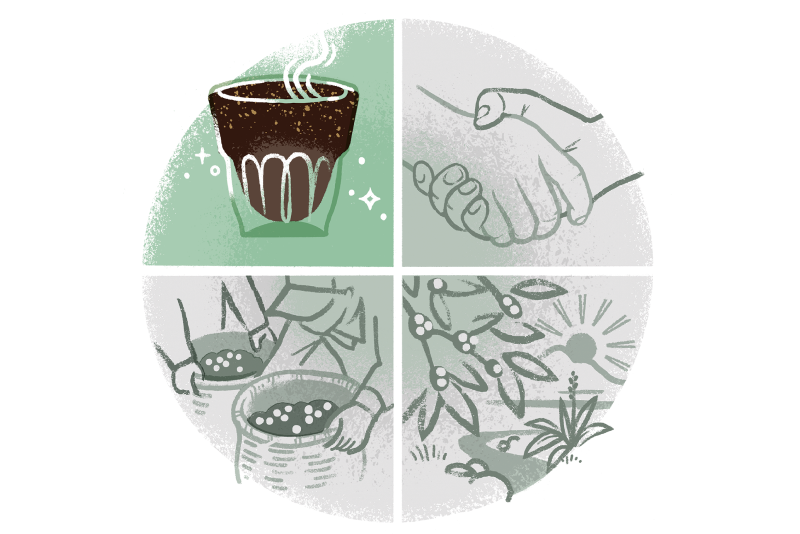
To ensure a sustainable supply and sourcing of coffee for the future, Starbucks has developed and implemented C.A.F.E. (Coffee and Farmer Equity) Practices. C.A.F.E. Practices are guidelines that invest in coffee communities while conserving the global environment and promoting improved quality and productivity. It is not merely a certification system but incorporates a “comprehensive approach that encourages continuous improvement” in sustainable coffee production.
Here, we introduce C.A.F.E. Practices, the standard for Starbucks’ ethical sourcing.
C.A.F.E. Practices were developed in partnership with the international conservation organization Conservation International in 1998 and officially launched in 2004. It is one of the first sustainability standards in the coffee industry to be verified by independent third-party experts.
Thanks to this program, Starbucks can identify the challenges faced by producers in various coffee-growing regions. Furthermore, through C.A.F.E. Practices, Starbucks can support producers in various ways, including financial assistance through loans, providing healthy coffee plants, and technical support through Farmer Support Centers.
C.A.F.E. Practices are built on four components: Quality Standards, Economic Transparency, Social Responsibility, and Environmental Leadership. These components are essential for securing sustainable coffee, and understanding them reveals how Starbucks’ ethical sourcing is realized.
Starbucks is a specialty coffee retailer with strict quality standards for Arabica beans. Meeting the standards is absolute, and the higher the quality, the more compensation is paid to the producer.
The team of coffee quality experts at Starbucks Coffee Trading Company (SCTC) tastes all coffee before purchase. If it does not meet Starbucks’ standards, the purchase is rejected with an explanation. However, producers whose coffee is rejected are encouraged to cultivate according to C.A.F.E. Practices. By adhering to the C.A.F.E. Practices guidelines, producers can produce higher quality coffee, earn more compensation than before, and improve their livelihoods.
Starbucks’ Definition of “High Quality”
At Starbucks, the Quality Team evaluates hundreds of cups of coffee daily to determine if they meet strict standards. This process is also called green coffee grading. For consistency in evaluation, a proprietary glossary of cupping evaluation terms is used. The glossary includes acceptable green bean moisture content, density requirements, appearance (color, size, shape), and expected characteristics for each country of origin.
Cupping Evaluation Criteria:
- Aroma
- Acidity
- Body
- Flavor
- Complexity
Physical Evaluation Criteria:
- Green bean density and moisture content
- Green bean size
- Green bean color and shape
- Number of defects
To show how much of the payment for green beans is actually paid to the producer, C.A.F.E. Practices participants are required to submit proof of payment. The proof of payment includes receipts showing the amount paid to the producer for the coffee sold. The receipt must include the quantity sold, coffee type, unit of measurement, date, name of buyer and seller, and price.
Without economic transparency, it is impossible to know how much of the payment for green beans reaches the producer. This aligns with Starbucks’ mission and is crucial for the future supply of high-quality coffee. It helps producers continuously receive the compensation needed for business investment, and this accumulation contributes to sustaining the coffee industry.
Starbucks purchases coffee from over 450,000 producers worldwide. Considering the complexity, diversity, and challenges of the global supply chain, achieving economic transparency is not easy. Coffee exporters are independent organizations that purchase coffee from small farms, cooperatives, etc., and then arrange transportation to buyers. Starbucks builds very important relationships with exporters. Starbucks and exporters sometimes form partnerships to carry out social contribution projects for coffee communities.
Treating all people with dignity and respect throughout the supply chain, including partners, is an essential part of Starbucks’ mission. For the coffee business to thrive and succeed, the people working in it need to feel supported. Just as there are rights and rules protecting Starbucks partners wearing green aprons, there are necessary rules to protect the people who deliver coffee to Starbucks.
Social responsibility indicators evaluate employment conditions and the work environment. These items ensure that workers’ rights are protected and safe, humane conditions are maintained. This includes guaranteeing minimum wages and prohibiting child labor and forced labor in coffee production.
For example, compliance with minimum wage requirements and labor prohibitions is mandatory, and a Zero-Tolerance policy applies; no violations are permitted. Farms that do not meet Zero-Tolerance indicators are prohibited from participating in the program until corrective actions are taken and verified.
The Social Responsibility section of the C.A.F.E. Practices scorecard consists of over 70 indicators. Below are main criteria and example indicators from the scorecard.
Wages and Benefits
Example Indicator: The employer provides all legally mandated national benefits (social security, leave, disability benefits) to temporary and seasonal workers.
Working Hours
Example Indicator: No worker works longer than the regular working hours (hours before overtime is considered) per day or week permitted by local law. If regular working hours are not defined, regular working hours are considered 8 hours per day and 48 hours per week.
Access to Education
Example Indicator: Where public education is insufficient, primary school-age children of workers living at the worksite have access to primary education, facilities, and materials that meet national or local requirements.
Access to Healthcare
Example Indicator: The employer covers the cost of general medical services for all permanent employees.
Coffee-producing countries are among the most biologically rich in the world and notably overlap with regions where biodiversity is at risk. Environmental leadership is crucial to ensure that all coffee cultivation and processing not only minimizes environmental impact but also has a positive effect. By encouraging sustainable agriculture, Starbucks supports valuable habitats.
Environmental leadership indicators promote waste management, water quality protection, water and energy conservation, biodiversity preservation, and pesticide use reduction. These indicators serve as a method to confirm the sure implementation of environmental conservation. Environmental leadership also has Zero-Tolerance indicators. For example, farms cannot convert natural forests to agricultural land or use pesticides prohibited by the World Health Organization (WHO). If a farm does not meet Zero-Tolerance indicators during verification, it cannot participate in C.A.F.E. Practices.
To check farm conditions and evaluate them appropriately, we regularly re-examine the program and proactively update the guidelines. The Environmental Leadership section of the C.A.F.E. Practices scorecard consists of over 100 indicators. Below are main criteria and example indicators from the scorecard.
Wildlife Protection
Example Indicator: The farm manager has created a list of native wildlife species in the area, with each species categorized as “vulnerable,” “endangered,” or “critically endangered.”
Protected Areas
Example Indicator: Natural forests have not been converted to agricultural land.
Climate Change
Example Indicator: The farm has documented and stored records of climate change risks and their impact on coffee cultivation (e.g., changes in temperature or rainfall).
Reducing Water Consumption
Example Indicator: The processing facility recycles water used in transporting and pulping coffee cherries.
Ethical coffee sourcing cannot be easily judged by a checklist. However, research data can accurately show the impact C.A.F.E. Practices has had on over one million producers, farm workers, and their communities.
Indicators related to the Social Responsibility and Environmental Leadership components of C.A.F.E. Practices are verified by certified third-party organizations trained and monitored by SCS Global Services. SCS Global Services accompanies verifiers on inspections and provides feedback on the interpretation of C.A.F.E. Practices program indicators to ensure consistency in reporting to Starbucks.