Editor’s Note
This article examines the critical role of Chemical Mechanical Polishing (CMP) in achieving the nanometer-level precision required for advanced semiconductor manufacturing. As process nodes shrink, the demands on this enabling technology—and its consumables like polishing pads—grow ever more complex.
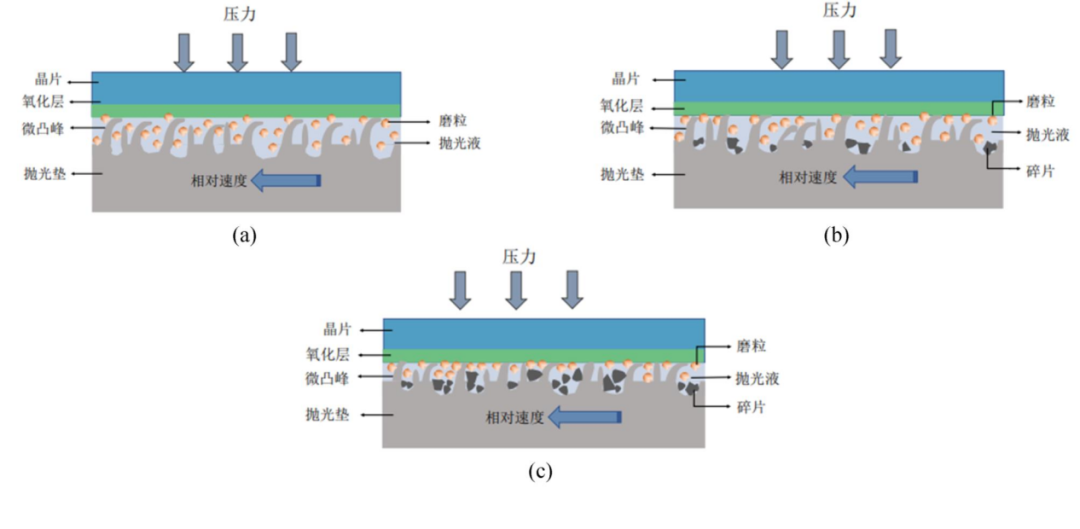
Chemical Mechanical Polishing (CMP) is currently the only polishing technology capable of achieving both global surface planarity and flatness, offering high controllability and nanometer-level precision. This technology provides reliable support for microelectronic device manufacturing, becoming increasingly crucial as wafer precision requirements continue to rise. For instance, chip manufacturing at the 28nm process node requires up to 12 polishing steps, while at the 10nm node, this number can increase to as many as 30.
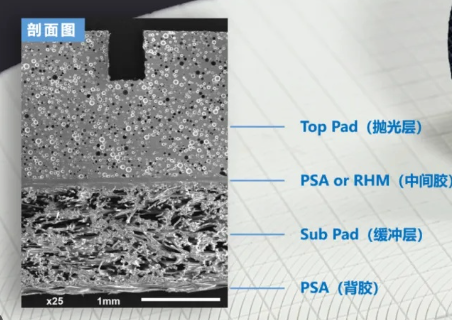
CMP polishing pads are typically made of polyurethane. As friction and normal pressure accumulate during the polishing process, the pad gradually wears down, its surface becomes smooth and glazed. Additionally, the grooves on the pad’s surface can become clogged with polishing residues and dust particles, leading to uneven distribution of the polishing slurry and reducing the storage and transport capacity of abrasives. This situation not only affects material removal efficiency but also impacts the surface quality of the polished product.
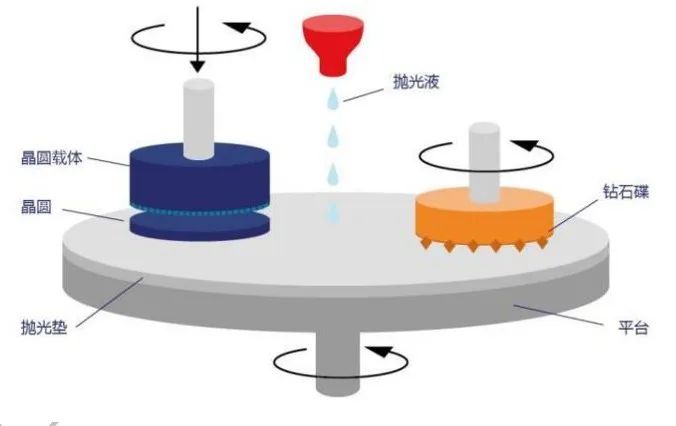
To address polishing pad wear and delay its replacement frequency, the introduction of diamond conditioners (diamond discs) becomes key. Diamond conditioners restore the pad’s original texture, ensuring it maintains a certain level of roughness, thereby improving the transfer efficiency of the polishing slurry and sustaining high-quality polishing results.
A diamond disc is a critical tool used in CMP processes for conditioning polishing pads. Its substrate is a disc with a diameter of 100-108mm, uniformly embedded with hundreds of thousands of tiny diamond particles on its surface. During operation, these particles effectively remove unevenness, glazed layers, and accumulated residues from the pad’s surface, thereby adjusting and restoring the pad’s microstructure and surface texture.
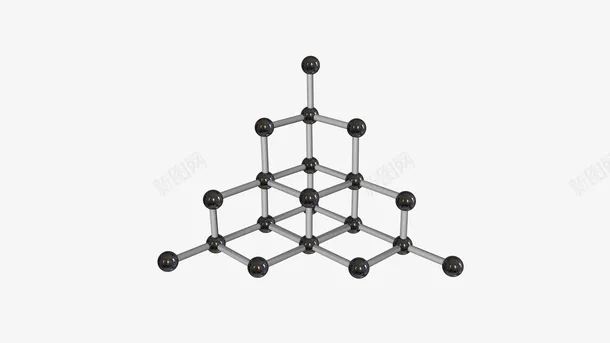
CMP, as a precision process combining chemical and mechanical polishing, imposes strict requirements on conditioners. Diamond conditioners/discs, with their unique crystal structure and properties, have become the ideal choice. Each carbon atom in diamond is connected to four surrounding carbon atoms via covalent bonds, forming a stable three-dimensional structure, granting it exceptional stability in both mechanical and chemical environments. This endows diamond conditioners with several significant advantages:
High Hardness and Wear Resistance: The mechanical polishing in CMP involves material removal through the rotation and pressure of the polishing pad. As one of the hardest substances on Earth, with a Mohs hardness of 10, diamond can effectively cut through accumulated materials and glazed layers on the pad surface, restoring its roughness. Simultaneously, diamond conditioners can maintain stable performance over long periods, exhibiting high wear resistance.
Chemical Inertness and Corrosion Resistance: During the chemical polishing stage of CMP, the polishing slurries used often possess certain corrosive properties. Diamond exhibits extremely high chemical inertness, reacting with almost no other substances in common chemical environments. Therefore, even in highly corrosive polishing slurries, diamond conditioners remain stable and are not easily subject to chemical erosion or oxidation.
Diamond, due to its stable structural properties and extreme hardness, is an ideal material for conditioning polishing pads. However, these advantages also present challenges in the production and processing of diamond discs. Currently, the main production technologies for diamond discs include sintering, electroplating, and brazing:
Sintering Technology: Utilizes powder metallurgy methods to mix diamond particles with a binder, press them, and then sinter them into shape at high temperatures. This process ensures a strong bond between diamond particles and the substrate, forming a durable multi-layer structure suitable for long-term use. However, the diamond exposure rate in sintering is relatively low, meaning some particles cannot directly participate in cutting, affecting conditioning efficiency.
Electroplating Technology: Attaches diamond particles to the substrate surface through an electroplating process, forming a working layer with high exposure. This method can improve the conditioning efficiency of the diamond disc. However, diamond particles are prone to detachment, leading to a relatively shorter tool lifespan, and the detached particles may cause damage to the wafer.
Brazing Technology: Utilizes the chemical metallurgical action of brazing filler metal to create a strong bond between diamond particles and the substrate, forming a single-layer diamond structure. The brazing process can effectively increase the exposure rate of diamond particles, improve grinding efficiency, and reduce particle detachment issues. However, this technology is complex and has a high technical barrier; research and application within China are still in the development stage.
These three technologies each have their own advantages and disadvantages. Brazing technology, as it combines the strengths of sintering and electroplating, is becoming the main trend in diamond disc production.
Enhancing the conditioning performance of diamond conditioners can be approached from two aspects: diamond size and arrangement.
First, diamond size has a significant impact on conditioning results. Larger diamond particles can quickly remove material from the pad surface, thereby increasing the conditioning rate. However, this may lead to increased surface roughness and more scratches, affecting polishing quality. Smaller diamond particles provide finer surface conditioning, although the conditioning efficiency is lower, and they may struggle to remove glazed layers effectively. Therefore, selecting the appropriate diamond size is key to balancing conditioning rate and surface quality.
Second, the arrangement of diamond particles also significantly influences conditioning effectiveness. In a random arrangement, particles in dense areas may detach due to insufficient holding force from the substrate, leading to excessive pad wear and shortened tool life. In sparse areas, individual diamond particles bear larger workloads, making them prone to breakage and detachment from impact forces, causing premature tool failure. In contrast, an ordered arrangement (such as matrix or concentric circle patterns) can ensure uniform force distribution on diamond particles, reduce scratches and defects, improve service life, and more effectively form grooves during conditioning. This promotes the rapid transport and uniform distribution of processing residues and polishing slurry, thereby enhancing conditioning effectiveness.
CMP diamond conditioners, due to their unique high hardness and corrosion resistance, play a crucial role in the semiconductor manufacturing field. Through the application of different production processes, diamond conditioners have achieved a good balance in durability, conditioning efficiency, and precision. With the development of brazing technology, the performance of diamond conditioners is expected to further improve, addressing issues of exposure rate and durability present in traditional production processes, and providing higher-quality support for CMP polishing technology.