Editor’s Note
This article highlights Nestlé’s significant investment to promote regenerative agriculture in its coffee supply chain, addressing critical sustainability challenges.
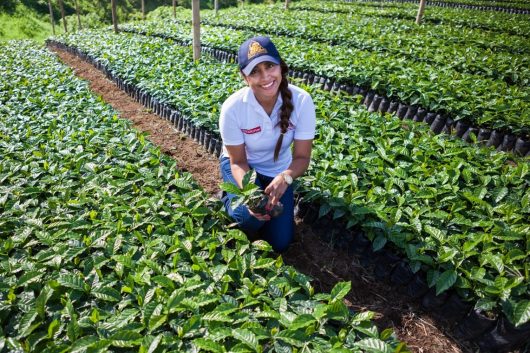
Amidst challenges such as coffee farmer poverty and the reduction of arable land due to climate change, which threaten the sustainability of coffee, Nestlé announced its “Nescafé Plan 2030” in 2022. The plan commits to investing 10 billion Swiss Francs (approximately 170 billion yen) by 2030 to support contracted farmers in transitioning to “regenerative agriculture.”
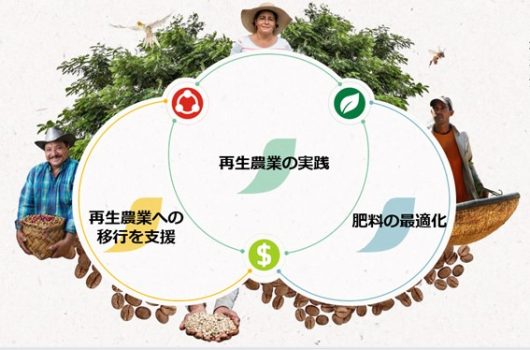
Regenerative agriculture aims to enhance soil health and fertility while protecting water resources and biodiversity. Healthy soil is more resilient to the impacts of climate change and can increase yields. It also supports the improvement of producers’ livelihoods.
The plan sets interim targets for 2025 and final goals for 2030. By 2025, the interim goals include sourcing 100% of coffee beans responsibly and ensuring that 20% of sourced beans come from regenerative agriculture.
These interim targets are within reach. By the end of 2023, 92.5% of sourced coffee beans were responsibly sourced. Coffee beans sourced from regenerative agriculture accounted for over 20% of total sales volume in 2023.
The next mission is to achieve the 2030 goals: by 2030, 50% of sourced coffee beans should be cultivated through regenerative agriculture, aiming for a 50% reduction in greenhouse gas (GHG) emissions.
In 2023, Nestlé provided regenerative agriculture training to 148,000 coffee farmers across 16 countries, including Brazil, Colombia, and Vietnam. To promote farm reform and increase yields, the company distributed 21 million coffee seedlings to farmers in 2023.
To encourage the transition, “conditional financial incentives” are provided to over 3,000 farms in Côte d’Ivoire, Indonesia, and Mexico. In Indonesia, support was also given for the pilot introduction of climate change insurance for over 800 small-scale farmers.
Entrepreneurship is also fostered among coffee producers. In Honduras, training on entrepreneurship, coffee quality, and regenerative agriculture was provided to 12,000 young people in coffee communities.

Supporting the transition to regenerative agriculture has yielded certain results. “By transitioning to regenerative agriculture, farmers’ yields have improved by 5-25%. According to 2023 data, it led to a 15-30% reduction in greenhouse gases per kilogram of coffee beans,” said Mr. Yamaguchi.
A future challenge is how to reduce risks associated with the transition. Many coffee farmers are small-scale farmers living in poverty.
One of Nestlé’s initiatives is the sharing of “wisdom.” The company has published a guidebook compiling the principles and know-how for transitioning to regenerative agriculture.
Transitioning to regenerative agriculture brings benefits to the entire coffee industry. However, the environmental impact of these methods is often not yet fully understood. Therefore, with the cooperation of experts, the definition of regenerative agriculture and its social impact have been “visualized.”
Mr. Isshiki stated, “To transition to regenerative agriculture, it is important to choose the optimal method rooted in that specific land. Utilizing expert knowledge, we propose the best method suited to the land.”
What defines a successful transition to regenerative agriculture? According to Mr. Isshiki, there are three conditions. The first is soil conservation, which forms the foundation of regenerative agriculture. The second is the incorporation of multiple plant species, such as cover crops and shade trees. The third is the cultivation of cash crops other than coffee, like pepper and cashew nuts. From a risk diversification perspective, cultivating other crops alongside coffee is recommended.

Nestlé has over 800 agronomists worldwide, leveraging this expertise to promote a transition with reduced risks.
What can Japanese consumers do to enhance coffee sustainability? Mr. Nakanishi from the Beverage Business Division, Regular Soluble Coffee & System/Gift Box Business Department, said:
Nescafé underwent rebranding in the autumn of 2023. The new brand concept is “Make your world,” re-emphasizing that sustainability is at the core of the “Nescafé” brand. The “Nescafé Plan 2030” underpins this concept.
Already, 100% of the coffee beans used for Nescafé in Japan meet responsible sourcing standards*, but environmental considerations are also being strengthened in product packaging. The “Nescafé Gold Blend Eco & System Pack” has reduced plastic usage since its launch in 2008, and a new package design was adopted in March of this year.
*Adjustments may be made not to fall below 98% due to unavoidable reasons such as weather in raw bean producing countries.
The feature of the Nescafé Gold Blend Eco & System Pack is that it can be refilled into a container of your choice (recommended airtight container with an opening diameter of 6cm or more). Previous refill packs were only compatible with dedicated “Nescafé” jars or coffee machines. The concept is to “enjoy” the refilling process. The design was changed to allow “fun and easy” participation in the eco-friendly initiative of reusing your favorite jar.
Mr. Nakanishi points out that to enhance sustainability, it is important to think together with the youth who will shape future society.
As part of this, Nestlé Japan ran a campaign where consumers could design their own labels for Nescafé refill containers. Using a smartphone, users could freely select illustrations of faces, clothing, etc., and create a label image with their name.
The attempt, named the “Nescafé Hero Bottle Project,” was held from June to August, and the campaign on X (formerly Twitter) attracted around 14,000 participants, mainly young people.