Editor’s Note
This article highlights the inauguration of the Perles d’Anjou facility in France, a new industrial site dedicated to processing quinoa, lentils, and chickpeas. The project, led by a regional agricultural cooperative, aims to create added value and new market opportunities for local farmers producing gluten-free crops.
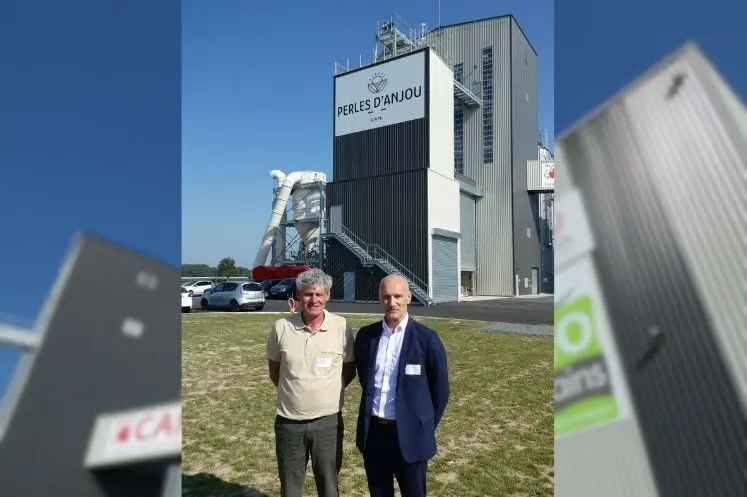
The Pays de la Loire Agricultural Cooperative inaugurated a new industrial facility named Perles d’Anjou in September 2024 in Jumelles, Maine-et-Loire. The goal is to provide an outlet and added value for gluten-free seeds produced by farmers in the region.
This is stated by Christian Blet, President of the Pays de la Loire Agricultural Cooperative (CAPL) and a farmer in the Saumurois area. The industrial site handles the reception, drying, sorting, hulling, storage, and packaging of a range of nine protein-rich seeds, both conventional and organic. The main volume productions are quinoa (with Anjou being France’s leading production basin), lentils, and chickpeas. Perles d’Anjou also processes millet, flax, poppy, sorghum, chia, and buckwheat. This investment was approved by the cooperative in 2019.
analyzes Christian Blet.
Built on a 7-hectare plot, the facility replaces the one in Brissac (49), which retains its storage function. The total investment amounts to €16.3 million, including €6 million for high-tech machinery. According to the cooperative, the new sorting line has no equivalent in Europe. The grains go through more than ten processing stages: analysis, cleaning, separation, stone removal, concentration, sieving… and, if necessary, polishing and hulling. With two sorting lines (the one from Brissac will be relocated in 2025), the processing capacity will increase from 1 to 4 tons of seeds per hour. For this first agricultural season, 7,500 tons have been supplied by CAPL members. This tonnage could rise to 10,000 – 12,000 tons internally, but the facility, with a capacity of 25,000 tons operating on three shifts, is intended to open up to other players.
These crops currently represent 9% of the cooperative’s cultivated area, i.e., 7,000 to 8,000 hectares. While the market for gluten-free seeds for human consumption has grown by 20% over the last five years, the share of dedicated area could reach 15 to 20% in the medium term. Out of 1,500 grain-supplying members, one-third cultivates one or several of these seeds. To explain this enthusiasm, Christian Blet notes that:
Initiated in 2008 at CAPL, the Anjou quinoa sector represents 90% of French volumes.
The example of Antoine Roveyaz, who farms 220 hectares in Chemiré-le-Gaudin (72), mainly wheat and corn, illustrates this. He started quinoa five years ago.
he estimates. Quinoa, planted in sandy soils with low potential and on a farm without irrigation, also presents an interest in his rotation. By reducing the frequency and cost of interventions compared to wheat, the Sarthe farmer can
CAPL offers its quinoa-producing members an annual contract, with a guaranteed price and outlet.
indicates Christian Blet.
Will the Perles d’Anjou tool bring additional added value to farmers producing these seeds? The guaranteed purity of 99.9%, increased storage capacity, and new markets offered by finishing operations could contribute. The huller will allow the processing of red lentils, whose first sowings will be done in March 2025. The polisher enables the marketing of quick-cook quinoa.
supports Antoine Roveyaz, who does not minimize the risks and constraints associated with quinoa cultivation.