Editor’s Note
The natural diamond market is undergoing a significant shift, with rough prices falling sharply over the past year. This decline is driven by the dual pressures of rising lab-grown diamond supply and softer consumer demand in key markets. The result is a growing price divide, where smaller stones bear the brunt of the downturn while larger, high-quality rough remains more resilient.
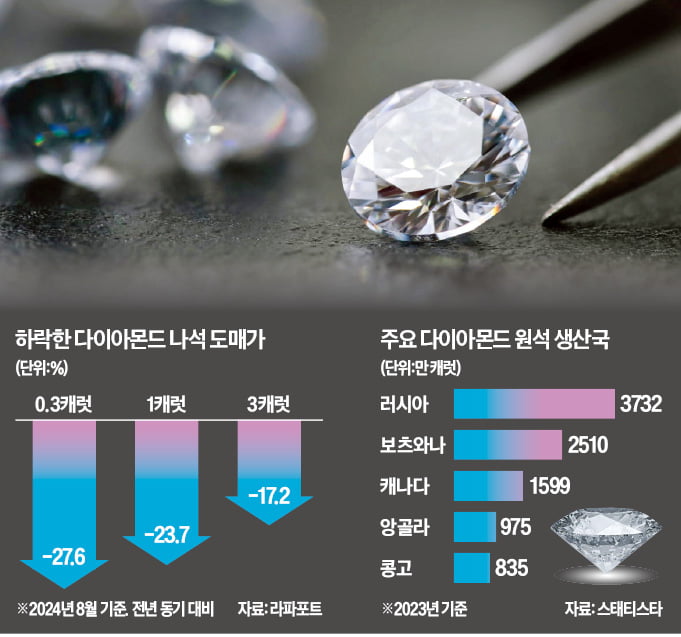
Wholesale prices for natural diamond rough have plummeted by 20-30% over the past year. This is due to increased supply of ‘lab-grown diamonds’, which cost about one-tenth of traditional diamonds, and weakened jewelry consumption in major markets like the US and China. While high-quality rough larger than 1 carat is less affected by lab-grown diamonds, smaller rough continues to see price declines, intensifying a ‘price polarization’ trend.
According to the international diamond price benchmark Rapaport on the 9th, wholesale prices for natural diamond rough have been steadily declining since late last year. The price drop is particularly pronounced for rough under 1 carat. As of August, the wholesale price for 0.3-carat rough fell 27.6% compared to a year ago. Over the same period, the price for 1-carat rough also dropped 23.7%. The decline for 3-carat rough was relatively smaller at 17.2%.
Diamonds are categorized into two types based on processing stage: ‘rough’ mined from mines and ‘polished’ stones cut for jewelry. Global diamond polishers cut rough into polished stones, which are then purchased by jewelry companies to create pieces. This is why global jewelry brands like Cartier, Tiffany & Co., and Bulgari are sensitive to polished stone wholesale prices.
The sharper price drop for polished stones under 1 carat is largely due to the impact of lab-grown diamonds. Lab-grown diamonds are literally artificial diamonds cultivated in laboratories. They are made by applying high pressure and high temperature to graphite or by layering carbon obtained from decomposed methane. Current major lab-grown diamond suppliers are mass-producing diamonds under 1 carat, which are easier to produce. An industry insider explained,
Geopolitical factors have also influenced diamond price fluctuations. Russia, the world’s largest producer supplying one-third of global diamond rough, has faced blocked export routes due to Western sanctions following the Ukraine war. Consequently, local companies like Alrosa are selling their products through polishing factories in India, which primarily process rough under 1 carat, for indirect sales. Rapaport analyzed,
The industry predicts that price gaps will gradually widen based on rough size. While the market for rough under 1 carat will increasingly be replaced by lab-grown diamonds, the superiority of natural diamonds for larger rough over 1 carat is expected to persist.
A jewelry buyer for a domestic department store said,
This outlook is reinforced by major players in the high-end rough wholesale market, like Tiffany, who insist on natural diamonds.
Domestic companies are also moving to secure high-quality rough. Shinsegae Department Store, which launched its own high-end jewelry brand ‘Adir’, formed a strategic partnership last month with Israeli diamond wholesaler Lakhminov. This is to ensure a stable supply of large, high-carat, or colored diamonds. They also plan to enter the diamond rough wholesale business.