Editor’s Note
This week’s report examines the sharp decline in natural diamond prices, driven by the rise of lab-grown alternatives and weakened demand in key markets. As major suppliers cut production, the industry faces a pivotal adjustment.
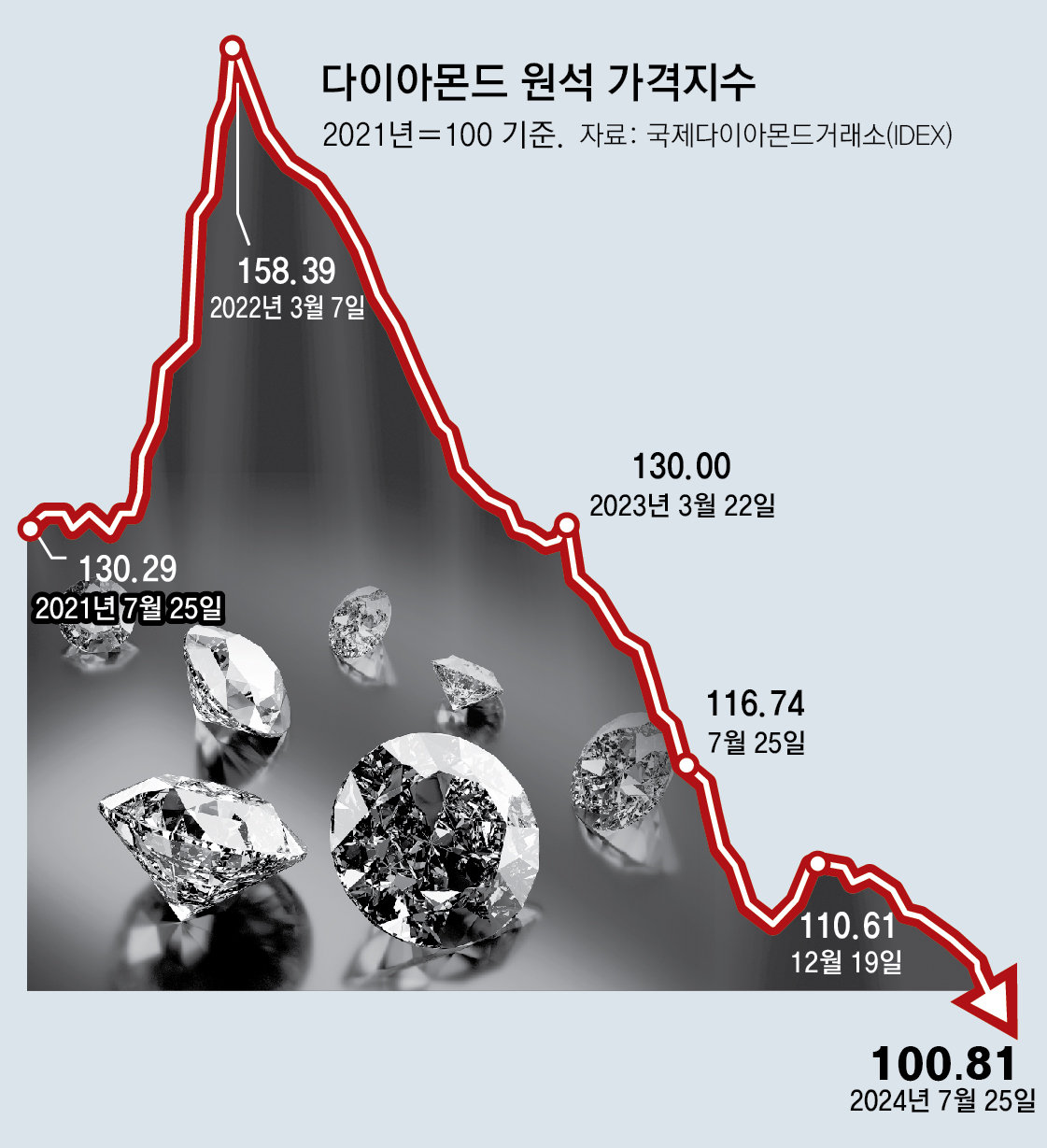
The rough diamond price index has fallen 36% from its peak… left out of this year’s asset price rally despite the surge in other assets.
The spread of lab-grown diamonds has been a decisive blow… their high cost-effectiveness has reduced demand for natural diamonds.
The economic slowdown in China, a major market, has also played a role… suppliers like De Beers have begun cutting production.
Some predict a gradual price recovery as production decreases.
The decline in the price of the ‘King of Gems’, the diamond, is unusual. While gold prices are soaring, diamond prices have fallen by 36% compared to their peak two years ago. The popularity of lab-grown gems is analyzed as a cause for the decrease in demand for natural diamonds.
According to the International Diamond Exchange (IDEX) on the 26th, the rough diamond price index fell to 100.81 the previous day. This is a drop of over 36% compared to the peak recorded on March 7, 2022 (158.39), and a decline of over 13% compared to a year ago (116.74). Although prices seemed to rebound temporarily in the first quarter of last year (Jan-Mar), hovering around 130, they have been on a downward trend for over a year since then.
When the Russia-Ukraine war broke out in 2022, diamond prices hit record highs and were even considered long-term investment products. As Russia, which produced one-third of the world’s diamonds, invaded Ukraine, concerns about a diamond supply shortage grew, even forecasting scarcity.
However, diamond prices have since fallen to a degree that makes those forecasts seem irrelevant. This year, global financial and asset markets experienced the so-called ‘Everything Rally’. Not only global stock markets, but also the US dollar, oil prices, precious metals like gold and silver, and even raw material prices like copper and aluminum all rose—except for diamonds. It’s to the point where people say the ‘King of Gems’ is losing its luster.
Diamonds have long been considered one of the most valuable gems. They were regarded as sacred gems since ancient Egypt and were symbols of power and wealth in medieval Europe. As pure carbon crystals, they are the hardest mineral on Earth, and their ability to refract and reflect light earned them high aesthetic praise.
Diamonds, once considered the exclusive domain of the wealthy and powerful, became popularized by the mid-20th century. The world’s leading rough diamond distributor, the UK’s De Beers, played a significant role. The copy ‘A diamond is forever’, used in a De Beers diamond advertisement created in 1947, ignited the hearts of young people of marriageable age. Since then, diamonds became a marriage essential, the best gift for proposals, and established themselves as a symbol of eternal commitment.
However, diamonds have not always shone brightly throughout history. Major African countries waged civil wars over diamond mines, drawing global criticism. Criticism also poured in over unethical mining methods and reckless mine development. In particular, diamonds were pointed out as a major culprit of environmental pollution because mining one carat of diamond requires 500 liters of water and scraping 6.5 tons of land surface, and generates a large amount of carbon.
Nevertheless, diamonds maintained their position as the top gem from the 20th century into the 21st. Thanks to supply control by rough diamond distributors like De Beers, diamond prices remained stable, their value trended upward, and they were recognized as high-value investment products.
The growth of the ‘Lab Grown Diamond’ market has been a decisive factor behind the plummeting diamond prices. Unlike natural diamonds obtained through mining, lab-grown diamonds are diamonds grown (Grown) in a laboratory (Lab). While natural diamonds are formed over millions of years under high pressure and high temperature 120-200 km below the Earth’s surface, lab-grown diamonds are created in just two weeks. A small diamond seed is placed in a high-temperature, high-pressure chamber, or methane or hydrogen gas is injected into a vacuum vessel to grow its size.
Initially used mainly for industrial purposes, with repeated technological advancements, they began to gain serious attention in the jewelry market from the late 2010s. Lab-grown diamonds are 100% identical to natural diamonds in physical, optical, and chemical aspects, but their price is only 10-20% that of natural diamonds, making them much cheaper. They became even more of a topic when American actress Meghan Markle, who married Britain’s Prince Harry in 2018, wore lab-grown diamonds.
The market is gradually growing as young consumers respond to the high cost-effectiveness. According to the US market research firm Allied Market Research, the global lab-grown diamond market, which was only about $1 billion (approximately 1.3 trillion won) in 2016, grew to about $12 billion (approximately 15.7 trillion won) in 2022. It is projected that the market size will expand to about $49.9 billion (approximately 68 trillion won) by 2030.
Global jewelry brands are also rushing to enter the lab-grown diamond market. France’s global luxury brand Fred released a lab-grown diamond collection, and Prada also launched a jewelry line using lab-grown diamonds last year. Swarovski introduced lab-grown diamond products to the domestic market in April this year, the first global luxury brand to do so. The world’s top luxury brand group, LVMH, also acquired a stake in the lab-grown producer Lusix through an investment company.
Domestic brands are also entering the lab-grown diamond market one by one. E-Land’s jewelry brand Lloyd was the first in the domestic industry to introduce a lab-grown diamond jewelry line in 2020. Domestic distributors like Shinsegae and Lotte are also increasing lab-grown diamond sales through various channels. Accordingly, the domestic lab-grown diamond market, which was only 35 billion won in 2021, increased to 50 billion won in 2022 and surged to 70 billion won last year.
The impact of the global economic downturn, which has reduced consumption of luxury goods like diamonds, is also cited as a reason for the decline in diamond prices. In particular, analysis suggests that the economic downturn in China, the world’s second-largest diamond consumer after the US for the past decade, has negatively impacted the natural diamond market.
According to foreign media, as China’s real estate market slumped, consumption of luxury goods like jewelry plummeted. Amid China’s declining population and marriage rates, people who used to buy diamonds for investment purposes have turned to gold investment, also affecting sales decline. Market research firm Daxue Consulting explained, “In China, demand for natural diamonds has decreased as gold or lab-grown diamonds have gained popularity.” China’s diamond brand I Do even applied for bankruptcy restructuring in January last year. Hong Kong-based jewelry company Luk Fook also saw a 21.4% decrease in wholesale sales related to natural diamonds last year.
As diamond prices fall and sales volume decreases, diamond-producing countries and related companies are also being hit. Bloomberg and others recently reported that De Beers has decided to reduce diamond production. De Beers had previously announced it would cut diamond production by 10% this year, and now declared additional cuts. Production in the second quarter (Apr-Jun) of this year also decreased by about 15% compared to the previous year. Russia’s competitor Alrosa is also reducing diamond production. Botswana, Africa’s second-largest diamond producer, saw its GDP decrease by 5.3% in the first quarter of this year as diamond production plummeted.
Experts believe the diamond market slump will continue for the time being. However, some predict that price recovery will occur gradually as production decreases and the popularity of lab-grown diamonds wanes.