Editor’s Note
This article explores the global rise of “quiet luxury,” a consumer trend favoring understated, high-quality, and durable goods over conspicuous branding. It reflects a broader shift in values towards mindful consumption and longevity.
A consumer trend known as “quiet luxury” has been gaining popularity globally, particularly overseas, marking a shift in consumer consciousness towards items that are simple in design yet high in quality and durability. In Japan, a survey by the Consumer Affairs Agency on “awareness of ethical consumption” revealed that the percentage of people who “know the term” has gradually increased from 6.0% in 2016 to 29.3% in 2023 (※1).
This trend is underpinned by a growing global awareness of “sustainability” among both corporations and individuals, as well as a recognition and endorsement, especially among affluent demographics, of the value in using simple, high-quality items for extended periods.
(※1) https://www.caa.go.jp/notice/assets/consumer_research_cms201_231109_01.pdf
Jewelry retains its beauty and value over time. It is often purchased as a lifelong item, whether as a gift, a self-reward, or an heirloom to be passed down to loved ones. Jewelry inherently holds value, and cherishing and passing down high-quality pieces contributes to a sustainable society across generations.
Furthermore, the company deals in jewelry made from recycled pre-owned gemstones. The Ministry of the Environment’s publication “The Mysterious Story of Mercury” (※2), released in March 2021 as part of health and chemical substance measures, includes a page on “The Meaning of Choosing Ethical Jewelry,” which addresses labor and environmental issues. Regarding gold, it notes that the jewelry industry and mining companies have established the “Fairmined Standard” as a voluntary initiative to audit the social development and environmental considerations of small-scale mining operations, certifying these miners. Certified gold is stamped with marks guaranteeing it meets fair trade standards and is used in items like the Cannes Film Festival’s Palme d’Or and Nobel Prize gold medals.
(※2) https://www.env.go.jp/chemi/tmms/husigi.html
During Japan’s bubble economy, a vast quantity of high-quality gemstones was imported. It is estimated that Japan’s “urban mine” now holds approximately 10 trillion yen worth of pre-owned gemstones. However, some gemstones are no longer mined, meaning only existing resources circulate in the market. For example, pink diamonds are no longer mined following the closure of the primary source, the Argyle mine in Australia, making the existing supply extremely rare and valuable. Gemstones are natural resources, and over-exploitation can deplete them, highlighting the need to cherish finite resources.
While there’s a common perception of buying “brand new” when purchasing gemstones, pre-owned jewelry from the urban mine can be revived to like-new condition through repolishing and redesigning. Moreover, pre-owned jewelry is relatively more affordable than new gemstones and has the eco-friendly benefit of resource efficiency. This lowers the barrier to entry for first-time jewelry buyers, and the choice of ethical jewelry itself contributes to sustainable practices.
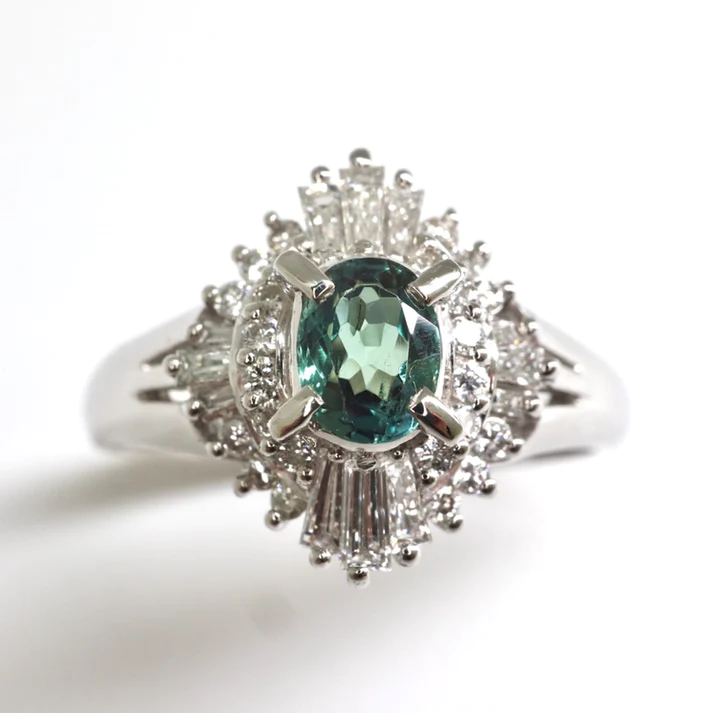
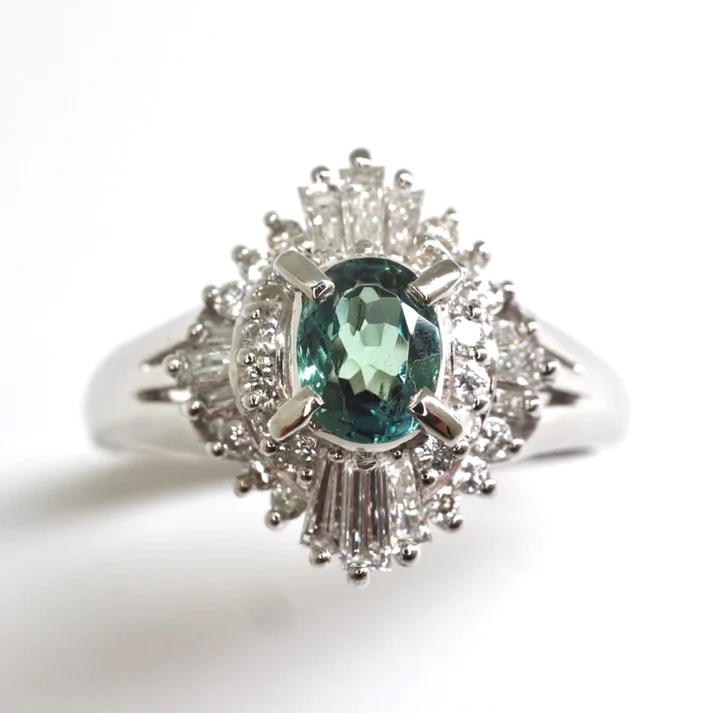
Alexandrite is one of the world’s three rarest gemstones, alongside Paraiba tourmaline and Padparadscha sapphire, making it highly scarce.
Alexandrite possesses the property of dichroic color change (pleochroism), and its value increases with the clarity of the color change.
(Reference price for right photo: 120,000 yen)
While sapphires are commonly associated with blue, they come in a rich variety of colors, including yellow and pink.
Among fancy-color sapphires, the highest grade is the Padparadscha sapphire, produced only in Sri Lanka.
(Reference price for right photo: 230,000 yen)
While the jewelry industry may appear glamorous, gem-producing countries often face serious social issues such as forced labor, revenue exploitation, CO2 emissions from mining, human rights violations, and environmental destruction. The company aims to transform this industry. By establishing a business model that handles the entire process from procurement to sale of pre-owned colored stones—previously deemed “worthless” and discarded—it creates new value and aims to completely change the concept of the jewelry industry. Having been the first to assign value to “worthless” colored stones, the company continues this reframing beyond just stones, generating new value through unique employee benefits, women’s empowerment, and other corporate activities that are “unconstrained by preconceptions.” The company has established “Reframing Company” as its fundamental policy. Reframing means “viewing things with a new framework, unconstrained by preconceptions.” Starting from assigning value to colored stones said to have none, Kishun bases itself on this Reframing Company policy and has established corporate principles accordingly.