Editor’s Note
The diamond industry faces significant headwinds as De Beers implements another round of price cuts. This move, driven by sustained weak demand and a sharp decline in the global rough diamond price index, signals ongoing challenges for the sector.
According to CCTV Finance, since 2023, influenced by factors such as sluggish demand, international rough diamond prices have been continuously declining. Recently, the international diamond giant De Beers Group has once again lowered prices for various rough diamonds in an effort to stimulate production and consumption. According to the latest global rough diamond price index, as of January 27, the index has fallen by 18.5% over the past 52 weeks, hitting its lowest point in 52 weeks on the 27th. At its first rough diamond sight of the year, De Beers Group played the “price reduction card.”
This represents one of De Beers’ more significant price reductions in recent years.
Diamond is a colorless crystal composed of carbon, currently known as the hardest substance after lonsdaleite. Diamond is one of the five cardinal gemstones, referred to as diamond in chemical and industrial fields. Based on production methods, diamonds can be categorized as natural diamonds and lab-grown diamonds. Natural diamonds are mined from natural diamond deposits; lab-grown diamonds are artificially cultivated in laboratories using carbon powder by simulating the natural diamond growth environment. Unlike colored gemstones and jade, diamonds have a systematic grading standard (the 4C grading standard), and the price of loose diamonds can be determined based on this standard.
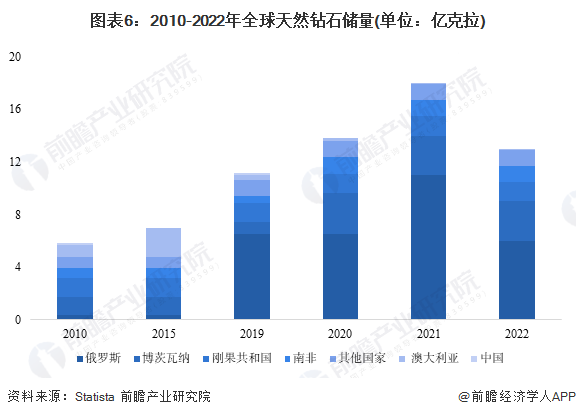
From the upstream diamond mining segment of the diamond industry chain, Russia currently holds the largest global reserves of natural diamonds. According to Statista data, Russia’s natural diamond reserves in 2022 were 600 million carats; the global total natural diamond reserves were 1.301 billion carats, with Russia accounting for 46.12% of the world’s total. On the other hand, countries like Botswana, Congo, South Africa, and Australia have maintained unchanged natural diamond reserves since 2021, suggesting that the tight global supply situation for natural diamonds may persist.
Synthetic diamonds are also known as lab-grown diamonds, lab-created diamonds, lab-synthesized diamonds, or even man-made diamonds. These names all point to the fact that man-made diamonds are created in laboratories or factories, rather than being naturally formed in nature and mined from the earth. Some synthetic diamond laboratories use advanced technology to simulate the formation conditions of natural diamonds beneath the earth’s crust.
This formation process is the main factor distinguishing synthetic diamonds from natural diamonds, as synthetic diamonds are essentially identical to natural diamonds in chemical, optical, and physical properties, as well as crystal structure. Synthetic diamonds emerged in the 1950s and have gradually developed since then.
Bain & Company points out that in 2020, lab-grown diamond production reached 6 to 7 million carats, while the total output of natural diamonds was approximately 135 million carats. In 2013, these figures were 300,000 to 350,000 carats and 124 million carats, respectively. This shows that synthetic diamonds have experienced quite rapid growth in recent years, not only due to their inherently lower prices but also because of the rise of a new generation of consumers and changing perceptions.
Whether it’s “environmental protection” or “social responsibility,” both are driving the development of the diamond industry. By 2030, the global production scale of lab-grown diamonds is expected to reach 10 to 17 million carats, with China being the main global production capacity. The global lab-grown diamond industry has significant space for growth and is in a growth phase.
Lab-grown diamonds have existed for over 60 years. The United States first synthesized large-grain diamonds as early as 1973. They were not widely produced before because the cost of gem-quality synthetic diamonds was too high at the time, even more expensive than natural diamonds.
However, with technological advancements, the price of synthetic diamonds will continue to decrease. Coupled with significant changes in current consumption concepts, the wedding attribute of diamonds is weakening. If synthetic diamond jewelry is more beautiful and priced lower, it is believed many people would be willing to purchase it.

There is an opinion that the market will increasingly accept synthetic diamonds. They serve as a good supplement to natural diamond supplies for consumers and can, to some extent, alleviate the supply shortage caused by the natural decline in natural diamond production. Synthetic diamonds have good expressive power in fashion jewelry, and with appropriate marketing, they are believed to have promising development prospects.
Currently, the selling price of synthetic diamonds is about 50% to 70% of that of natural diamonds. With technological progress and the decreasing marginal costs brought by large-scale production, the future cost of synthetic diamonds could even drop to 10% to 30% of that of natural diamonds. According to a Morgan Stanley research report, by 2020, the market price of small-grain synthetic diamonds was expected to reach 50% of that of natural diamonds of the same grade, while the price of large-grain synthetic diamonds could drop to 30% of that of natural diamonds of the same grade.
Morgan Stanley also predicted that although synthetic diamond sales currently account for only 1% of the global market, with the rapid improvement in process quality and diamond size, synthetic diamonds might occupy about 15% of the gem market by 2020. However, overall, natural diamonds still have a huge consumer market, and the synthetic diamond market still cannot replace the natural diamond market.
Wanlian Securities released a research report stating that due to their identical composition and structure to natural diamonds and their significant price advantage over natural diamonds, coupled with media and brand education of downstream consumers in recent years,
Bain & Company’s consulting report predicts,
Wan Zhe, a professor at Beijing Normal University and former chief economist of China National Gold Group, believes,
