Editor’s Note
This article provides a comprehensive overview of the rapid evolution of laboratory-grown diamonds over the past two decades, charting their rise in quantity, size, and quality. It also examines novel types that may become more common in the future.
 ABSTRACT
Over the past two decades, GIA has documented a rapid evolution of laboratory-grown diamonds; this article provides a comprehensive overview of these developments and summarizes novel laboratory-grown diamonds that may become more common in the future. The industry has seen a significant increase in the quantity, size, and quality of laboratory-grown diamonds, making them viable for commercialization on a larger scale. Nevertheless, there have been relatively few changes in laboratory-grown diamonds during the last five years, indicating that developments have largely stabilized for now. This overview summarizes the two diamond growth processes: high-pressure, high-temperature (HPHT) and chemical vapor deposition (CVD). It explores the major trends observed by GIA since 2007, the year it began issuing synthetic diamond grading reports. CVD products now dominate the supply of laboratory-grown diamonds submitted for grading reports, with the majority of these also undergoing post-growth HPHT treatment to remove their color. This article discusses methods and strategies for identifying laboratory-grown diamonds by providing their distinguishing gemological characteristics as well as results from recent developments in advanced testing approaches.
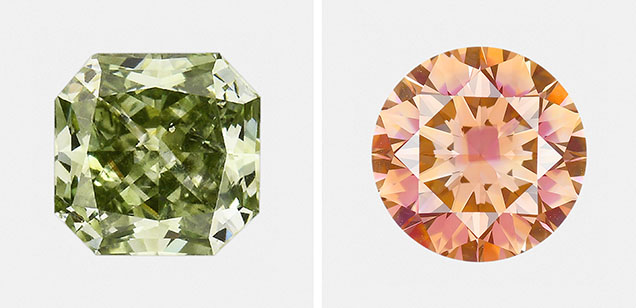
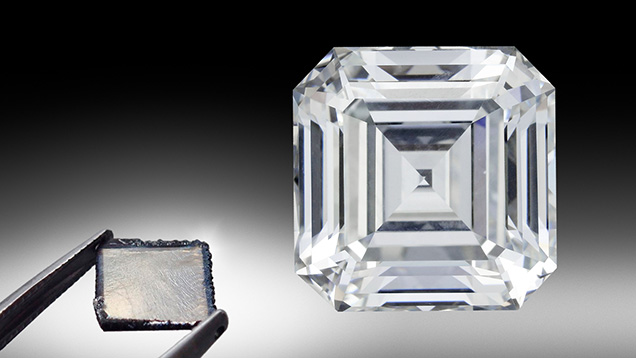
The introduction of laboratory-grown diamonds to the consumer market has expanded the variety of products available but also increased the complexity of identification for many in the trade. Laboratory-grown diamonds that are colorless to near-colorless share many gemological and physical properties with their natural counterparts (figure 1), which presents a challenge for independent gemologists and appraisers in distinguishing these gems from natural diamonds. Consequently, gemologists have needed to invest in powerful analytical testing equipment or depend on gemological laboratories for accurate identification.
Colorless to near-colorless laboratory-grown diamonds are type II, meaning they have no detectable nitrogen impurities (Breeding and Shigley, 2009). By contrast, only about 1% of natural diamonds are type II (Smith et al., 2016; Eaton-Magaña et al., 2020). Despite the increasing prevalence of laboratory-grown diamonds within the trade, their volume remains small compared to that of natural diamonds submitted for grading. Therefore, only those diamonds that test as type II require extensive analysis to determine whether they are laboratory-grown. These can be produced by high-pressure, high-temperature (HPHT) or chemical vapor deposition (CVD) processes.
This study summarizes the wide range of laboratory-grown diamonds submitted to GIA over the years, allowing these stones to tell the story. Over the past 20 years, advances in diamond growth processes have substantially altered the color and size of gem-quality stones submitted to GIA. In addition, this survey emphasizes some new laboratory-grown products that could become more common in the future.
Although the mechanisms for laboratory growth of diamonds are well established (e.g., Eaton-Magaña and Shigley, 2016; Eaton-Magaña et al., 2017; D’Haenens-Johansson et al., 2022), this article provides a brief summary of the CVD and HPHT growth processes. For both methods, a diamond substrate (often referred to as a “seed” in HPHT growth) is used to create the crystal blueprint from which the new diamond is created. The quality, size, and preparation of the substrate can have a significant impact on the resulting diamond (D’Haenens-Johansson et al., 2022). Substrate availability—previously a limiting factor for commercial production—has dramatically improved to meet demand.
To achieve a blue color with a boron-doped CVD diamond overgrowth, only a thin film (<0.1 mm) is needed to significantly influence the stone’s color. The deep-UV fluorescence image in figure 13 (right) shows a marked color change at the interface between the natural diamond substrate and the CVD overgrowth layers, resulting in a Fancy grayish greenish blue color (Ardon and McElhenny, 2019). Only a small number of these CVD overgrowth diamonds have been documented by gemological labs. Although their identification is straightforward, it is worth noting that some hybrid diamonds may go undetected by standard screening equipment if the underlying natural diamond is type Ia, as many screening instruments are based (either directly or indirectly) on differences between type Ia and type II diamond (figure 9).
Growing colorless CVD diamond on natural type Ia diamond substrates requires precise control of the temperature around the natural diamond used as a substrate, and its application currently offers little economic advantage.