Editor’s Note
This article highlights a notable divergence between the robust growth of the broader luxury sector and the relative stagnation of the art market, based on a recent industry report.
While the luxury sector shows robust growth, art sales are stagnating. A recent report released in June by consulting firm Bain & Company and the Italian luxury goods association Altagamma reveals that last year, art sales grew by only 1% to 3%, while the overall luxury goods sector increased by 8% to 10%. The total global luxury market sales are estimated at approximately $1.66 trillion.
Meanwhile, surveys of auction participants and analysis of publicly available art sales data by Bain & Company indicate that spending at auctions has decreased by an estimated 20%. This aligns with recent announcements from major auction houses. For instance, Christie’s reported in July this year that its auction sales for the first half of 2024 fell by 22% compared to the second half of 2023, while Sotheby’s saw a 25% decline in auction sales for the same period. Private dealers showed modest growth, which the report attributes to collectors seeking more in-person communication since the COVID-19 pandemic. Reasons cited for the auction sales decline include more cautious spending amid a slow recovery in the U.S. market, ongoing geopolitical tensions, and a “lack of consistency” in Asian market trends.
Indeed, fine art has underperformed compared to other smaller luxury categories that continue to grow, such as jewelry and non-art collectibles.
The Bain survey also touches on broader trends in luxury consumption. While growth in traditional luxury items like fine art has been limited, experiential luxury, such as high-end travel, has shown significant growth. According to Montgolfier, consumers increasingly prefer experiences over goods, and traditional brands are shifting their focus towards experiential sectors with more hospitality-like functions.
The art industry is responding to this trend. Hauser & Wirth founders Manuela and Iwan Wirth have opened the luxury hotel “Fife Arms” in the Scottish Highlands and operate restaurants in St. Moritz, London, New York, and Los Angeles. Sotheby’s also announced a partnership earlier this month with Marriott’s subsidiary, The Luxury Group.
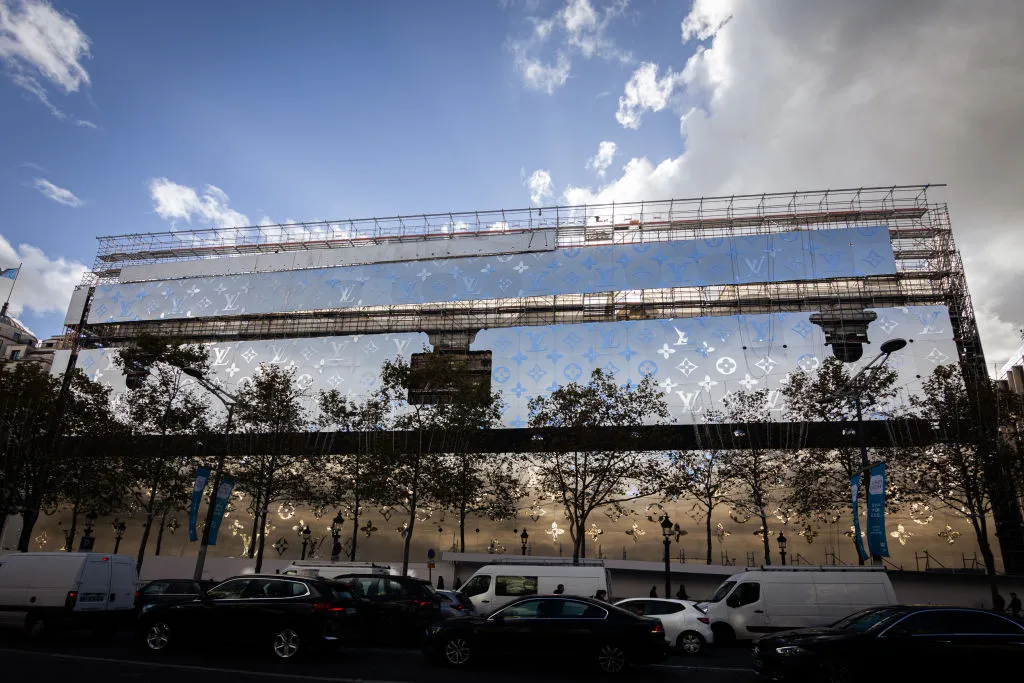
Meanwhile, major luxury brands like Louis Vuitton, Dior, and Loewe are also venturing into the art world, sponsoring global art prizes and commissioning works or exhibitions. LVMH, which owns Louis Vuitton, opened the Fondation Louis Vuitton in Paris’s Bois de Boulogne in 2014 and owns/operates several hotel brands (with a Louis Vuitton hotel scheduled to open in Paris in 2026).
Natasha Degen, a professor at the Fashion Institute of Technology in New York, sees these luxury brands expanding into businesses like hotels, museums, and foundations—not just selling so-called luxury goods—as a way to maintain customer interest for longer.
On the other hand, auction houses are increasingly relying on non-fine art luxury categories to generate revenue. Last year, jewelry, watches, memorabilia, and other luxury items accounted for nearly one-third of Sotheby’s total sales of $7.9 billion. At Christie’s, this figure was $2.1 billion.
Montgolfier cites as a factor accelerating the overall slowdown that art purchasing is now at the bottom of the financial priority list for the wealthy. Degen adds, “In times of conflict, spending is seen as inappropriate or excessive,” noting that unstable global conditions clearly suppress active consumption, which is a major factor in the profit stagnation.