Editor’s Note
This article details the initial discovery and acquisition of sapphires from a new rush near Matepwende, Tanzania, in early 2024. It is based on field reports and the procurement of reference samples for study.
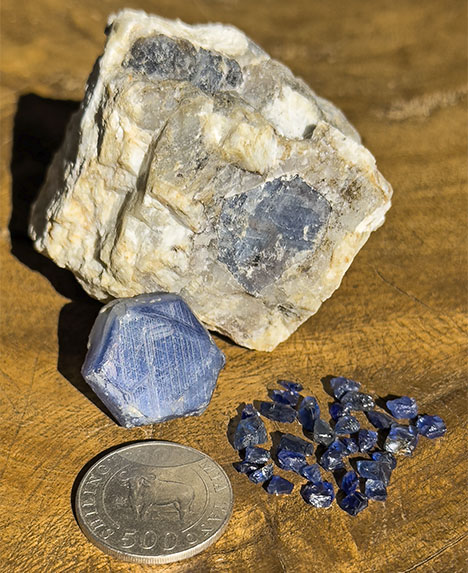
In February 2024, Mark Saul (Amor Gems, Kenya) informed author Vincent Pardieu about a sapphire rush near Matepwende village, located in the Namtumbo district in Songea, in southern Tanzania. News of a rush involving several thousand migrant miners from all around the country was soon publicized on Tanzanian television.
The following month in Bangkok, VP acquired a parcel of “F-type” reference samples (according to the GIA classification system) reportedly from the new deposit for preliminary study. Some were used for a heat treatment experiment in Thailand, and 27 others were sent to author Aaron Palke for gemological study.
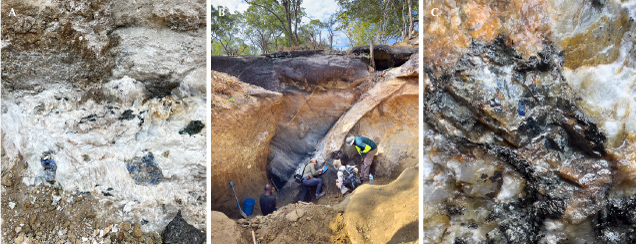
While samples were being studied at GIA, VP visited the new deposit in early June 2024 with geologists Leonard Cornuz and Yedidia Mgema. The site is in a remote area about five hours’ drive from Songea using dirt roads during the dry season. It is 7 km north of the Ruvuma River bordering Mozambique. Geologically, it lies at the boundary between the Luwegu sedimentary sub-basin (part of the Selous basin) and the metamorphic Usagaran Belt. A uranium prospective license covers most of the deposit.
The deposit is a primary hard rock deposit where blue sapphires are associated with feldspar and mica in pegmatites intruding into gneisses. Most of the sapphires are inside the pegmatites, while others are found in a mica-rich reaction zone between the pegmatite and the gneiss, indicating a desilicated pegmatite deposit. Most of the mining activity occurred in the nearby detrital deposit over and near the pegmatites and in the limited secondary deposits along streams. The site of the rush covered approximately 1 square kilometer. About 400 artisanal miners (mostly from the Songea or Tunduru) were in the area during VP’s visit, down from 1,000 a few weeks earlier at the height of the rush. About half were directly involved in mining, while the others were buying gems or providing supplies to the miners.
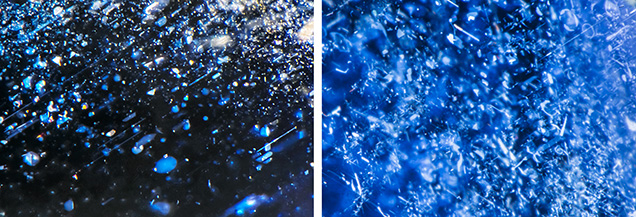
The best facet-grade, fine-color sapphire seen during the expedition was a deep blue stone weighing about 2 ct, while the other fine stones were under 1 ct. We also saw kilos of heavily fractured and twinned corundum specimens up to 500 g, locally called “cabochons,” that are broken to extract fragments of blue facetable material to be used for calibrated stones. Most of these stones were industrial-, carving-, or bead-grade. According to locals, the deposit has been a known source of this material for more than 30 years. While some of the stones have an attractive blue coloration, most have a grayish overtone. Regarding clarity, most stones exhibit polysynthetic twinning and fractures, and more than half are also milky/silky. A heat treatment experiment under reducing conditions was conducted in Thailand by Karim Guerchouche from Premacut Ltd. The stones did not improve with heat treatment.
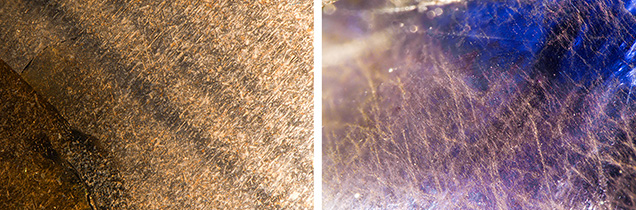
Author AP used 12 sapphires from the deposit for a preliminary study, splitting the material into two groups based on their ultraviolet/visible/near-infrared (UV-Vis-NIR) spectra. One group of six samples had UV-Vis-NIR spectra more typically seen in basalt-related sapphires, such as those from Australia or Thailand, with a prominent broad band absorption at 880 nm and significant Fe3+-related features at 377, 388, and 450 nm. These are often called “magmatic-type” or “CMG” sapphires. The other group of six samples lacked the prominent 880 nm band but still had significant Fe3+-related features. These are often called “nonclassical” (NCL) sapphires, and they include sapphires from Montana in the United States and both Umba and Songea in Tanzania.