Editor’s Note
This article explores a persistent scientific puzzle: why experimental attempts to replicate natural diamond formation often yield contradictory results, even under controlled conditions. It highlights the enduring mysteries within Earth’s most extreme environments.
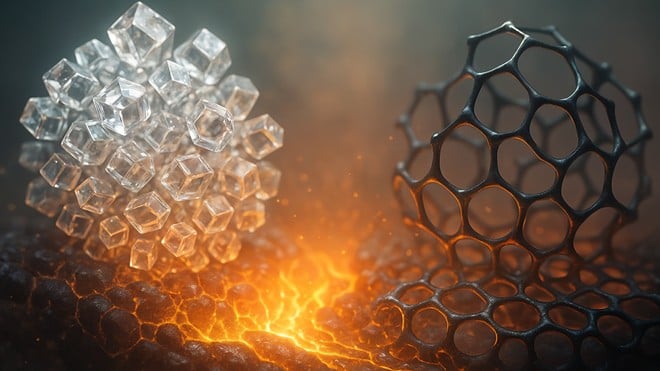
Deep beneath the Earth, where pressure and heat transform every material, the world’s hardest gemstones are formed over millions of years: diamonds. Their origin has long been considered well-researched – and can even be artificially replicated today. Yet a central question remained unanswered: Why do many experiments on carbon crystallization contradict each other even under controlled conditions?
What nature dictates deep in the Earth’s mantle, laboratories worldwide try to replicate – not only technically, but also physically. While it has long been possible to grow diamonds intentionally, for example in high-pressure presses or through gas deposition, researchers investigating how liquid carbon crystallizes spontaneously under extreme conditions encounter a surprising uncertainty: sometimes diamond forms, sometimes graphite, sometimes both – even when temperature and pressure are set exactly the same.
A research team led by Davide Donadio has now revealed, using AI-supported molecular dynamics, what was often overlooked in these experiments. In their simulations, diamond frequently did not form, even though it should be stable under these conditions – instead, graphite prevailed initially, even though it is not the most stable state in the long term. Physicists refer to this as a metastable crystal. This is not an error, but follows a physical principle: Ostwald’s step rule.
In the case of carbon, this means: At pressures up to about 15 GPa, the density of the liquid is closer to that of graphite than to that of diamond. The energy barrier for graphite crystallization is lower – making it the faster, but not the best, choice. The crystal is metastable: quickly formed, but theoretically “overtakable.”
Using AI-supported simulations, the researchers systematically investigated under which conditions liquid carbon transforms into diamond or graphite – and in the process, they remeasured a particularly critical area: the zone where all three states can exist simultaneously. They observed two completely different crystallization mechanisms: Diamond forms via a direct path: uniformly shaped crystal nuclei grow from the dense melt – compact, spherical, and stable.
Graphite, on the other hand, forms in two steps: First, loose areas with lower density emerge, in which the typical honeycomb-like layers then stack. These fundamental differences in the process explain why previous experiments often yielded contradictory results – depending on which of the two paths prevailed at the time.
The study, published in Nature, thus shows for the first time that even in a seemingly simple system like pure carbon, two competing crystallization processes are possible side by side – depending on which state is easier to achieve.
This provides a new explanation for many contradictory observations from earlier experiments – and places metastable phases at the center of materials research.