Editor’s Note
This investigation reveals the devastating scale of illegal gold mining in the Amazon, where short-term profit is turning vital rainforest into a poisoned landscape. The ancient myth of Midas serves as a stark warning: some gifts are curses in disguise.
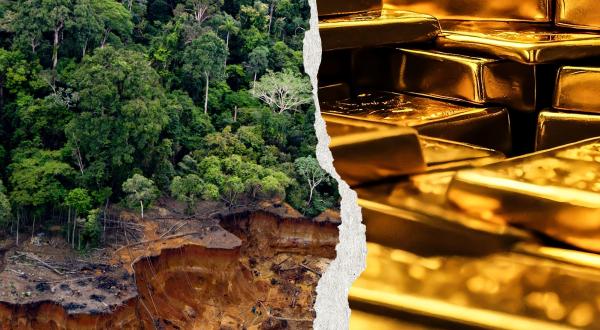
After weeks of investigation, Greenpeace is sounding the alarm: Illegal gold miners have destroyed over 4,000 hectares of rainforest in indigenous territories in just two years.
The ancient King Midas wished that everything he touched would turn to gold. A gift that quickly proved to be a curse: he could not satisfy his hunger nor embrace his daughter without her turning into cold metal. Today, the warning of this ancient myth is reflected in a real tragedy: In the Amazon, the global hunger for gold is destroying vast areas of rainforest. And the mercury used in mining is poisoning the indigenous people and animals living there.
A new Greenpeace investigation, analyzing satellite data from 2023 and 2024, reveals alarming developments in the Amazon: Government measures to combat illegal gold mining have not led to a general decline in activities – rather, they have shifted to other indigenous territories. The situation is particularly drastic in the Sararé area, where illegal mining increased by a staggering 93%. At the same time, activities declined in other regions such as the Yanomami territory (-7%), Munduruku land (-57%), and Kayapó land (-31%).
The investigation results clearly show how intense the pressure on indigenous territories remains – a direct consequence of the previous Brazilian government under President Bolsonaro, which tolerated illegal gold mines for years. Between 2018 and 2022, illegal mining literally exploded: The mining areas on indigenous land grew by an incredible 265%. The consequences? Destroyed forests, contaminated rivers, and massive intrusions into the livelihood of indigenous communities.
Since 2023, the new government under President Lula has taken a harder stance against illegal mines – with increased controls and targeted police actions. Yet, although these measures are more visible, it has so far not been possible to fundamentally stop the spread of mining. Instead, mine operators are adapting, moving to other areas, and driving destruction forward. The business is too lucrative, the gold miners too poor.
This shows: Without long-term, consistent strategies, illegal gold mining cannot be contained.
The Amazon rainforest is one of THE hotspots for biodiversity. It stabilizes the global climate and is home to around 410 different indigenous communities.
Could this gold be from the Amazon? We don’t know. Gold is extremely difficult to trace. Its high value, the compact size of gold bars, and its nearly unlimited durability make it an ideal smuggling good. Once in the supply chains, its trace is lost: It is traded, refined, processed further – and finally enters the legal market.
Today, four of the world’s seven largest gold refineries are located in Switzerland and dominate the global market. They purchase raw or recycled gold, sometimes refine it again, and process it further or export it. Once in Switzerland, gold is relabeled and resold under the coveted “Swiss Gold” label. Its original origin? Often hardly traceable anymore.