Editor’s Note
This article explores the surprising journey of stibnite, from its toxic historical uses in ancient eyeliner and dubious medicinal pills to its modern status as a critical source for antimony—a metal vital for flame-retardants and electronics.
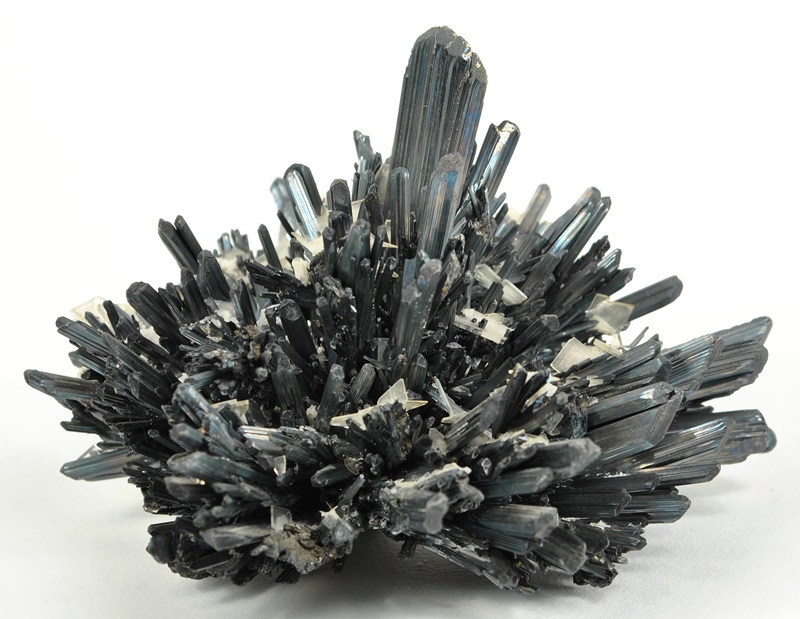
Stibnite (Sb₂S₃) is a metallic sulfide mineral with a needle-like appearance. Derived from the Latin word ‘stibium’ meaning antimony, it is the primary ore for the metal.
Historically, antimony had dubious uses in cosmetics and medicine despite its toxicity. Egyptians used the mineral in kohl eyeliners to ward off evil spirits. Early alchemists and medics prescribed metallic antimony pills to stimulate digestive purges. Dubbed ‘everlasting pills,’ they passed unchanged through the digestive tract, were retrieved (hopefully rinsed), and passed down through generations.
Just a small amount of antimony makes lead significantly harder. It is used in lead-acid batteries to prevent lead plates from degrading and was prized by newspaper typesetters because the typeface stayed sharper longer.
Today, antimony is valued for its industrial strength. In the modern world of critical minerals, antimony is becoming one of the most strategically important elements. From flame retardants and semiconductors to solar panels, military-grade alloys, and night vision goggles, antimony fuels technologies that underpin defense, energy, and digital infrastructure. However, as global demand surges, supply chains are under pressure.
China dominates the global antimony supply. Together with Russia and Tajikistan, these three countries account for 90% of global antimony production.
Western nations face growing supply vulnerability, highlighted by recent export restrictions and geopolitical tensions. Antimony prices have surged, sparking a global race to secure alternative sources.
Ranked as having the world’s fourth-largest antimony reserves, Australia is emerging as a strategic option for reliable and secure supply. With a stable political environment, rich geology, and an active exploration sector, Australia is well-positioned to meet rising demand.
Mineral processing specialist Dr. Paul Breuer believes Australia, with its rich stibnite deposits, has great potential to become a global supplier of antimony metal and antimony oxide.
High-grade stibnite deposits in regions like Victoria, New South Wales, Queensland, and Western Australia are gaining attention as the world seeks secure, ethical sources of this critical mineral.
Costerfield is the only mine currently producing an antimony (stibnite)-gold concentrate, which is sold overseas for processing. Other projects include Hillgrove, due to recommence in 2026, and Sunday Creek, which are leading the charge, with some ores showing world-class antimony concentrations.
Antimony is often associated with gold in stibnite, making mining and extraction processes more economically attractive.
Typically, stibnite-gold concentrates are produced and shipped to China or other countries with smelters to recover the antimony and gold. Currently, there are no established processing routes to produce antimony metal (or oxide) and recover the gold in Australia.
As the world pivots toward clean energy and more digital infrastructure, antimony’s role will only grow. As global supply chains tighten, Australia, backed by stable government, advanced mining and processing expertise, and rich stibnite reserves, is poised to become a global leader in antimony production.