Editor’s Note
This article highlights the significant economic pressures facing Germany’s foundry industry, including skilled labor shortages and high energy costs, with a specific focus on the Eisenwerk in Brühl. It details a recent meeting between company management and local CDU politicians following the federal election.
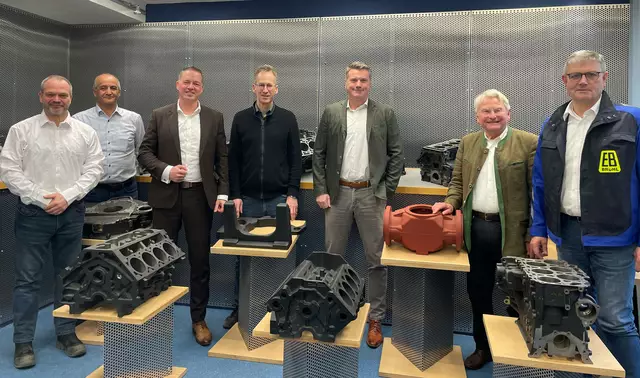
The current economic challenges such as skilled labor shortages, excessive bureaucracy, high energy costs, and the industrial transformation towards climate neutrality are also burdening the German foundry industry and thus the Eisenwerk (Ironworks) in Brühl.
Shortly after the federal election, the re-elected CDU member of the Bundestag, Detlef Seif, and the CDU state parliament member, Gregor Golland, met with the management of the ironworks, Matthias Pampus-Meder and Thomas Friedrich, to discuss the concerns of the industry. The focus was particularly on the consequences of the European Commission’s tightened environmental policy.
The Eisenwerk Brühl GmbH has been producing engine blocks from cast iron for renowned automotive manufacturers for around 100 years and currently employs more than 1,500 people. This makes it the second-largest foundry in Germany and one of the ten largest foundries in all of Europe. Furthermore, the company is the largest employer in the Rhein-Erft district.
As Pampus-Meder and Friedrich explained, the current European environmental legislation is causing the company great concern, as it could, in an extreme case, lead to the closure of the ironworks.
The background is the new BREF document, which came into force in December 2024 and must now be transposed into the national legislation of EU member states. BREF stands for “Best Available Techniques Reference”. It is a document from the European Commission that describes the best available techniques (BAT) for avoiding and reducing the environmental impacts of an industrial sector and must be considered by authorities in the EU for plant permits.
The ironworks in Brühl is already investing large sums in climate-friendly measures. Currently, 52 million euros are flowing into new exhaust air purification systems, which use a completely new technology to reduce emissions and account for climate protection.
The new EU limit values could be achieved with special technologies, but these are only applicable for low exhaust air volumes.
Thus, the Eisenwerk Brühl would additionally have to thermally afterburn correspondingly large quantities of exhaust air, as the exhaust air from all dust extraction systems in the casting production area would not meet the new limit values even with the state-of-the-art new technology.
Seif and Golland want to advocate for the Brühl site and communicate the problem to the future federal government.
Even if a potential closure is not up for discussion in the short term, the right course must be set promptly now.
Seif warned of creeping deindustrialization: