Editor’s Note
This article outlines new anti-money laundering regulations from China’s central bank, mandating stricter compliance for dealers in precious metals and gems. The rules require enhanced customer checks and internal control systems to curb illicit financial flows.

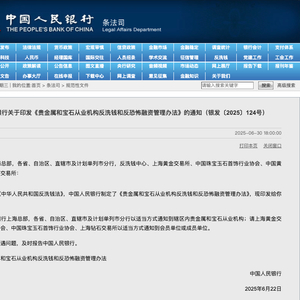
The People’s Bank of China (PBOC) recently released the “Administrative Measures for Anti-Money Laundering and Counter-Terrorist Financing for Precious Metals and Gems Industry Institutions” (hereinafter referred to as the “Measures”). The regulations clarify the anti-money laundering (AML) obligations for institutions dealing in precious metals and gems. They are required to establish and improve internal AML control systems, conduct customer due diligence, fulfill obligations for reporting large-value and suspicious transactions, strengthen money laundering risk management, and accept self-regulatory and regulatory oversight.
The Measures will take effect on August 1, 2025.
In detail, the Measures stipulate that for transactions involving precious metals and gems:
Simultaneously, any suspicious transactions must be reported promptly regardless of the amount.
Transactions involving precious metals and gems are considered high-risk areas for money laundering and terrorist financing by the international community due to their large transaction amounts and high proportion of cash payments. As money laundering methods become increasingly complex, traditional regulatory models struggle to cope. The introduction of these new regulations highlights the regulatory authorities’ determination to combat illegal money laundering activities and maintain financial security and stability.
The Measures clarify the scope of precious metals and gems and require member units or constituent members such as the Shanghai Gold Exchange, the China Gold Association, the China Gems & Jewelry Trade Association, and the Shanghai Diamond Exchange to strictly comply with the relevant regulations.
Analysis indicates that the new rules apply to dealers engaged in spot transactions of precious metals and gems within the territory of the People’s Republic of China. This includes precious metals such as gold, silver, and platinum and their products, as well as various raw materials and jewelry made from gems like diamonds and jade. An institution’s qualification as a subject is based on its business scope. Even if spot transactions related to precious metals and gems constitute only a small-scale or auxiliary business, the institution must still fulfill its AML obligations.
The Measures also require institutions to complete customer due diligence before or at the conclusion of a transaction. This is particularly necessary when a customer’s single transaction or daily cumulative transaction amount reaches 100,000 yuan or more, when there is reasonable suspicion that the customer is involved in money laundering activities, or when there are doubts about the customer’s identity information. Furthermore, the regulatory level will adopt a risk-differentiated strategy, strengthening supervision for high-risk institutions while allowing simplified or exempted procedures for low-risk ones.
At the operational level, the Measures establish a full-process management system. Institutions are required to establish internal AML control systems, designate responsible personnel, allocate staff according to risk and scale, and conduct periodic money laundering risk assessments, with a maximum cycle of 3 years. Simultaneously, they must implement risk classification management based on customer due diligence information, continuously monitor changes in customer risk, transactions, and identity information, and ensure that business transactions align with the customer’s profile.
Additionally, the Measures stipulate that customer identity information and transaction records must be retained for at least 10 years.
Regarding three categories of entities—terrorist organization lists and UN sanctions targets—services must be immediately terminated and fund transfers restricted upon discovery. Group-type institutions need to coordinate AML work centrally. Overseas branches must implement these regulations within the limits permitted by the laws of the host country. In terms of legal liability, accountability mechanisms are established for violations by regulatory personnel, self-regulatory organization staff, and the institutions themselves, with serious cases to be transferred to judicial authorities.